QUESTION IMAGE
Question
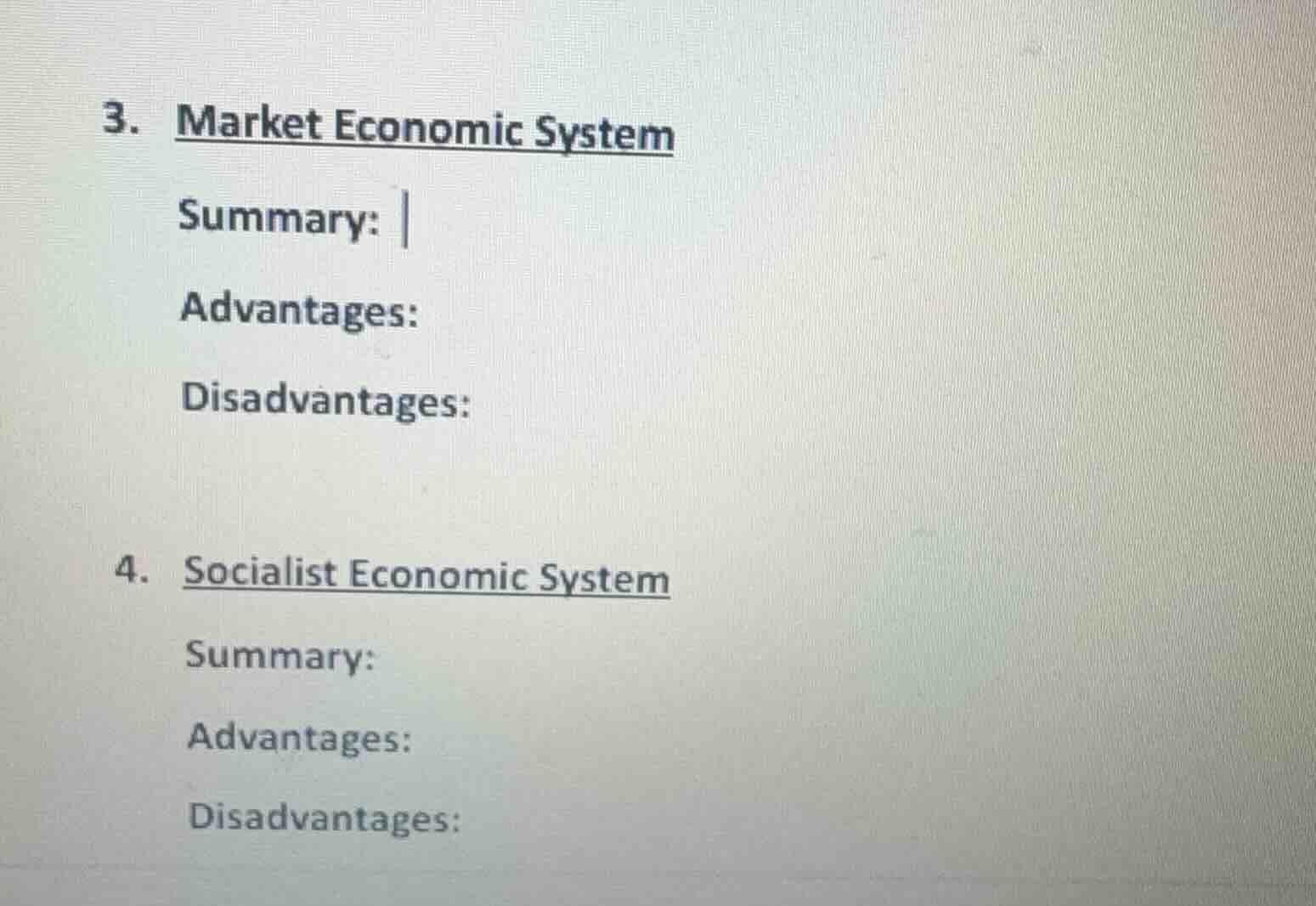
- market economic system
summary:
advantages:
disadvantages:
- socialist economic system
summary:
advantages:
disadvantages:
3. Market Economic System
Summary:
An economic system where economic decisions and the pricing of goods and services are guided by the interactions of a country's individual citizens and businesses, with minimal government intervention. Supply and demand drive production, distribution, and consumption.
Advantages:
- Efficiency: Prices adjust to balance supply and demand, leading to efficient resource allocation as businesses produce what consumers want.
- Innovation: Competition encourages businesses to innovate to gain market share, driving technological and product advancements.
- Consumer Choice: A wide variety of goods and services are available, and consumers can choose based on preferences and price.
- Flexibility: The system can adapt quickly to changing consumer tastes or economic conditions.
Disadvantages:
- Inequality: Can lead to significant income and wealth gaps, as successful businesses/individuals accumulate more resources.
- Market Failures: Externalities (e.g., pollution), monopolies, and lack of public goods (e.g., healthcare for all) may arise without regulation.
- Instability: Prone to booms and busts (recessions/depressions) due to unregulated market cycles.
- Exploitation: Workers or consumers may be exploited (e.g., low wages, unsafe products) without regulatory safeguards.
4. Socialist Economic System
Summary:
An economic system where the means of production (e.g., factories, resources) are owned or controlled by the state or community, with the goal of promoting social welfare, equality, and collective ownership. Production and distribution aim to meet societal needs rather than maximize profit.
Advantages:
- Equality: Reduces income and wealth disparities through collective ownership and redistributive policies (e.g., universal healthcare, education).
- Stability: Government planning can reduce economic volatility (e.g., avoiding recessions via centralized resource allocation).
- Public Goods: Ensures access to essential services (e.g., healthcare, education) for all citizens, regardless of income.
- Social Welfare: Prioritizes societal well - being over individual profit, addressing issues like poverty and unemployment.
Disadvantages:
- Inefficiency: Central planning may lack the flexibility of market signals, leading to overproduction/underproduction of goods.
- Lack of Incentives: Without profit motives or competition, workers/businesses may have less incentive to innovate or work efficiently.
- Bureaucracy: Large - scale government planning can lead to slow decision - making and bureaucratic red tape.
- Limited Choice: Consumer goods may be less diverse or of lower quality due to reduced competition.

Snap & solve any problem in the app
Get step-by-step solutions on Sovi AI
Photo-based solutions with guided steps
Explore more problems and detailed explanations
3. Market Economic System
Summary:
An economic system where economic decisions and the pricing of goods and services are guided by the interactions of a country's individual citizens and businesses, with minimal government intervention. Supply and demand drive production, distribution, and consumption.
Advantages:
- Efficiency: Prices adjust to balance supply and demand, leading to efficient resource allocation as businesses produce what consumers want.
- Innovation: Competition encourages businesses to innovate to gain market share, driving technological and product advancements.
- Consumer Choice: A wide variety of goods and services are available, and consumers can choose based on preferences and price.
- Flexibility: The system can adapt quickly to changing consumer tastes or economic conditions.
Disadvantages:
- Inequality: Can lead to significant income and wealth gaps, as successful businesses/individuals accumulate more resources.
- Market Failures: Externalities (e.g., pollution), monopolies, and lack of public goods (e.g., healthcare for all) may arise without regulation.
- Instability: Prone to booms and busts (recessions/depressions) due to unregulated market cycles.
- Exploitation: Workers or consumers may be exploited (e.g., low wages, unsafe products) without regulatory safeguards.
4. Socialist Economic System
Summary:
An economic system where the means of production (e.g., factories, resources) are owned or controlled by the state or community, with the goal of promoting social welfare, equality, and collective ownership. Production and distribution aim to meet societal needs rather than maximize profit.
Advantages:
- Equality: Reduces income and wealth disparities through collective ownership and redistributive policies (e.g., universal healthcare, education).
- Stability: Government planning can reduce economic volatility (e.g., avoiding recessions via centralized resource allocation).
- Public Goods: Ensures access to essential services (e.g., healthcare, education) for all citizens, regardless of income.
- Social Welfare: Prioritizes societal well - being over individual profit, addressing issues like poverty and unemployment.
Disadvantages:
- Inefficiency: Central planning may lack the flexibility of market signals, leading to overproduction/underproduction of goods.
- Lack of Incentives: Without profit motives or competition, workers/businesses may have less incentive to innovate or work efficiently.
- Bureaucracy: Large - scale government planning can lead to slow decision - making and bureaucratic red tape.
- Limited Choice: Consumer goods may be less diverse or of lower quality due to reduced competition.