QUESTION IMAGE
Question
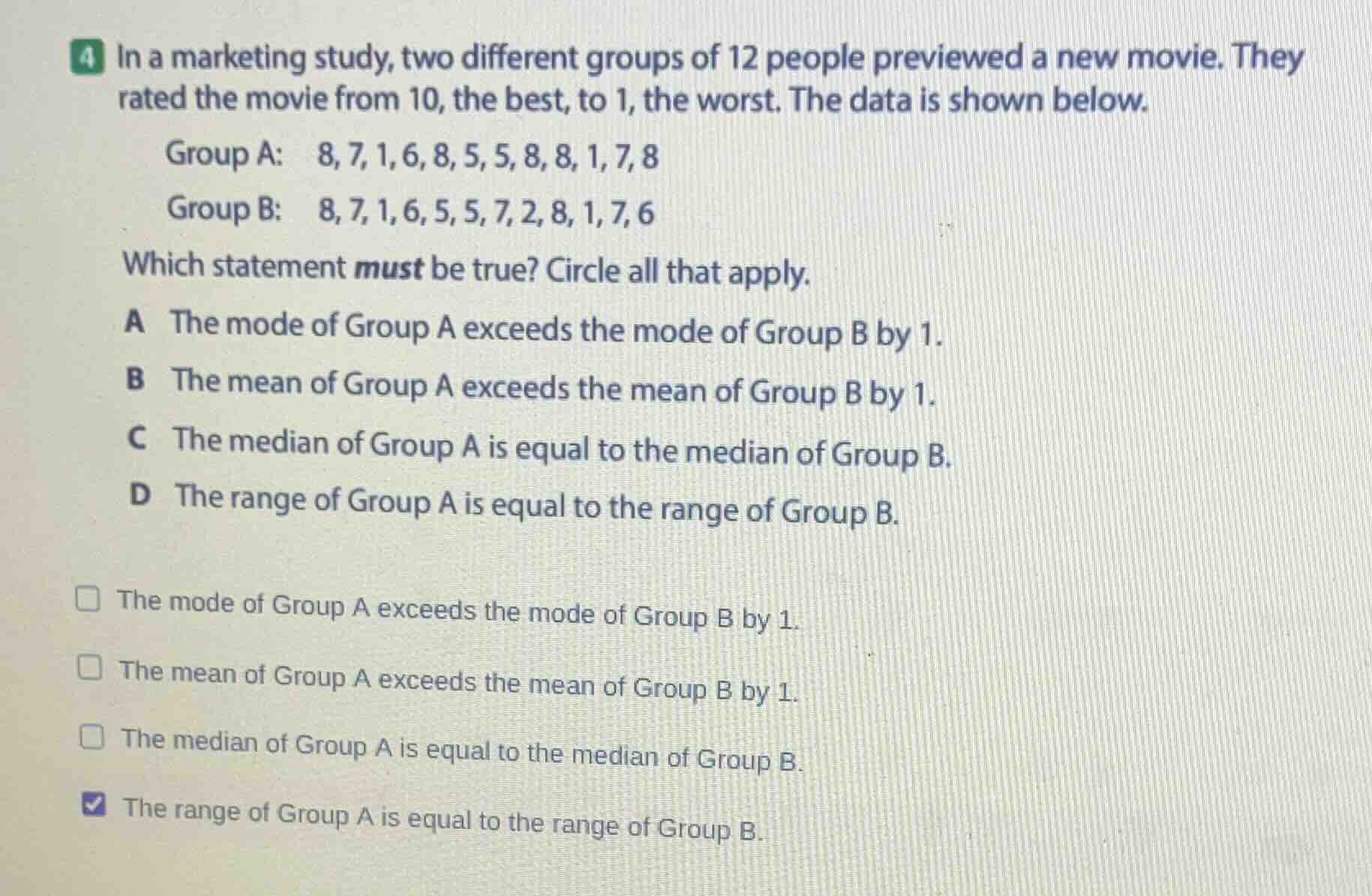
4 in a marketing study, two different groups of 12 people previewed a new movie. they rated the movie from 10, the best, to 1, the worst. the data is shown below. group a: 8, 7, 1, 6, 8, 5, 5, 8, 8, 1, 7, 8 group b: 8, 7, 1, 6, 5, 5, 7, 2, 8, 1, 7, 6 which statement must be true? circle all that apply. a the mode of group a exceeds the mode of group b by 1. b the mean of group a exceeds the mean of group b by 1. c the median of group a is equal to the median of group b. d the range of group a is equal to the range of group b. the mode of group a exceeds the mode of group b by 1. the mean of group a exceeds the mean of group b by 1. the median of group a is equal to the median of group b. the range of group a is equal to the range of group b.
To solve this, we analyze each option by calculating mode, mean, median, and range for both groups.
Step 1: Organize the data
- Group A (sorted): \(1, 1, 5, 5, 6, 7, 7, 8, 8, 8, 8, 8\) (Wait, no, original data: \(8,7,1,6,8,5,5,8,8,1,7,8\). Sorted: \(1, 1, 5, 5, 6, 7, 7, 8, 8, 8, 8, 8\)? Wait, count: 12 numbers. Let's list correctly:
- Original Group A: \(8,7,1,6,8,5,5,8,8,1,7,8\)
- Sort: \(1, 1, 5, 5, 6, 7, 7, 8, 8, 8, 8, 8\) (Wait, 1,1,5,5,6,7,7,8,8,8,8,8? Wait, 12 numbers: positions 1 - 12.
- Group B (sorted): \(1, 1, 2, 5, 5, 6, 6, 7, 7, 7, 8, 8\) (Original data: \(8,7,1,6,5,5,7,2,8,1,7,6\). Sort: \(1, 1, 2, 5, 5, 6, 6, 7, 7, 7, 8, 8\))
Option A: Mode
- Mode of Group A: The most frequent number. \(8\) appears \(5\) times (wait, original data: \(8\) occurs how many times? Let's count: \(8\) in Group A: positions 1,5,8,9,12? Wait, original data: \(8,7,1,6,8,5,5,8,8,1,7,8\) → \(8\) appears at indices 0,4,7,8,11? Wait, 0:8, 4:8, 7:8, 8:8, 11:8 → 5 times? Wait, no: 0,4,7,8,11 → 5 times? Wait, 1,1,5,5,6,7,7,8,8,8,8,8: 8 appears 5 times? Wait, no, 1,1,5,5,6,7,7,8,8,8,8,8: 8 appears at positions 7,8,9,10,11? Wait, 7:8, 8:8, 9:8, 10:8, 11:8 → 5 times? Wait, no, 12 numbers: 1,1,5,5,6,7,7,8,8,8,8,8? Wait, 1,1,5,5,6,7,7,8,8,8,8,8: that's 12 numbers. So 8 appears 5 times? Wait, no: 1 (2), 5 (2), 6 (1), 7 (2), 8 (5). Yes, mode is 8.
- Mode of Group B: Original data: \(8,7,1,6,5,5,7,2,8,1,7,6\). Count frequencies:
- \(1\): 2, \(2\):1, \(5\):2, \(6\):2, \(7\):3, \(8\):2. So mode is 7 (appears 3 times).
- Group A mode: 8, Group B mode:7. \(8 - 7 = 1\). So A is true? Wait, but let's check again. Wait, Group A: \(8\) appears how many times? Let's list Group A: \(8,7,1,6,8,5,5,8,8,1,7,8\) → count 8s: 8 appears at positions 0,4,7,8,11 → 5 times. Group B: \(8\) appears at 0,8 → 2 times. \(7\) appears at 1,6,10 → 3 times. So mode of A is 8, mode of B is 7. \(8 - 7 = 1\). So A is true? Wait, but let's check other options.
Option B: Mean
- Mean of Group A: Sum all numbers and divide by 12.
- Sum of Group A: \(8 + 7 + 1 + 6 + 8 + 5 + 5 + 8 + 8 + 1 + 7 + 8\)
- Calculate: \(8+7=15; 15+1=16; 16+6=22; 22+8=30; 30+5=35; 35+5=40; 40+8=48; 48+8=56; 56+1=57; 57+7=64; 64+8=72\). Sum = 72. Mean = \(72 / 12 = 6\).
- Mean of Group B: Sum of Group B: \(8 + 7 + 1 + 6 + 5 + 5 + 7 + 2 + 8 + 1 + 7 + 6\)
- Calculate: \(8+7=15; 15+1=16; 16+6=22; 22+5=27; 27+5=32; 32+7=39; 39+2=41; 41+8=49; 49+1=50; 50+7=57; 57+6=63\). Sum = 63. Mean = \(63 / 12 = 5.25\).
- Difference: \(6 - 5.25 = 0.75\), not 1. So B is false.
Option C: Median
- Median of Group A: For 12 numbers, median is average of 6th and 7th terms (sorted).
- Sorted Group A: \(1, 1, 5, 5, 6, 7, 7, 8, 8, 8, 8, 8\) (Wait, no, wait: original sorted Group A: let's do it correctly. Original data: \(8,7,1,6,8,5,5,8,8,1,7,8\). Sort: \(1, 1, 5, 5, 6, 7, 7, 8, 8, 8, 8, 8\)? Wait, no, 12 numbers: positions 0 - 11. So sorted:
- 0:1, 1:1, 2:5, 3:5, 4:6, 5:7, 6:7, 7:8, 8:8, 9:8, 10:8, 11:8.
- 6th term (index 5): 7, 7th term (index 6):7. Median = \((7 + 7)/2 = 7\).
- Median of Group B: Sorted Group B: \(1, 1, 2, 5, 5, 6, 6, 7, 7, 7, 8, 8\) (indices 0 - 11).
- 6th term (index 5):6, 7th term (index 6):6. Median = \((6 + 6)/2 = 6\).
- \(7
eq 6\), so C is false.
Option D: Range
- Range of Group A: Max - Min. Max = 8, Min = 1. Range = \(8 - 1 = 7\).
- Range of Group B: Max = 8, Min = 1. Wait, Group B data: \(8,7,1,6,5,5,7,2,8,1,7,6\). Min is 1, Max is 8? Wait, no: Group B has 2. Wait, sorted Group B: \(1, 1, 2, 5, 5, 6, 6, 7, 7, 7, 8, 8\). Min =…

Snap & solve any problem in the app
Get step-by-step solutions on Sovi AI
Photo-based solutions with guided steps
Explore more problems and detailed explanations
To solve this, we analyze each option by calculating mode, mean, median, and range for both groups.
Step 1: Organize the data
- Group A (sorted): \(1, 1, 5, 5, 6, 7, 7, 8, 8, 8, 8, 8\) (Wait, no, original data: \(8,7,1,6,8,5,5,8,8,1,7,8\). Sorted: \(1, 1, 5, 5, 6, 7, 7, 8, 8, 8, 8, 8\)? Wait, count: 12 numbers. Let's list correctly:
- Original Group A: \(8,7,1,6,8,5,5,8,8,1,7,8\)
- Sort: \(1, 1, 5, 5, 6, 7, 7, 8, 8, 8, 8, 8\) (Wait, 1,1,5,5,6,7,7,8,8,8,8,8? Wait, 12 numbers: positions 1 - 12.
- Group B (sorted): \(1, 1, 2, 5, 5, 6, 6, 7, 7, 7, 8, 8\) (Original data: \(8,7,1,6,5,5,7,2,8,1,7,6\). Sort: \(1, 1, 2, 5, 5, 6, 6, 7, 7, 7, 8, 8\))
Option A: Mode
- Mode of Group A: The most frequent number. \(8\) appears \(5\) times (wait, original data: \(8\) occurs how many times? Let's count: \(8\) in Group A: positions 1,5,8,9,12? Wait, original data: \(8,7,1,6,8,5,5,8,8,1,7,8\) → \(8\) appears at indices 0,4,7,8,11? Wait, 0:8, 4:8, 7:8, 8:8, 11:8 → 5 times? Wait, no: 0,4,7,8,11 → 5 times? Wait, 1,1,5,5,6,7,7,8,8,8,8,8: 8 appears 5 times? Wait, no, 1,1,5,5,6,7,7,8,8,8,8,8: 8 appears at positions 7,8,9,10,11? Wait, 7:8, 8:8, 9:8, 10:8, 11:8 → 5 times? Wait, no, 12 numbers: 1,1,5,5,6,7,7,8,8,8,8,8? Wait, 1,1,5,5,6,7,7,8,8,8,8,8: that's 12 numbers. So 8 appears 5 times? Wait, no: 1 (2), 5 (2), 6 (1), 7 (2), 8 (5). Yes, mode is 8.
- Mode of Group B: Original data: \(8,7,1,6,5,5,7,2,8,1,7,6\). Count frequencies:
- \(1\): 2, \(2\):1, \(5\):2, \(6\):2, \(7\):3, \(8\):2. So mode is 7 (appears 3 times).
- Group A mode: 8, Group B mode:7. \(8 - 7 = 1\). So A is true? Wait, but let's check again. Wait, Group A: \(8\) appears how many times? Let's list Group A: \(8,7,1,6,8,5,5,8,8,1,7,8\) → count 8s: 8 appears at positions 0,4,7,8,11 → 5 times. Group B: \(8\) appears at 0,8 → 2 times. \(7\) appears at 1,6,10 → 3 times. So mode of A is 8, mode of B is 7. \(8 - 7 = 1\). So A is true? Wait, but let's check other options.
Option B: Mean
- Mean of Group A: Sum all numbers and divide by 12.
- Sum of Group A: \(8 + 7 + 1 + 6 + 8 + 5 + 5 + 8 + 8 + 1 + 7 + 8\)
- Calculate: \(8+7=15; 15+1=16; 16+6=22; 22+8=30; 30+5=35; 35+5=40; 40+8=48; 48+8=56; 56+1=57; 57+7=64; 64+8=72\). Sum = 72. Mean = \(72 / 12 = 6\).
- Mean of Group B: Sum of Group B: \(8 + 7 + 1 + 6 + 5 + 5 + 7 + 2 + 8 + 1 + 7 + 6\)
- Calculate: \(8+7=15; 15+1=16; 16+6=22; 22+5=27; 27+5=32; 32+7=39; 39+2=41; 41+8=49; 49+1=50; 50+7=57; 57+6=63\). Sum = 63. Mean = \(63 / 12 = 5.25\).
- Difference: \(6 - 5.25 = 0.75\), not 1. So B is false.
Option C: Median
- Median of Group A: For 12 numbers, median is average of 6th and 7th terms (sorted).
- Sorted Group A: \(1, 1, 5, 5, 6, 7, 7, 8, 8, 8, 8, 8\) (Wait, no, wait: original sorted Group A: let's do it correctly. Original data: \(8,7,1,6,8,5,5,8,8,1,7,8\). Sort: \(1, 1, 5, 5, 6, 7, 7, 8, 8, 8, 8, 8\)? Wait, no, 12 numbers: positions 0 - 11. So sorted:
- 0:1, 1:1, 2:5, 3:5, 4:6, 5:7, 6:7, 7:8, 8:8, 9:8, 10:8, 11:8.
- 6th term (index 5): 7, 7th term (index 6):7. Median = \((7 + 7)/2 = 7\).
- Median of Group B: Sorted Group B: \(1, 1, 2, 5, 5, 6, 6, 7, 7, 7, 8, 8\) (indices 0 - 11).
- 6th term (index 5):6, 7th term (index 6):6. Median = \((6 + 6)/2 = 6\).
- \(7
eq 6\), so C is false.
Option D: Range
- Range of Group A: Max - Min. Max = 8, Min = 1. Range = \(8 - 1 = 7\).
- Range of Group B: Max = 8, Min = 1. Wait, Group B data: \(8,7,1,6,5,5,7,2,8,1,7,6\). Min is 1, Max is 8? Wait, no: Group B has 2. Wait, sorted Group B: \(1, 1, 2, 5, 5, 6, 6, 7, 7, 7, 8, 8\). Min = 1, Max = 8. Range = \(8 - 1 = 7\)? Wait, no: 8 - 1 = 7? Wait, Group B's max is 8, min is 1? Wait, no, Group B has a 2. Wait, min is 1, max is 8. So range is \(8 - 1 = 7\). Group A: max 8, min 1, range \(8 - 1 = 7\). Wait, but wait: Group B's data includes 2, but min is 1. So range for A: 8 - 1 = 7. Range for B: 8 - 1 = 7? Wait, no: 8 (max) - 1 (min) = 7. But wait, Group B has 2, but min is still 1. So yes, range A: 8 - 1 = 7, range B: 8 - 1 = 7? Wait, no, wait: Group B's max is 8, min is 1. So range is 7. Group A: max 8, min 1, range 7. So D is true? Wait, but earlier when I thought Group B's min is 1, yes. Wait, but let's check again:
Wait, Group A data: numbers are 8,7,1,6,8,5,5,8,8,1,7,8. The minimum is 1, maximum is 8. Range: 8 - 1 = 7.
Group B data: 8,7,1,6,5,5,7,2,8,1,7,6. Minimum is 1, maximum is 8. Range: 8 - 1 = 7. So range A = range B = 7. So D is true.
Wait, but earlier for option A: mode of A is 8 (appears 5 times), mode of B is 7 (appears 3 times). 8 - 7 = 1, so A is true? Wait, but let's recheck mode:
Group A: count of each number:
- 1: 2
- 5: 2
- 6: 1
- 7: 2
- 8: 5 (Wait, 8 appears at positions 0,4,7,8,11 → 5 times? Wait, original data: 8,7,1,6,8,5,5,8,8,1,7,8 → that's 8 (index 0), 8 (index 4), 8 (index 7), 8 (index 8), 8 (index 11) → 5 times. So mode is 8.
Group B: count of each number:
- 1: 2
- 2: 1
- 5: 2
- 6: 2
- 7: 3 (indices 1,6,10)
- 8: 2 (indices 0,8)
So mode is 7 (appears 3 times). So 8 - 7 = 1 → A is true.
Wait, but earlier mean calculation:
Group A sum: 8+7=15, +1=16, +6=22, +8=30, +5=35, +5=40, +8=48, +8=56, +1=57, +7=64, +8=72. Sum=72, mean=72/12=6.
Group B sum: 8+7=15, +1=16, +6=22, +5=27, +5=32, +7=39, +2=41, +8=49, +1=50, +7=57, +6=63. Sum=63, mean=63/12=5.25. 6 - 5.25=0.75≠1 → B is false.
Median:
Group A sorted: [1,1,5,5,6,7,7,8,8,8,8,8] (wait, no, 12 numbers: positions 0-11. So 6th term (index 5) is 7, 7th term (index 6) is 7. Median=(7+7)/2=7.
Group B sorted: [1,1,2,5,5,6,6,7,7,7,8,8]. 6th term (index 5) is 6, 7th term (index 6) is 6. Median=(6+6)/2=6. So 7≠6 → C is false.
Range:
Group A: max 8, min 1 → 8-1=7.
Group B: max 8, min 1 → 8-1=7. So D is true.
Wait, but earlier I thought A was true (mode A:8, mode B:7, 8-7=1). So A and D are true? But the initial checkmark was on D. Wait, maybe I made a mistake in mode.
Wait, Group A: let's count 8s again. Original data: 8,7,1,6,8,5,5,8,8,1,7,8. Let's list all numbers:
- 8
- 7
- 1
- 6
- 8
- 5
- 5
- 8
- 8
- 1
- 7
- 8
So 8 appears at positions 1,5,8,9,12? Wait, no, positions 1 (8), 5 (8), 8 (8), 9 (8), 12 (8)? Wait, no, 12 numbers: indices 0-11. So:
- Index 0:8
- Index 4:8
- Index 7:8
- Index 8:8
- Index 11:8
That's 5 times (indices 0,4,7,8,11). So 8 appears 5 times.
Group B: numbers:
- 8
- 7
- 1
- 6
- 5
- 5
- 7
- 2
- 8
- 1
- 7
- 6
Wait, no, 12 numbers: indices 0-11:
- Index 0:8
- Index 1:7
- Index 2:1
- Index 3:6
- Index 4:5
- Index 5:5
- Index 6:7
- Index 7:2
- Index 8:8
- Index 9:1
- Index 10:7
- Index 11:6
Now count frequencies:
- 1: indices 2,9 → 2 times
- 2: index 7 → 1 time
- 5: indices 4,5 → 2 times
- 6: indices 3,11 → 2 times
- 7: indices 1,6,10 → 3 times
- 8: indices 0,8 → 2 times
So mode of B is 7 (appears 3 times). Mode of A is 8 (appears 5 times). So 8 - 7 = 1 → A is true.
Range: A: 8 - 1 = 7; B: 8 - 1 = 7 → D is true.
But the original checkmark was on D. Maybe the question's options have A and D as true? But let's recheck the problem statement.
Wait, the problem says "Circle all that apply". So we need to check which are true.
Let's recalculate:
Option A: Mode
- Group A mode: 8 (appears 5 times)
- Group B mode: 7 (appears 3 times)
- \(8 - 7 = 1\) → A is true.
Option B: Mean
- Group A sum: \(8+7+1+6+8+5+5+8+8+1+7+8 = 72\) → mean \(72/12 = 6\)
- Group B sum: \(8+7+1+6+5+5+7+2+8+1+7+6 = 63\) → mean \(63/12 = 5.25\)
- \(6 - 5.25 = 0.75
eq 1\) → B is false.
Option C: Median
- Group A sorted: \(1, 1, 5, 5, 6, 7, 7, 8, 8, 8, 8, 8\) (wait, no,