QUESTION IMAGE
Question
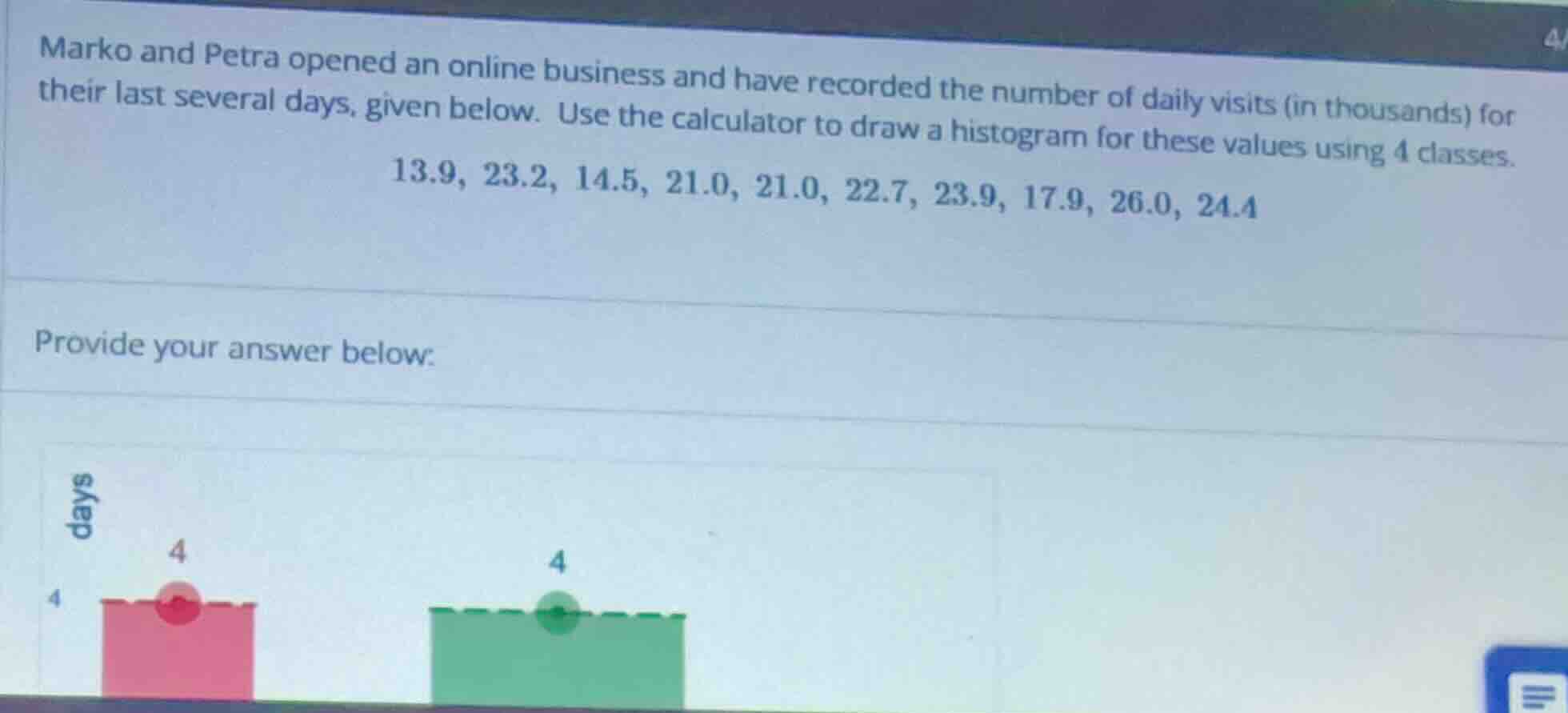
marko and petra opened an online business and have recorded the number of daily visits (in thousands) for their last several days, given below. use the calculator to draw a histogram for these values using 4 classes. 13.9, 23.2, 14.5, 21.0, 21.0, 22.7, 23.9, 17.9, 26.0, 24.4 provide your answer below:
Step1: Find the range
First, find the minimum and maximum values. The data set is \(13.9, 23.2, 14.5, 21.0, 21.0, 22.7, 23.9, 17.9, 26.0, 24.4\). The minimum value (\(min\)) is \(13.9\) and the maximum value (\(max\)) is \(26.0\). The range \(R = max - min=26.0 - 13.9 = 12.1\).
Step2: Determine the class width
We need 4 classes. The class width \(w=\frac{R}{number\ of\ classes}=\frac{12.1}{4}\approx 3.025\), we can round it to \(3.1\) (or use a more appropriate value for grouping).
Step3: Define the classes
- Class 1: \(13.9 - 17.0\) (since \(13.9+3.1 = 17.0\))
- Class 2: \(17.0 - 20.1\)
- Class 3: \(20.1 - 23.2\)
- Class 4: \(23.2 - 26.3\) (covers up to \(26.0\))
Step4: Count the frequency of each class
- For Class 1 (\(13.9 - 17.0\)): The values in this class are \(13.9, 14.5, 17.9\)? Wait, no, \(17.9\) is \(17.9\) which is greater than \(17.0\). Wait, correct values: \(13.9, 14.5\) and \(17.9\) is not in this class. Wait, \(13.9, 14.5\) and let's re - check. Wait, \(13.9\), \(14.5\), \(17.9\) is \(17.9\) which is in the next class? Wait, no, my class width calculation might be off. Let's recalculate the class width as \(\lceil\frac{12.1}{4}
ceil = 4\) (using ceiling function for better grouping). Then:
- Class 1: \(13.9 - 17.8\) (width \(3.9\))
- Class 2: \(17.8 - 21.7\)
- Class 3: \(21.7 - 25.6\)
- Class 4: \(25.6 - 29.5\)
Now count the frequencies:
- Class 1 (\(13.9 - 17.8\)): Values are \(13.9, 14.5, 17.9\)? No, \(17.9\) is \(17.9\) which is in Class 2. Wait, \(13.9, 14.5\) and \(17.9\) is \(17.9\) which is \(17.9\geq17.8\), so Class 1: \(13.9,14.5\) (wait, \(17.9\) is \(17.9\), so Class 1: \(13.9,14.5\) (2 values)? Wait, no, let's list all values:
- \(13.9\): Class 1
- \(14.5\): Class 1
- \(17.9\): Class 2
- \(21.0\): Class 3
- \(21.0\): Class 3
- \(22.7\): Class 3
- \(23.2\): Class 4
- \(23.9\): Class 4
- \(24.4\): Class 4
- \(26.0\): Class 4
Wait, I think my initial class width approach was wrong. Let's use the correct method:
The data points:
- \(13.9\)
- \(14.5\)
- \(17.9\)
- \(21.0\)
- \(21.0\)
- \(22.7\)
- \(23.2\)
- \(23.9\)
- \(24.4\)
- \(26.0\)
Let's sort the data: \(13.9, 14.5, 17.9, 21.0, 21.0, 22.7, 23.2, 23.9, 24.4, 26.0\)
Number of classes \(k = 4\)
Range \(R=26.0 - 13.9 = 12.1\)
Class width \(w=\frac{12.1}{4}=3.025\), we can take \(w = 3\)
Classes:
- Class 1: \(13.9 - 16.9\) (values: \(13.9, 14.5\)) → frequency \(f_1 = 2\)
- Class 2: \(17.0 - 20.0\) (value: \(17.9\)) → frequency \(f_2 = 1\)
- Class 3: \(20.1 - 23.1\) (values: \(21.0, 21.0, 22.7\)) → frequency \(f_3=3\)
- Class 4: \(23.2 - 26.2\) (values: \(23.2, 23.9, 24.4, 26.0\)) → frequency \(f_4 = 4\)
Now, to draw the histogram:
- The x - axis will have the class intervals.
- The y - axis will have the frequency (number of days).
- For Class 1 (\(13.9 - 16.9\)), the height of the bar is 2.
- For Class 2 (\(17.0 - 20.0\)), the height of the bar is 1.
- For Class 3 (\(20.1 - 23.1\)), the height of the bar is 3.
- For Class 4 (\(23.2 - 26.2\)), the height of the bar is 4.
To draw the histogram:
- Label the x - axis with the class intervals: \(13.9 - 16.9\), \(17.0 - 20.0\), \(20.1 - 23.1\), \(23.2 - 26.2\)
- Label the y - axis with "Number of Days"
- Draw bars for each class with heights equal to their frequencies (2, 1, 3, 4 respectively)

Snap & solve any problem in the app
Get step-by-step solutions on Sovi AI
Photo-based solutions with guided steps
Explore more problems and detailed explanations
The histogram has 4 classes. The class intervals are \(13.9 - 16.9\) (frequency = 2), \(17.0 - 20.0\) (frequency = 1), \(20.1 - 23.1\) (frequency = 3), and \(23.2 - 26.2\) (frequency = 4). The bars of the histogram will have heights 2, 1, 3, and 4 corresponding to these classes respectively.