QUESTION IMAGE
Question
martin luther king jr. and civil disobedience
letter from birmingham jail
by martin luther king jr.
16 april 1963
my dear fellow clergymen:
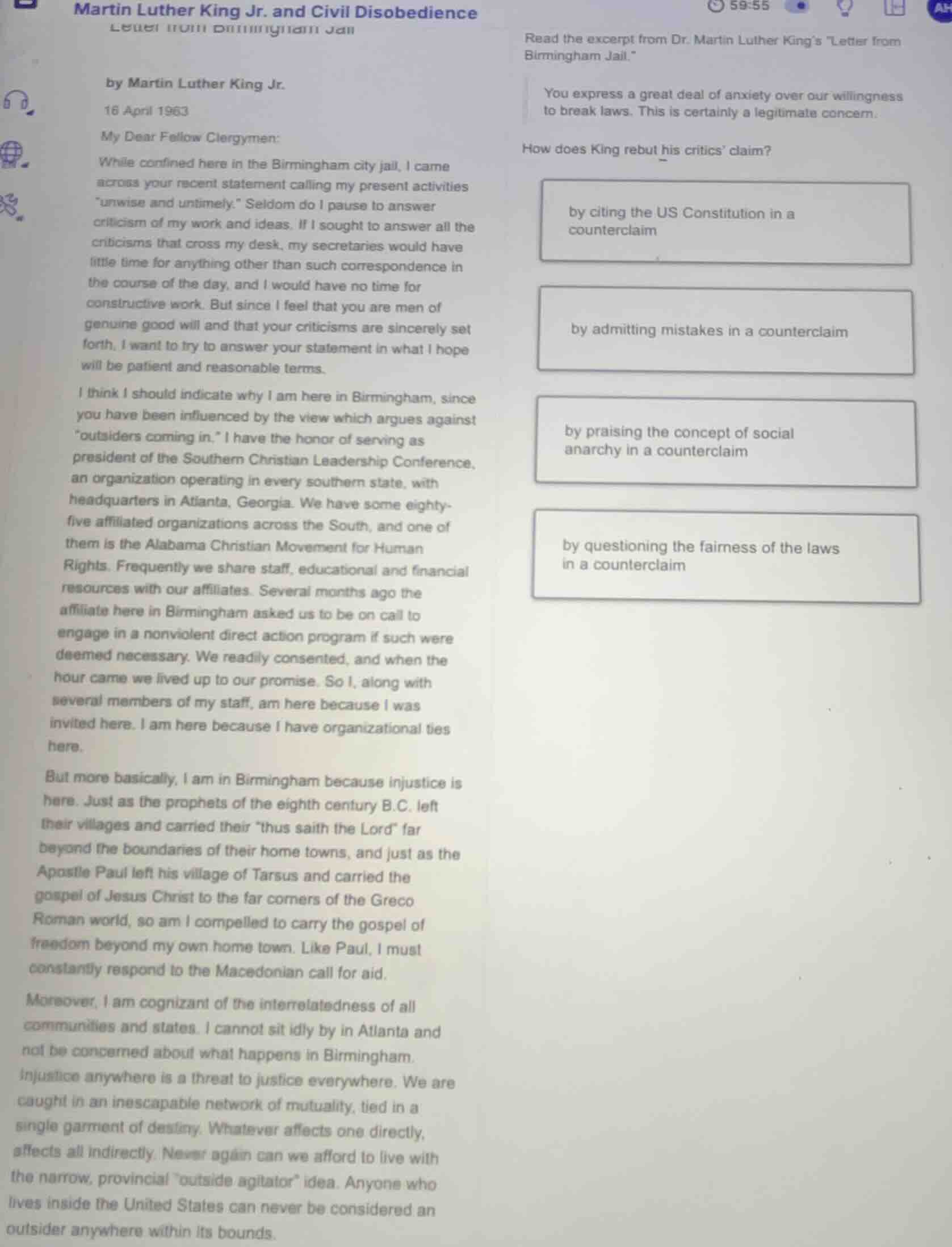
while confined here in the birmingham city jail, i came across your recent statement calling my present activities “unwise and untimely.” seldom do i pause to answer criticism of my work and ideas. if i sought to answer all the criticisms that cross my desk, my secretaries would have little time for anything other than such correspondence in the course of the day, and i would have no time for constructive work. but since i feel that you are men of genuine good will and that your criticisms are sincerely set forth, i want to try to answer your statement in what i hope will be patient and reasonable terms.
i think i should indicate why i am here in birmingham, since you have been influenced by the view which argues against “outsiders coming in.” i have the honor of serving as president of the southern christian leadership conference, an organization operating in every southern state, with headquarters in atlanta, georgia. we have some eighty - five affiliated organizations across the south, and one of them is the alabama christian movement for human rights. frequently we share staff, educational and financial resources with our affiliates. several months ago the affiliate here in birmingham asked us to be on call to engage in a nonviolent direct action program if such were deemed necessary. we readily consented, and when the hour came we lived up to our promise. so i, along with several members of my staff, am here because i was invited here. i am here because i have organizational ties here.
but more basically, i am in birmingham because injustice is here. just as the prophets of the eighth century b.c. left their villages and carried their “thus saith the lord” far beyond the boundaries of their home towns, and just as the apostle paul left his village of tarsus and carried the gospel of jesus christ to the far corners of the greco - roman world, so am i compelled to carry the gospel of freedom beyond my own home town. like paul, i must constantly respond to the macedonian call for aid.
moreover, i am cognizant of the interrelatedness of all communities and states. i cannot sit idly by in atlanta and not be concerned about what happens in birmingham. injustice anywhere is a threat to justice everywhere. we are caught in an inescapable network of mutuality, tied in a single garment of destiny. whatever affects one directly, affects all indirectly. never again can we afford to live with the narrow, provincial “outside agitator” idea. anyone who lives inside the united states can never be considered an outsider anywhere within its bounds.
read the excerpt from dr. martin luther king’s “letter from birmingham jail.”
you express a great deal of anxiety over our willingness to break laws. this is certainly a legitimate concern.
how does king rebut his critics’ claim?
by citing the us constitution in a counterclaim
by admitting mistakes in a counterclaim
by praising the concept of social anarchy in a counterclaim
by questioning the fairness of the laws in a counterclaim
To determine how King rebuts his critics' claim about breaking laws, we analyze each option:
- The first option (citing the US Constitution) is incorrect as the excerpt doesn't show this.
- The second option (admitting mistakes) is wrong because King doesn't admit mistakes in his response.
- The third option (praising social anarchy) is incorrect; King was a proponent of non - violent action, not social anarchy.
- The fourth option (questioning the fairness of the laws) is correct. King's argument about injustice and the interrelatedness of communities implies that he is challenging the fairness of the laws that led to his actions, as he believes injustice in one place threatens justice everywhere and that the "outsider" argument is flawed, which is a way of questioning the fairness of the laws his critics are defending.

Snap & solve any problem in the app
Get step-by-step solutions on Sovi AI
Photo-based solutions with guided steps
Explore more problems and detailed explanations
D. by questioning the fairness of the laws in a counterclaim