QUESTION IMAGE
Question
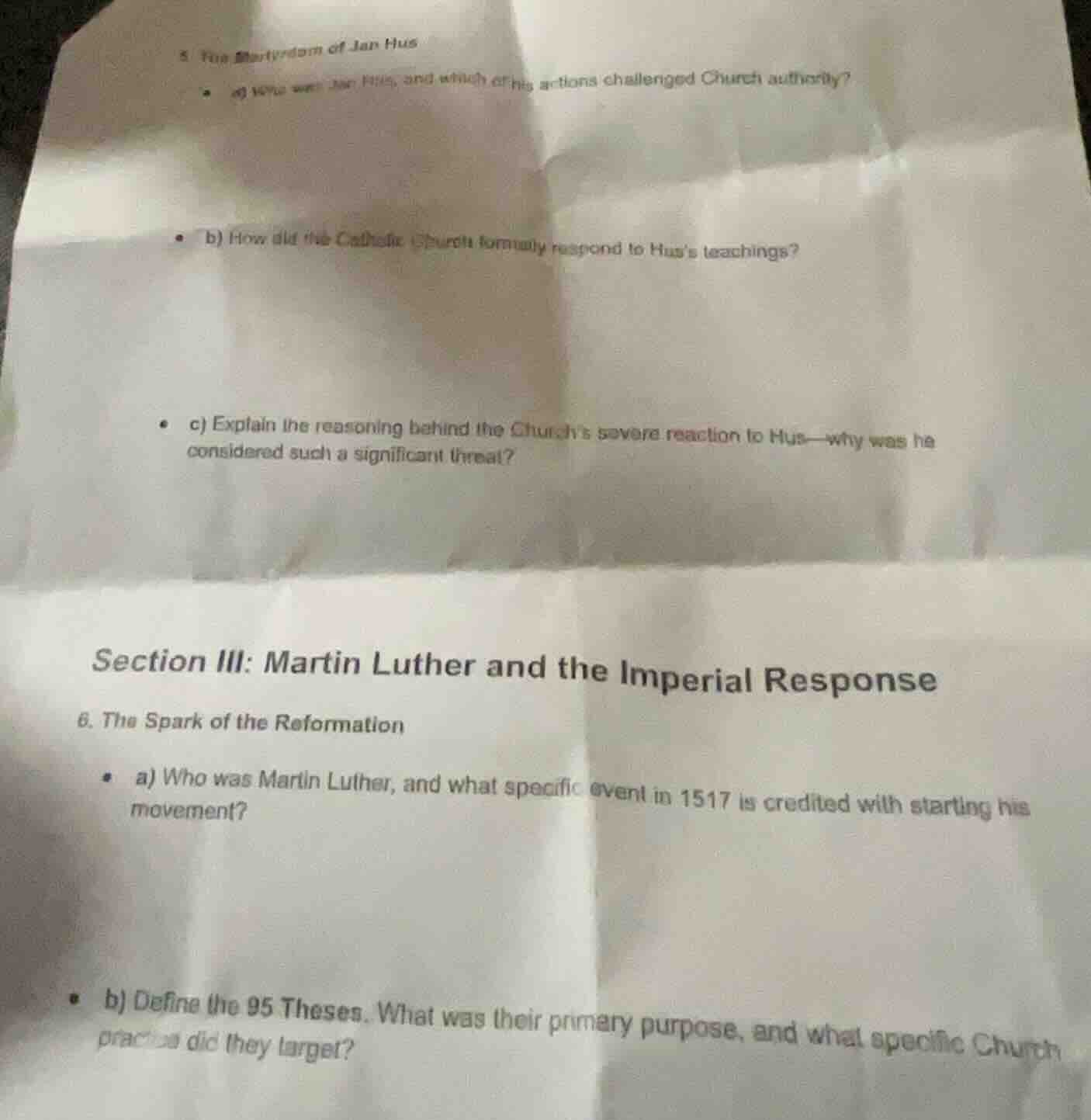
5 the martyrdom of jan hus
- a) who was jan hus, and which of his actions challenged church authority?
- b) how did the catholic church formally respond to hus’s teachings?
- c) explain the reasoning behind the church’s severe reaction to hus—why was he considered such a significant threat?
section iii: martin luther and the imperial response
- the spark of the reformation
- a) who was martin luther, and what specific event in 1517 is credited with starting his movement?
- b) define the 95 theses. what was their primary purpose, and what specific church practice did they target?
Part 5: The Martyrdom of Jan Hus
a) Who was Jan Hus, and which of his actions challenged Church authority?
Jan Hus was a Czech theologian, philosopher, and reformer. He challenged Church authority by criticizing the sale of indulgences, advocating for the use of the Czech language in religious services, and questioning the moral and financial corruption within the Catholic Church, including the wealth and power of the clergy. He also supported some of the teachings of John Wycliffe, which were considered heretical by the Church.
The Catholic Church responded by declaring Jan Hus a heretic. He was summoned to the Council of Constance, where he was tried, convicted, and ultimately burned at the stake in 1415. The Church also sought to suppress his teachings and influence, particularly in Bohemia, leading to the Hussite Wars as his followers resisted the Church's efforts to eliminate his ideas.
Hus was a significant threat because his teachings challenged the Church's authority, wealth, and dogma. He questioned the Church's financial practices (like indulgences) and hierarchical structure, which could undermine the Church's political and economic power. His use of the Czech language in services promoted national identity and religious independence from Rome, threatening the Church's universal authority. Additionally, his popularity in Bohemia and potential to inspire further reform movements posed a risk to the Church's unity and control over its followers.

Snap & solve any problem in the app
Get step-by-step solutions on Sovi AI
Photo-based solutions with guided steps
Explore more problems and detailed explanations
Jan Hus was a Czech reformer. His actions like criticizing indulgences, advocating Czech in services, and supporting Wycliffe’s ideas challenged Church authority.