QUESTION IMAGE
Question
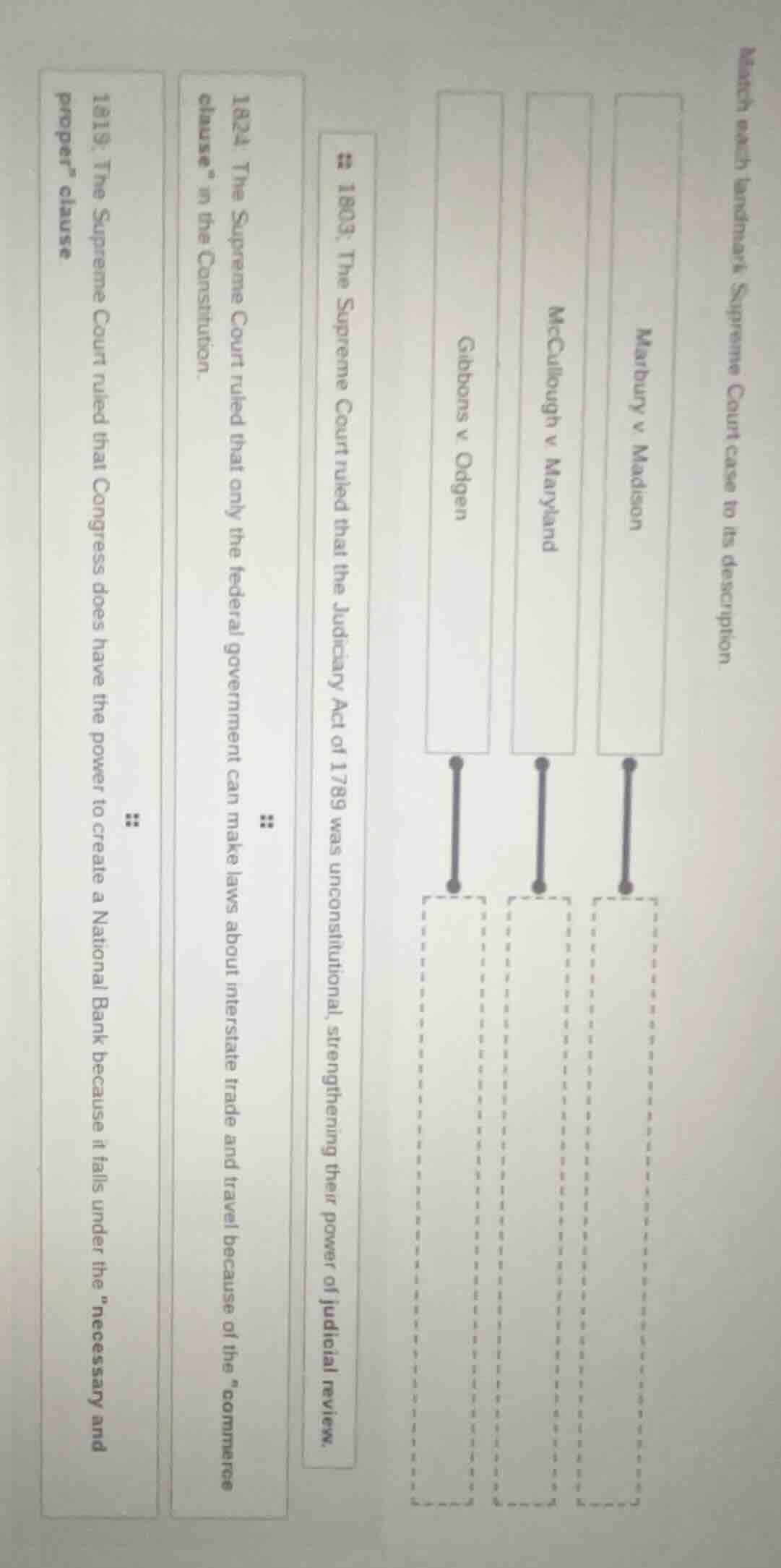
match each landmark supreme court case to its description
marbury v. madison
mccullough v. maryland
gibbons v. ogden
:: 1803: the supreme court ruled that the judiciary act of 1789 was unconstitutional, strengthening their power of judicial review.
1824: the supreme court ruled that only the federal government can make laws about interstate trade and travel because of the \commerce clause\ in the constitution.
1819: the supreme court ruled that congress does have the power to create a national bank because it falls under the
ecessary and proper\ clause.
To solve this matching problem, we analyze each Supreme Court case and its corresponding description:
1. Marbury v. Madison (1803)
The description “1803: The Supreme Court ruled that the Judiciary Act of 1789 was unconstitutional, strengthening their power of judicial review” matches Marbury v. Madison. This case established judicial review.
2. McCullough v. Maryland (1819)
The description “1819: The Supreme Court ruled that Congress does have the power to create a National Bank because it falls under the ‘necessary and proper’ clause” matches McCullough v. Maryland. This case upheld the implied powers of Congress via the Necessary and Proper Clause.
3. Gibbons v. Ogden (1824)
The description “1824: The Supreme Court ruled that only the federal government can make laws about interstate trade and travel because of the ‘commerce clause’ in the Constitution” matches Gibbons v. Ogden. This case clarified federal authority over interstate commerce.

Snap & solve any problem in the app
Get step-by-step solutions on Sovi AI
Photo-based solutions with guided steps
Explore more problems and detailed explanations
- Marbury v. Madison → 1803: The Supreme Court ruled that the Judiciary Act of 1789 was unconstitutional, strengthening their power of judicial review.
- McCullough v. Maryland → 1819: The Supreme Court ruled that Congress does have the power to create a National Bank because it falls under the “necessary and proper” clause.
- Gibbons v. Ogden → 1824: The Supreme Court ruled that only the federal government can make laws about interstate trade and travel because of the “commerce clause” in the Constitution.