QUESTION IMAGE
Question
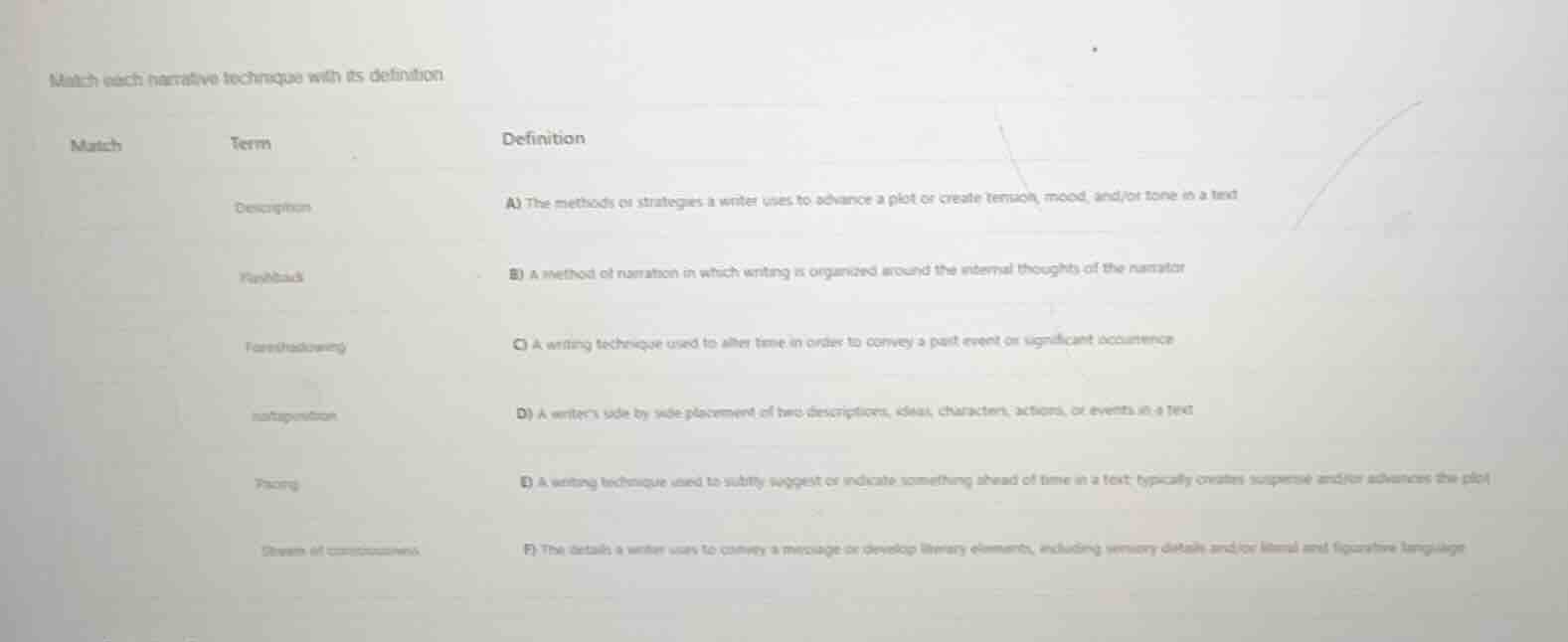
match each narrative technique with its definition.
match\tterm\tdefinition
\tdescription\ta) the methods or strategies a writer uses to advance a plot or create tension, mood, and/or tone in a text
\tflashback\tb) a method of narration in which writing is organized around the internal thoughts of the narrator
\tforeshadowing\tc) a writing technique used to alter time in order to convey a past event or significant occurrence
\tjuxtaposition\td) a writer’s side - by - side placement of two descriptions, ideas, characters, actions, or events in a text
\tpacing\te) a writing technique used to subtly suggest or indicate something ahead of time in a text (typically creates suspense and/or advances the plot)
\tstream of consciousness\tf) the details a writer uses to convey a message or develop literary elements, including sensory details and/or literal and figurative language
- Description: Looks at the definition F which talks about details (sensory, literal, figurative) to convey a message or develop literary elements. So Description - F.
- Flashback: Definition C is about altering time to convey a past event, which is flashback. So Flashback - C.
- Foreshadowing: Definition E is about subtly suggesting something ahead of time, creating suspense, which is foreshadowing. So Foreshadowing - E.
- Juxtaposition: Definition D is about side - by - side placement of two descriptions, ideas, etc. So Juxtaposition - D.
- Pacing: Definition A is about methods to advance plot, create tension/mood/tone, which is pacing. So Pacing - A.
- Stream of consciousness: Definition B is about writing organized around the internal thoughts of the narrator, which is stream of consciousness. So Stream of consciousness - B.

Snap & solve any problem in the app
Get step-by-step solutions on Sovi AI
Photo-based solutions with guided steps
Explore more problems and detailed explanations
- Description - F) The details a writer uses to convey a message or develop literary elements, including sensory details and/or literal and figurative language
- Flashback - C) A writing technique used to alter time in order to convey a past event or significant occurrence
- Foreshadowing - E) A writing technique used to subtly suggest or indicate something ahead of time in a text (typically creates suspense and/or advances the plot)
- Juxtaposition - D) A writer's side - by - side placement of two descriptions, ideas, characters, actions, or events in a text
- Pacing - A) The methods or strategies a writer uses to advance a plot or create tension, mood, and/or tone in a text
- Stream of consciousness - B) A method of narration in which writing is organized around the internal thoughts of the narrator