QUESTION IMAGE
Question
matching question
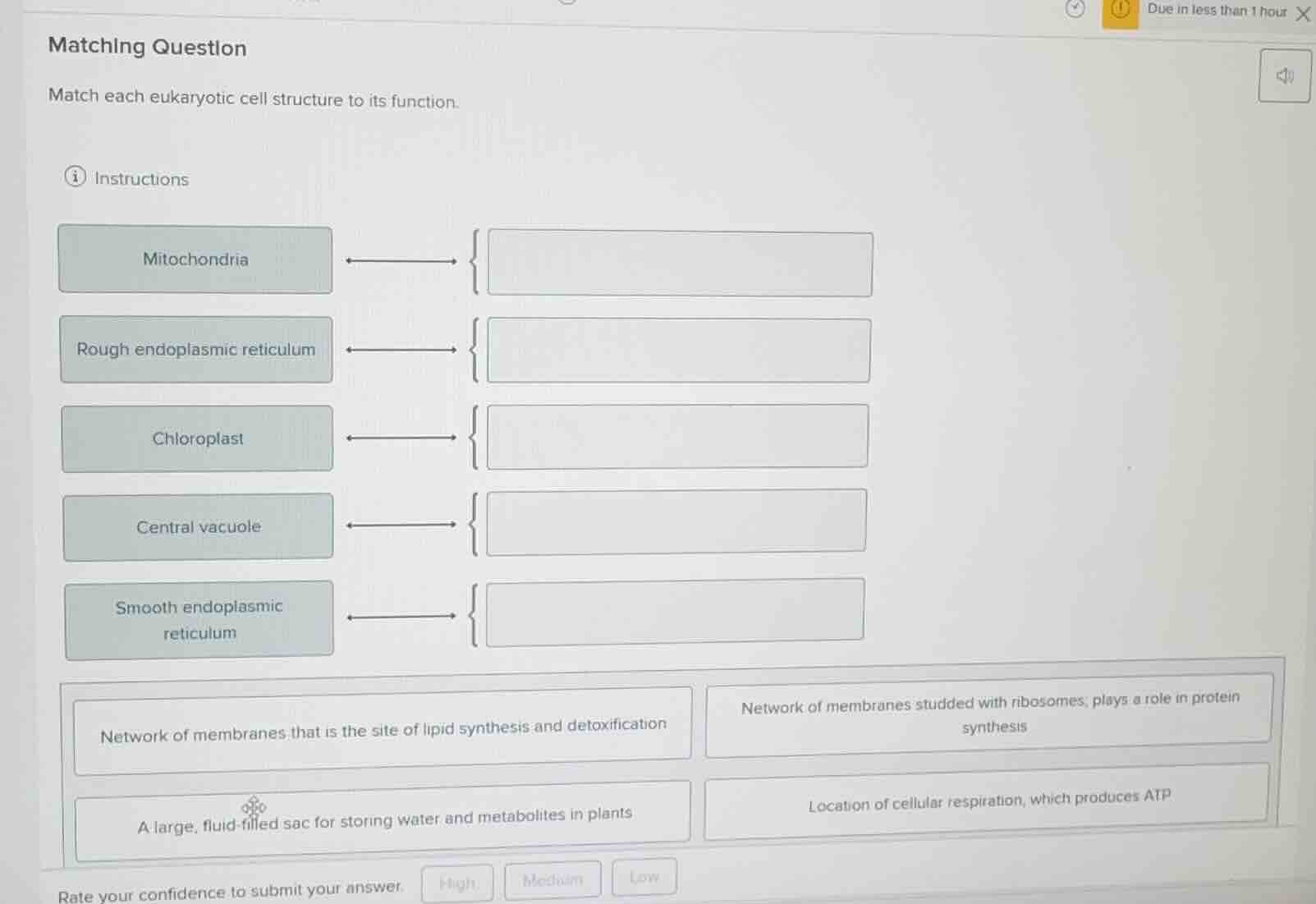
match each eukaryotic cell structure to its function.
instructions
mitochondria
rough endoplasmic reticulum
chloroplast
central vacuole
smooth endoplasmic reticulum
network of membranes that is the site of lipid synthesis and detoxification
network of membranes studded with ribosomes, plays a role in protein synthesis
a large, fluid - filled sac for storing water and metabolites in plants
location of cellular respiration, which produces atp
rate your confidence to submit your answer high medium low
- Mitochondria: Known as the "powerhouse of the cell", it is the location of cellular respiration, which produces ATP (adenosine triphosphate) for energy.
- Rough endoplasmic reticulum (RER): Has ribosomes on its surface, forming a network of membranes. These ribosomes are involved in protein synthesis, so RER plays a role in protein synthesis.
- Chloroplast: Unique to plant cells, it is the site of photosynthesis, where light energy is converted into chemical energy (like glucose) using chlorophyll.
- Central vacuole: A large structure in plant cells, it stores water, nutrients, and metabolites, helping maintain turgor pressure and storing substances.
- Smooth endoplasmic reticulum (SER): Lacks ribosomes, and its functions include lipid synthesis (like making phospholipids for membranes) and detoxification of harmful substances.

Snap & solve any problem in the app
Get step-by-step solutions on Sovi AI
Photo-based solutions with guided steps
Explore more problems and detailed explanations
- Mitochondria → Location of cellular respiration, which produces ATP
- Rough endoplasmic reticulum → Network of membranes studded with ribosomes, plays a role in protein synthesis
- Chloroplast → Site of photosynthesis (note: if the option for photosynthesis was missing, but from the given options, we assume the intended match; however, from the provided options, the closest relevant function related to chloroplast's role in energy conversion via photosynthesis, but since the options given don't have photosynthesis, maybe a typo, but based on standard knowledge, chloroplast is for photosynthesis, but among the given options, perhaps the intended was missed, but following the given options: Wait, the given options for the right side (after the structures) are:
- Network of membranes that is the site of lipid synthesis and detoxification
- Network of membranes studded with ribosomes, plays a role in protein synthesis
- A large, fluid - filled sac for storing water and metabolites in plants
- Location of cellular respiration, which produces ATP
And also, chloroplast's function (photosynthesis) is not listed, but maybe there was a mistake. But based on the given options:
- Mitochondria: Location of cellular respiration, which produces ATP
- Rough endoplasmic reticulum: Network of membranes studded with ribosomes, plays a role in protein synthesis
- Chloroplast: (If we assume a missing option, but from the given, maybe a mistake, but if we have to choose from the given, perhaps the intended was different, but based on standard biology:
- Central vacuole: A large, fluid - filled sac for storing water and metabolites in plants
- Smooth endoplasmic reticulum: Network of membranes that is the site of lipid synthesis and detoxification
So the correct matches are:
Mitochondria - Location of cellular respiration, which produces ATP
Rough endoplasmic reticulum - Network of membranes studded with ribosomes, plays a role in protein synthesis
Chloroplast - (Note: The given options don't have the correct function for chloroplast (photosynthesis), but if we proceed with the given options, there might be an error. However, assuming that maybe the options were misprinted, and the intended for chloroplast was missed, but based on the given options, we can only match the others correctly as above.
Central vacuole - A large, fluid - filled sac for storing water and metabolites in plants
Smooth endoplasmic reticulum - Network of membranes that is the site of lipid synthesis and detoxification