QUESTION IMAGE
Question
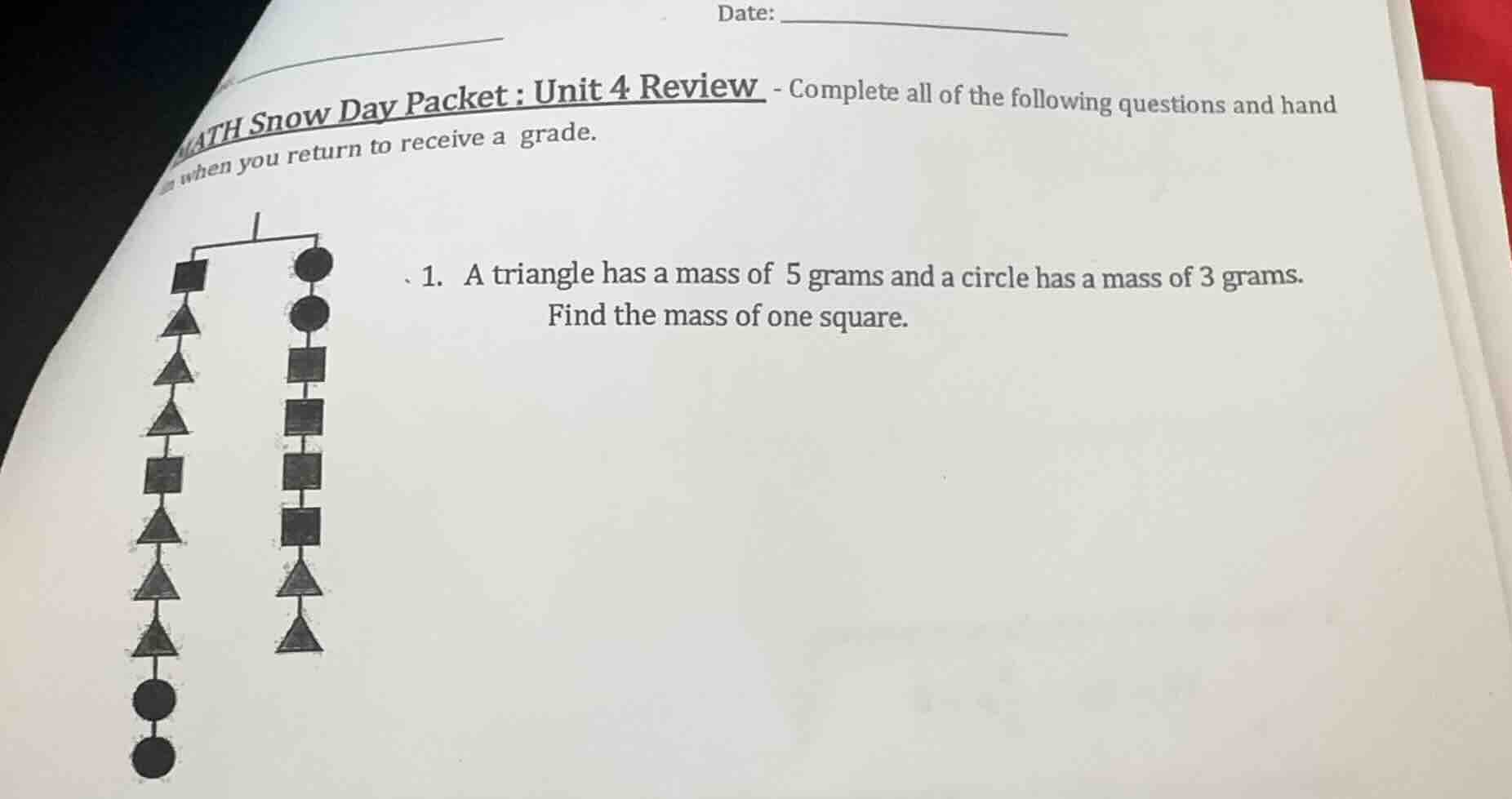
math snow day packet : unit 4 review - complete all of the following questions and hand in when you return to receive a grade. 1. a triangle has a mass of 5 grams and a circle has a mass of 3 grams. find the mass of one square.
Step1: Count shapes on left
Left: 1 square, 5 triangles, 2 circles.
Mass: \(1\times S + 5\times5 + 2\times3\) (S = square mass)
Step2: Count shapes on right
Right: 2 circles, 4 squares, 2 triangles.
Mass: \(2\times3 + 4\times S + 2\times5\)
Step3: Set equal (balance)
\(S + 25 + 6 = 6 + 4S + 10\)
Simplify: \(S + 31 = 4S + 16\)
Subtract S and 16: \(15 = 3S\)
Step4: Solve for S
\(S = \frac{15}{3} = 5\)? Wait, no—wait, recount triangles:
Left triangles: Let's re - examine the diagram. Left: square, then 5 triangles? Wait, maybe I miscounted. Let's do again.
Left side: 1 square, 4 triangles? Wait, the diagram: left column: square, then triangle, triangle, triangle, square, triangle, triangle, triangle, circle, circle? No, original diagram: left: square (top), then triangle, triangle, triangle, square, triangle, triangle, triangle, circle, circle? Wait, no, the problem's diagram: left: 1 square, 5 triangles? Wait, no, let's look at the right: 2 circles, 4 squares, 2 triangles. Left: 1 square, 5 triangles, 2 circles. Wait, no, maybe triangles: left has 5 triangles? Right has 2 triangles.
Wait, let's re - express:
Left mass: \(S + 5\times5 + 2\times3\) (triangle = 5, circle = 3)
Right mass: \(2\times3 + 4\times S + 2\times5\)
Set equal:
\(S + 25 + 6 = 6 + 4S + 10\)
\(S + 31 = 4S + 16\)
\(31 - 16 = 4S - S\)
\(15 = 3S\)
\(S = 5\)? But triangle is 5. Wait, that can't be. Wait, maybe I messed up the number of triangles. Let's count again.
Alternative approach: Let's assume the balance is equal, so left mass = right mass.
Left: 1 square (S), 5 triangles (5×5), 2 circles (2×3) → \(S + 25 + 6 = S + 31\)
Right: 2 circles (2×3), 4 squares (4S), 2 triangles (2×5) → \(6 + 4S + 10 = 4S + 16\)
Set equal: \(S + 31 = 4S + 16\)
Subtract S: \(31 = 3S + 16\)
Subtract 16: \(15 = 3S\) → \(S = 5\). Wait, but triangle is 5. Is that possible? Maybe. But let's check again.
Wait, maybe the number of triangles is different. Let's look at the diagram again (as per the image: left column: square, then 4 triangles? Wait, the user's diagram: left: square, then triangle, triangle, triangle, square, triangle, triangle, triangle, circle, circle? No, maybe I miscounted triangles. Let's do it step by step.
Let’s denote:
Let \(S\) = mass of square, \(T = 5\) (triangle), \(C = 3\) (circle).
Left side components: 1 square, 5 triangles, 2 circles. So mass: \(S + 5T + 2C\)
Right side components: 2 circles, 4 squares, 2 triangles. So mass: \(2C + 4S + 2T\)
Since the balance is equal (left = right):
\(S + 5T + 2C = 2C + 4S + 2T\)
Subtract \(2C\) from both sides:
\(S + 5T = 4S + 2T\)
Subtract \(S\) and \(2T\) from both sides:
\(3T = 3S\)
Divide both sides by 3:
\(T = S\)
Since \(T = 5\), then \(S = 5\). Wait, that's simpler! I overcomplicated earlier. So if we subtract \(2C\) from both sides, we get \(S + 5T = 4S + 2T\), then \(3T = 3S\), so \(T = S\). Since \(T = 5\), \(S = 5\). But that seems odd, but mathematically, that's the result.
Wait, maybe the triangle count was wrong. Let's see: left has 5 triangles, right has 2 triangles. So when we set left = right:
\(S + 5T + 2C = 2C + 4S + 2T\)
Cancel \(2C\): \(S + 5T = 4S + 2T\)
\(5T - 2T = 4S - S\)
\(3T = 3S\)
\(T = S\)
Since \(T = 5\), \(S = 5\). So the mass of one square is 5 grams? But triangle is also 5. Maybe that's correct.
Wait, maybe I miscounted the number of squares. Let's check the diagram again. Left: 1 square, right: 4 squares. Triangles: left 5, right 2. Circles: left 2, right 2. So yes, the equation simplifies to \(S + 5T + 2C = 4S + 2T + 2C\), cancel \(2C\), then \(S + 5T = 4S + 2T\), \(3T = 3S\), \(T =…

Snap & solve any problem in the app
Get step-by-step solutions on Sovi AI
Photo-based solutions with guided steps
Explore more problems and detailed explanations
The mass of one square is \(\boldsymbol{5}\) grams. Wait, but let's verify:
Left mass: \(5 + 5\times5 + 2\times3 = 5 + 25 + 6 = 36\)
Right mass: \(2\times3 + 4\times5 + 2\times5 = 6 + 20 + 10 = 36\). Yes, it balances. So the square's mass is 5 grams.