QUESTION IMAGE
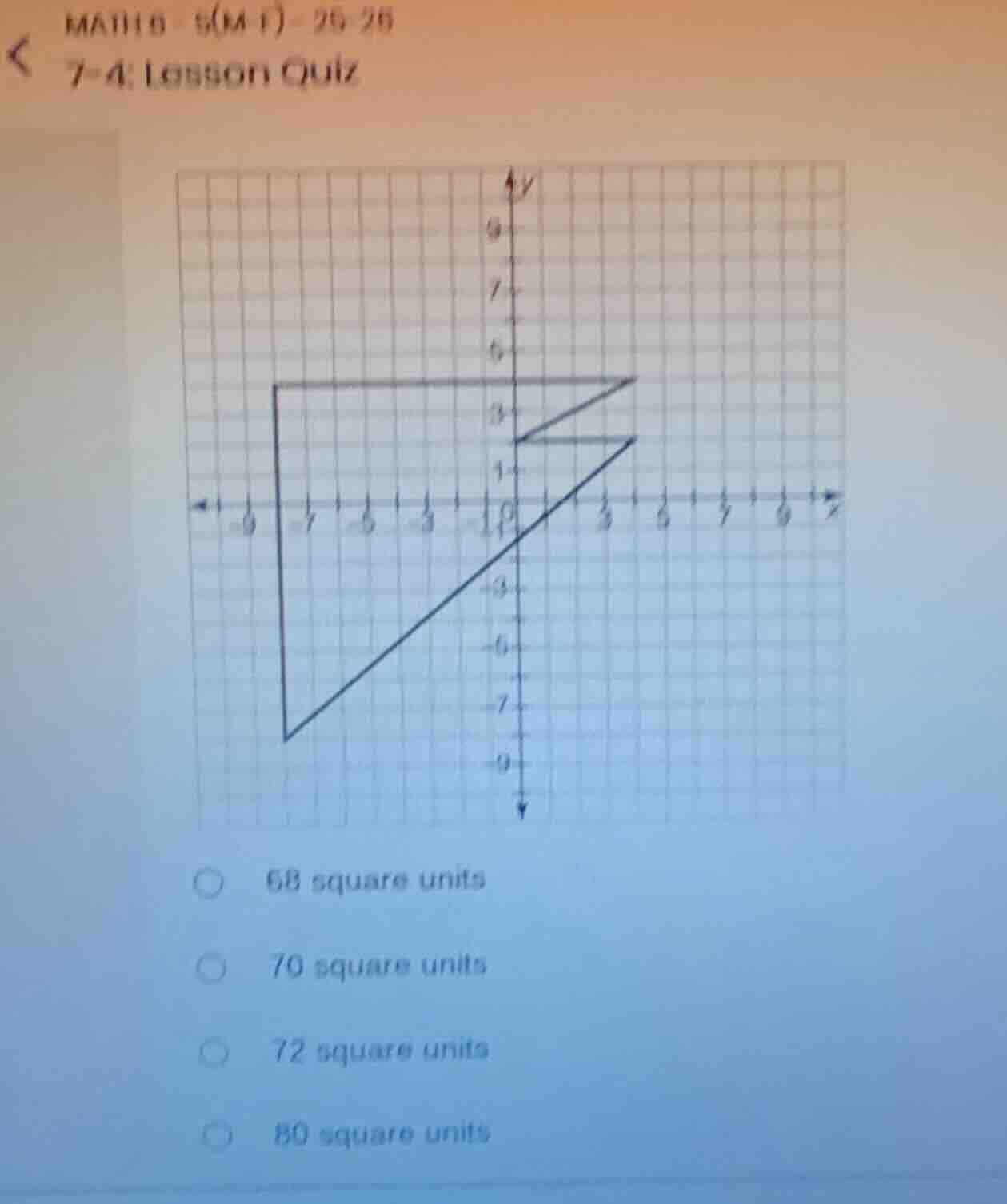
Question
math6 - s(m-1) - 25 - 26
7-4: lesson quiz
options:
68 square units
70 square units
72 square units
80 square units
Step1: Identify the shape (trapezoid)
The figure is a trapezoid with bases \( b_1 \) and \( b_2 \), and height \( h \).
Step2: Determine base lengths
From the graph, the lengths of the two parallel sides (bases):
- \( b_1 = 8 - (-8) = 16 \)? Wait, no, looking at the vertical distances. Wait, actually, the vertical extent: the top base (from y=2 to y=5? Wait, no, let's check the horizontal and vertical. Wait, the left side is at x=-7, right side at x=4? Wait, no, let's calculate the height (horizontal distance between the two vertical sides) and the two bases (vertical lengths).
Wait, the trapezoid has two parallel sides (vertical? No, horizontal? Wait, the left side is vertical from ( -7, -8 ) to ( -7, 5 ), so length is \( 5 - (-8) = 13 \). The right side: from (4, 2) to (4, 5)? Wait, no, the top base is from (-7,5) to (4,5), length \( 4 - (-7) = 11 \). The bottom base: from (-7,-8) to (4,-8)? No, the slant side? Wait, no, maybe I messed up. Wait, the formula for the area of a trapezoid is \( A=\frac{(b_1 + b_2)}{2}\times h \), where \( b_1 \) and \( b_2 \) are the lengths of the two parallel sides, and \( h \) is the distance between them.
Wait, looking at the graph: the two parallel sides (the vertical sides? No, horizontal? Wait, the left vertical side: from ( -7, -8 ) to ( -7, 5 ), so length \( 5 - (-8) = 13 \). The right parallel side: from (4, 2) to (4, 5)? No, wait the top horizontal segment: from (-7,5) to (4,5), length \( 4 - (-7) = 11 \). The bottom horizontal segment? No, the slant side is from (-7,-8) to (4,2). Wait, no, maybe the two parallel sides are the top and bottom? Wait, no, the figure is a trapezoid with bases as the two vertical sides? No, let's re-express.
Wait, the horizontal distance between the two vertical lines (x=-7 and x=4) is \( 4 - (-7) = 11 \)? No, 4 - (-7) = 11? Wait, 4 +7=11. Then the two vertical sides: left side from (-7, -8) to (-7,5): length \( 5 - (-8) = 13 \). Right side: from (4, 2) to (4,5): length \( 5 - 2 = 3 \). Wait, no, that can't be. Wait, maybe the two parallel sides are the top (length 11) and bottom (length? Wait, no, the slant side is from (-7,-8) to (4,2). Wait, maybe I made a mistake. Let's check the coordinates:
Left vertical side: x=-7, from y=-8 to y=5: length \( 5 - (-8) = 13 \).
Right parallel side: x=4, from y=2 to y=5? No, the top horizontal line is y=5, from x=-7 to x=4: length 11. The bottom horizontal line? No, the other parallel side is from x=-7 to x=4, but at y=2? Wait, no, the figure is a trapezoid with bases \( b_1 = 13 \) (left side) and \( b_2 = 3 \) (right side), and height \( h = 11 \) (horizontal distance between x=-7 and x=4). Wait, no, the formula for trapezoid area is average of the two bases times height (distance between them). So \( A=\frac{(13 + 3)}{2}\times 11 \)? No, that gives \( 8\times 11 = 88 \), which is not an option. Wait, maybe I got the bases wrong.
Wait, another approach: the figure can be divided or the coordinates. Let's list the vertices:
Looking at the graph:
- Left bottom: (-7, -8)
- Left top: (-7, 5)
- Right top: (4, 5)
- Right bottom: (4, 2)
Wait, no, the slant side is from (4,2) to (-7,-8). Wait, no, the four vertices are (-7,5), (4,5), (4,2), (-7,-8). So it's a trapezoid with two parallel sides: the left side (vertical from (-7,-8) to (-7,5), length 13) and the right side (from (4,2) to (4,5), length 3), and the distance between these two vertical sides is the horizontal distance between x=-7 and x=4, which is \( 4 - (-7) = 11 \). Wait, but that gives area \( \frac{(13 + 3)}{2} \times 11 = 8 \times 11 = 88 \), not mat…

Snap & solve any problem in the app
Get step-by-step solutions on Sovi AI
Photo-based solutions with guided steps
Explore more problems and detailed explanations
80 square units