QUESTION IMAGE
Question
mathematical literacy/investigation 01/grade 10
question 1
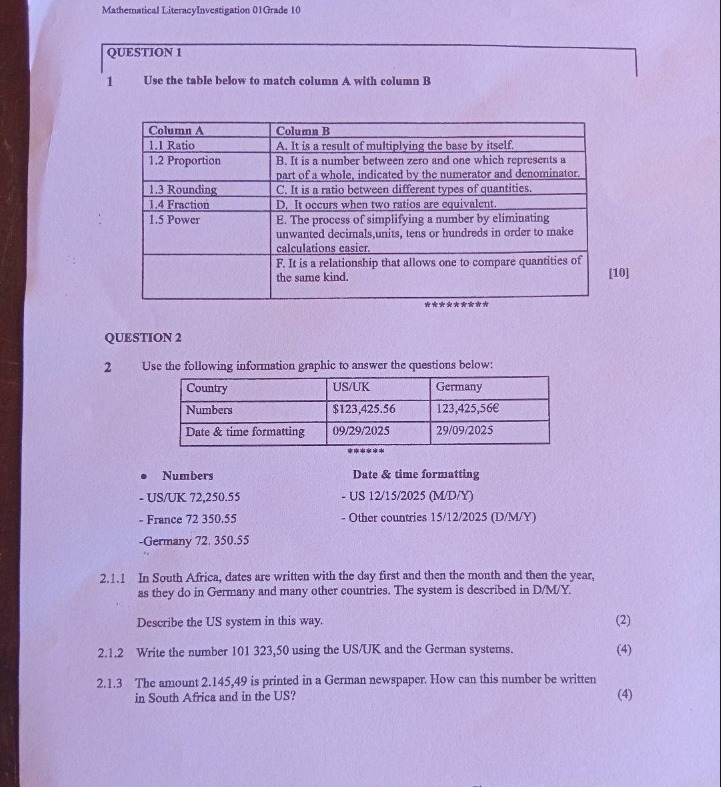
1 use the table below to match column a with column b
column a column b
1.1 ratio a. it is a result of multiplying the base by itself.
1.2 proportion b. it is a number between zero and one which represents a part of a whole, indicated by the numerator and denominator.
1.3 rounding c. it is a ratio between different types of quantities.
1.4 fraction d. it occurs when two ratios are equivalent.
1.5 power e. the process of simplifying a number by eliminating unwanted decimals,units, tens or hundreds in order to make calculations easier.
f. it is a relationship that allows one to compare quantities of the same kind.
10
**********
question 2
2 use the following information graphic to answer the questions below:
country us/uk germany
numbers $123,425.56 123,425,56€
date & time formatting 09/29/2023 29/09/2025
**********
- numbers - date & time formatting
- us/uk 72,250.55 - us 12/15/2025 (m/d/y)
- france 72 350,55 - other countries 15/12/2025 (d/m/y)
-germany 72. 350,55
2.1.1 in south africa, dates are written with the day first and then the month and then the year, as they do in germany and many other countries. the system is described in d/m/y.
describe the us system in this way. (2)
2.1.2 write the number 101 323,50 using the us/uk and the german systems. (4)
2.1.3 the amount 2,145,49 is printed in a german newspaper. how can this number be written in south africa and in the us? (4)
QUESTION 1
To solve this, we match each term in Column A with the correct description in Column B:
- 1.1 Ratio: A ratio can compare quantities of the same kind (e.g., ratio of boys to girls). So matches with F: "It is a relationship that allows one to compare quantities of the same kind."
- 1.2 Proportion: A proportion occurs when two ratios are equivalent (e.g., \( \frac{2}{4}=\frac{1}{2} \)). So matches with D: "It occurs when two ratios are equivalent."
- 1.3 Rounding: Rounding is the process of simplifying a number by eliminating unwanted decimals, units, tens or hundreds to make calculations easier. So matches with E: "The process of simplifying a number by eliminating unwanted decimals,units, tens or hundreds in order to make calculations easier."
- 1.4 Fraction: A fraction is a number between zero and one (or more) that represents a part of a whole, with numerator and denominator. So matches with B: "It is a number between zero and one which represents a part of a whole, indicated by the numerator and denominator."
- 1.5 Power: A power is the result of multiplying the base by itself (e.g., \( 2^3 = 2\times2\times2 \)). So matches with A: "It is a result of multiplying the base by itself."
QUESTION 2
2.1.1
The US date format is given as M/D/Y (Month/Day/Year). For example, 09/29/2023 in US format is September 29, 2023, where the month (09 - September) comes first, then the day (29), then the year (2023). So the US system in D/M/Y terms would be that the month is in the second position, the day in the first, and the year in the third? Wait, no. Wait, the US format is M/D/Y (Month, Day, Year). To describe it as D/M/Y (Day, Month, Year) - no, actually, we need to re - express the US format (M/D/Y) in terms of D/M/Y structure. Wait, the US format is Month first, then Day, then Year. So if we use the D/M/Y structure (where the first part is Day, second is Month, third is Year), the US system would be that the Day is in the second position, the Month in the first, and the Year in the third? Wait, no. Let's take an example: US date 12/15/2025 (M/D/Y: December 15, 2025). In D/M/Y (Day, Month, Year) terms, if we force it into D/M/Y, it would be 15/12/2025? No, wait, no. Wait, the US format is M (month) first, then D (day), then Y (year). So to describe the US system in the way we describe D/M/Y (where the order is Day, Month, Year), the US system has the order as Month, Day, Year. So in terms of the positions: in D/M/Y, position 1: Day, position 2: Month, position 3: Year. In US (M/D/Y), position 1: Month, position 2: Day, position 3: Year. So to describe the US system in the D/M/Y - like structure (talking about the order of day, month, year), the US system has the month first, then the day, then the year. So in terms of the D/M/Y structure (where D is first, M is second, Y is third), the US system is M/D/Y, so if we list the components as (Day, Month, Year) positions, the US system has Month in the first (of the three - part date), Day in the second, and Year in the third. But more simply, the US date format is M/D/Y (Month/ Day/ Year), so when described in the way we describe D/M/Y (which is Day/Month/Year), the US system is Month/Day/Year. So the US system for dates (in D/M/Y - like descriptive terms) is that the month is written first, then the day, then the year, so in the order of (Month, Day, Year) which can be described as M/D/Y, whereas D/M/Y is Day/Month/Year. So to describe the US system in the way we describe D/M/Y (i.e., stating the order of day, month, year), the US system has the month…

Snap & solve any problem in the app
Get step-by-step solutions on Sovi AI
Photo-based solutions with guided steps
Explore more problems and detailed explanations
QUESTION 1
To solve this, we match each term in Column A with the correct description in Column B:
- 1.1 Ratio: A ratio can compare quantities of the same kind (e.g., ratio of boys to girls). So matches with F: "It is a relationship that allows one to compare quantities of the same kind."
- 1.2 Proportion: A proportion occurs when two ratios are equivalent (e.g., \( \frac{2}{4}=\frac{1}{2} \)). So matches with D: "It occurs when two ratios are equivalent."
- 1.3 Rounding: Rounding is the process of simplifying a number by eliminating unwanted decimals, units, tens or hundreds to make calculations easier. So matches with E: "The process of simplifying a number by eliminating unwanted decimals,units, tens or hundreds in order to make calculations easier."
- 1.4 Fraction: A fraction is a number between zero and one (or more) that represents a part of a whole, with numerator and denominator. So matches with B: "It is a number between zero and one which represents a part of a whole, indicated by the numerator and denominator."
- 1.5 Power: A power is the result of multiplying the base by itself (e.g., \( 2^3 = 2\times2\times2 \)). So matches with A: "It is a result of multiplying the base by itself."
QUESTION 2
2.1.1
The US date format is given as M/D/Y (Month/Day/Year). For example, 09/29/2023 in US format is September 29, 2023, where the month (09 - September) comes first, then the day (29), then the year (2023). So the US system in D/M/Y terms would be that the month is in the second position, the day in the first, and the year in the third? Wait, no. Wait, the US format is M/D/Y (Month, Day, Year). To describe it as D/M/Y (Day, Month, Year) - no, actually, we need to re - express the US format (M/D/Y) in terms of D/M/Y structure. Wait, the US format is Month first, then Day, then Year. So if we use the D/M/Y structure (where the first part is Day, second is Month, third is Year), the US system would be that the Day is in the second position, the Month in the first, and the Year in the third? Wait, no. Let's take an example: US date 12/15/2025 (M/D/Y: December 15, 2025). In D/M/Y (Day, Month, Year) terms, if we force it into D/M/Y, it would be 15/12/2025? No, wait, no. Wait, the US format is M (month) first, then D (day), then Y (year). So to describe the US system in the way we describe D/M/Y (where the order is Day, Month, Year), the US system has the order as Month, Day, Year. So in terms of the positions: in D/M/Y, position 1: Day, position 2: Month, position 3: Year. In US (M/D/Y), position 1: Month, position 2: Day, position 3: Year. So to describe the US system in the D/M/Y - like structure (talking about the order of day, month, year), the US system has the month first, then the day, then the year. So in terms of the D/M/Y structure (where D is first, M is second, Y is third), the US system is M/D/Y, so if we list the components as (Day, Month, Year) positions, the US system has Month in the first (of the three - part date), Day in the second, and Year in the third. But more simply, the US date format is M/D/Y (Month/ Day/ Year), so when described in the way we describe D/M/Y (which is Day/Month/Year), the US system is Month/Day/Year. So the US system for dates (in D/M/Y - like descriptive terms) is that the month is written first, then the day, then the year, so in the order of (Month, Day, Year) which can be described as M/D/Y, whereas D/M/Y is Day/Month/Year. So to describe the US system in the way we describe D/M/Y (i.e., stating the order of day, month, year), the US system has the month first, then the day, then the year. So for a date like 09/29/2023 (US format: September 29, 2023), in terms of day, month, year order: the month (09) is first, then the day (29), then the year (2023). So the US system is M/D/Y (Month, Day, Year) when considering the order of day, month, year (with month in the "day" position of D/M/Y, day in the "month" position of D/M/Y, and year in the "year" position). So the US system can be described as M/D/Y, meaning the month is written first, followed by the day, and then the year.
2.1.2
- US/UK system: In the US/UK system, we use commas to separate groups of three digits from the right, starting after the first three digits. For the number 101 323,50 (assuming the comma is a decimal separator, but in US/UK, the decimal is a dot, and commas are for thousands). Wait, the number is 101 323,50. In US/UK, we use a dot for decimal and commas for thousands. So first, we handle the thousands: 101,323.50 (because we group the digits before the decimal as 101 (thousand) and 323, so 101,323.50).
- German system: In the German system, we use dots to separate groups of three digits from the right, and a comma for the decimal. So for 101 323,50, we group the digits before the decimal: 101.323,50 (grouping 101 and 323 with a dot, and decimal as comma).
2.1.3
The number is 2,145,49 (in German, but wait, German uses dots for thousands and commas for decimals? Wait, the number is 2,145,49. Wait, no, in German, the decimal is a comma, and thousands are separated by dots. Wait, the number is printed in a German newspaper as 2,145,49? Wait, no, maybe it's 2.145,49 (German format: dots for thousands, comma for decimal). Wait, the problem says "the amount 2,145,49 is printed in a German newspaper". In German, the thousands separator is a dot, and decimal is a comma. So the correct German format for this number should be 2.145,49 (maybe a typo in the problem, using commas instead of dots for thousands).
- South Africa: South Africa uses the same as German for number formatting? Wait, South Africa (and many countries) use the international system where thousands are separated by commas (or spaces) and decimal by dots? Wait, no, the problem says for dates South Africa uses D/M/Y like Germany. For numbers, in South Africa, we use commas for thousands and dots for decimals (similar to US/UK? Wait, no. Wait, let's think:
In German, the number is written with dots as thousands separators and commas as decimals. So 2.145,49 (German) means 2145.49 (numerically).
- In South Africa: We need to write it with commas for thousands and dots for decimals. So 2,145.49 (because we group the thousands: 2,145 and decimal 49, so 2,145.49).
- In the US: In the US, we use commas for thousands and dots for decimals. So the number is 2,145.49 (same as South Africa in terms of thousands and decimal separators? Wait, no, wait the German number is 2.145,49 which is 2145.49. So in US, we write it as 2,145.49 (commas for thousands, dot for decimal). In South Africa, also 2,145.49 (assuming South Africa uses commas for thousands and dots for decimals, similar to US/UK for numbers, but dates are D/M/Y like Germany).
Final Answers
QUESTION 1
1.1: F; 1.2: D; 1.3: E; 1.4: B; 1.5: A
QUESTION 2
2.1.1: The US system is M/D/Y, meaning the month is written first, followed by the day, and then the year (e.g., 09/29/2023 is September 29, 2023, with month (09) first, day (29) second, year (2023) third).
2.1.2: US/UK: \( 101,323.50 \); German: \( 101.323,50 \)
2.1.3: South Africa: \( 2,145.49 \); US: \( 2,145.49 \) (Wait, no, wait the German number is 2.145,49 (correct German format: dots for thousands, comma for decimal). So 2.145,49 in German is 2145.49. So in South Africa and US, we use commas for thousands and dots for decimals, so 2,145.49.
Final Answers (Summarized)
QUESTION 1
1.1: F
1.2: D
1.3: E
1.4: B
1.5: A
QUESTION 2
2.1.1: The US date system is M/D/Y, meaning the month is written first, followed by the day, and then the year (e.g., for a date, the order is Month, Day, Year).
2.1.2: US/UK: \( 101,323.50 \); German: \( 101.323,50 \)
2.1.3: South Africa: \( 2,145.49 \); US: \( 2,145.49 \)