QUESTION IMAGE
Question
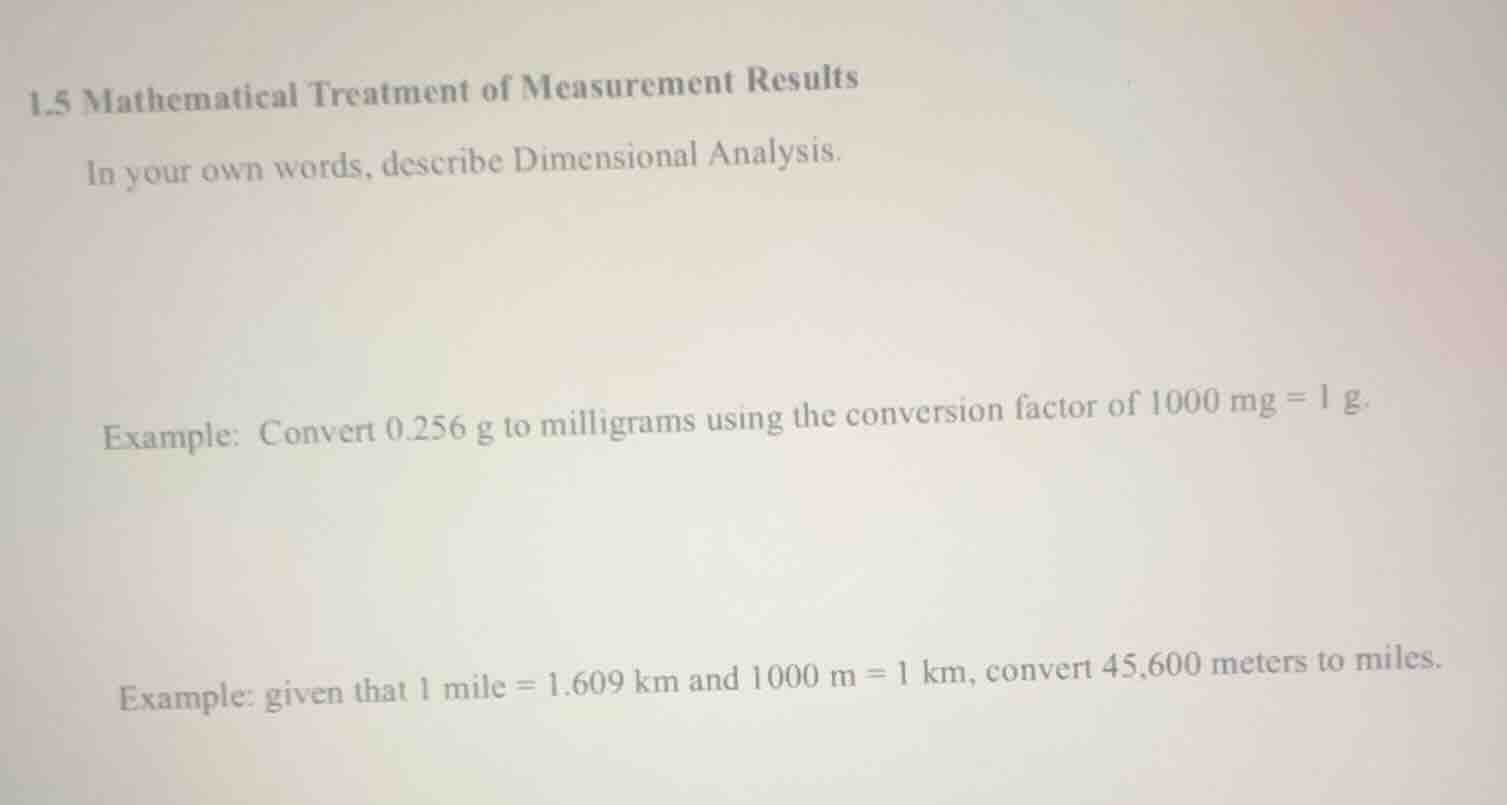
1.5 mathematical treatment of measurement results
in your own words, describe dimensional analysis.
example: convert 0.256 g to milligrams using the conversion factor of 1000 mg = 1 g.
example: given that 1 mile = 1.609 km and 1000 m = 1 km, convert 45,600 meters to miles.
Brief Explanations
- For the description: Dimensional analysis is a method that uses the units (dimensions) of physical quantities to check the validity of equations, convert between different units of measurement, and derive relationships between quantities by ensuring consistency of units throughout calculations.
- For the first conversion: Use the given conversion factor to cancel out grams and solve for milligrams.
- For the second conversion: First convert meters to kilometers, then convert kilometers to miles using the provided conversion factors, canceling out intermediate units step by step.
(for the conversion problems, Step-by-Step Format):
Step1: Convert g to mg
$0.256\ \text{g} \times \frac{1000\ \text{mg}}{1\ \text{g}}$
Step2: Calculate the result
$0.256 \times 1000 = 256$
Step3: Convert m to km
$45600\ \text{m} \times \frac{1\ \text{km}}{1000\ \text{m}} = 45.6\ \text{km}$
Step4: Convert km to miles
$45.6\ \text{km} \times \frac{1\ \text{mile}}{1.609\ \text{km}}$
Step5: Calculate the final value
$\frac{45.6}{1.609} \approx 28.34$

Snap & solve any problem in the app
Get step-by-step solutions on Sovi AI
Photo-based solutions with guided steps
Explore more problems and detailed explanations
- Dimensional Analysis: A practical method that leverages the units (dimensions) of measurements to convert between different unit systems, verify that equations make sense in terms of units, and derive quantitative relationships by ensuring unit consistency across all parts of a calculation.
- Converted mass: $256$ mg
- Converted distance: $\approx 28.34$ miles
---