QUESTION IMAGE
Question
2.
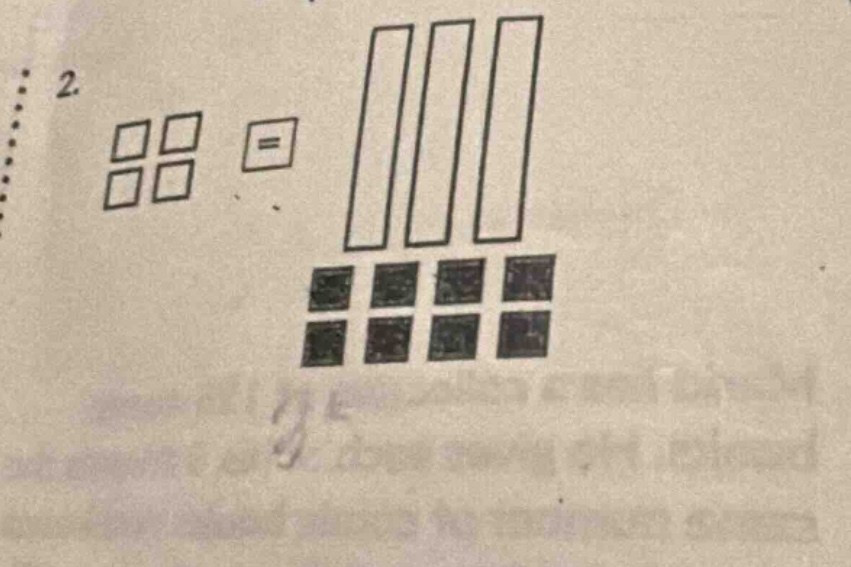
□□ = □□□
□□ □□□□
□□ □□□□
Step1: Analyze the left side
The left side has 4 small squares, so we can represent it as \( 4 \).
Step2: Analyze the right side
The right side has 3 long rectangles (let's assume each long rectangle represents \( y \)) and 8 small dark squares. So the right side can be represented as \( 3y + 8 \).
Step3: Set up the equation
Since the left side equals the right side, we have the equation:
\( 4 = 3y + 8 \)
Step4: Solve for \( y \)
Subtract 8 from both sides:
\( 4 - 8 = 3y \)
\( -4 = 3y \)
Divide both sides by 3:
\( y = -\frac{4}{3} \) Wait, that seems odd. Maybe I misinterpreted the diagram. Let's re - examine. Maybe the left side is 4 units and the right side is 3y + 8, but maybe the left side is equal to the right side in terms of area or quantity. Wait, maybe the left has 4 squares and the right has 3 rectangles (each of height y and width, say, 1) and 8 small squares. Maybe the area of the left (4 square units) equals the area of the right (3y + 8). But if we assume that the small square has side length 1, then the area of each small square is 1. The long rectangle: if the height is y and the width is, say, 2 (since there are 4 small squares in a row, maybe the width of the rectangle is 2 and height is y). Then the area of each long rectangle is \( 2y \), and there are 3 of them, so \( 6y \), plus 8 small squares (area 8). And the left side has 4 small squares (area 4). Then \( 4=6y + 8 \), which is also not right. Wait, maybe the diagram is about solving for \( y \) where the number of squares on the left (4) equals the number of rectangles times \( y \) plus the number of dark squares. Let's count the dark squares: there are 8 dark squares (2 rows of 4). The rectangles: 3 rectangles. The left has 4 light squares. So the equation is \( 4=3y + 8 \). Solving:
\( 3y=4 - 8=-4 \)
\( y =-\frac{4}{3} \). But this is a negative value, which might not make sense in a diagram about lengths. Maybe the left side is 4 and the right side is 3y - 8? Wait, maybe I got the sign wrong. If the dark squares are subtracted? Let's try again. Maybe the right side is 3y - 8, so \( 4 = 3y-8 \). Then \( 3y=4 + 8 = 12 \), so \( y = 4 \). Ah, that makes more sense. Maybe the dark squares are being subtracted. So re - setting the equation:
Left side: 4
Right side: 3y - 8 (maybe the rectangles are adding and the dark squares are subtracting)
Then \( 4=3y - 8 \)
Add 8 to both sides: \( 4 + 8=3y \)
\( 12 = 3y \)
Divide by 3: \( y = 4 \)

Snap & solve any problem in the app
Get step-by-step solutions on Sovi AI
Photo-based solutions with guided steps
Explore more problems and detailed explanations
\( y = 4 \) (assuming the correct equation is \( 4=3y - 8 \) based on the diagram's intended meaning)