QUESTION IMAGE
Question
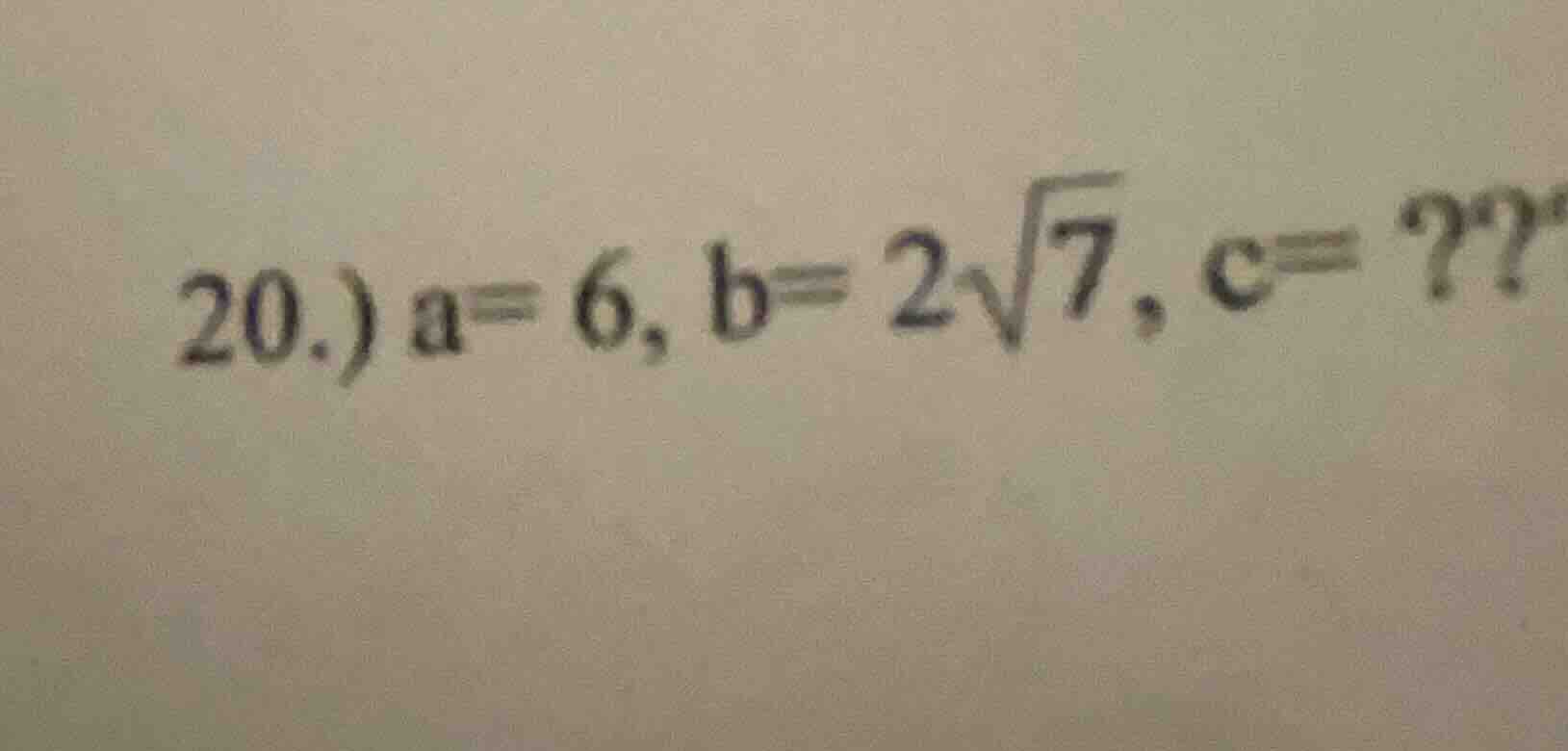
20.) a=6, b=2√7, c=??
Assuming this is a right - triangle problem where we use the Pythagorean theorem \(c^{2}=a^{2}+b^{2}\) (if \(c\) is the hypotenuse) or \(a^{2}=b^{2}+c^{2}\) (if \(a\) is the hypotenuse), we will first check which side is the hypotenuse. Since \(a = 6= \sqrt{36}\) and \(b = 2\sqrt{7}=\sqrt{28}\), and \(\sqrt{36}>\sqrt{28}\), so \(a\) is likely the hypotenuse. Then we use the formula \(a^{2}=b^{2}+c^{2}\), and we can transform it to \(c^{2}=a^{2}-b^{2}\) to find \(c\).
Step 1: Calculate \(a^{2}\) and \(b^{2}\)
We know that \(a = 6\), so \(a^{2}=6^{2}=36\).
We know that \(b = 2\sqrt{7}\), so \(b^{2}=(2\sqrt{7})^{2}=2^{2}\times(\sqrt{7})^{2}=4\times7 = 28\).
Step 2: Calculate \(c^{2}\)
Using the formula \(c^{2}=a^{2}-b^{2}\) (because \(a\) is the hypotenuse), we substitute the values of \(a^{2}\) and \(b^{2}\) we just calculated:
\(c^{2}=36 - 28=8\)
Step 3: Calculate \(c\)
Since \(c\) represents the length of a side of a triangle, \(c>0\). So we take the positive square root of \(c^{2}\):
\(c=\sqrt{8} = 2\sqrt{2}\)

Snap & solve any problem in the app
Get step-by-step solutions on Sovi AI
Photo-based solutions with guided steps
Explore more problems and detailed explanations
\(c = 2\sqrt{2}\) (If \(a\) is the hypotenuse) or if \(c\) is the hypotenuse, using \(c^{2}=a^{2}+b^{2}=36 + 28 = 64\), then \(c = 8\). Since \(a=6\) and \(b = 2\sqrt{7}\approx5.29\), \(a + b\approx6 + 5.29=11.29>8\), so \(c\) can't be the hypotenuse. So the correct value of \(c\) is \(2\sqrt{2}\))