QUESTION IMAGE
Question
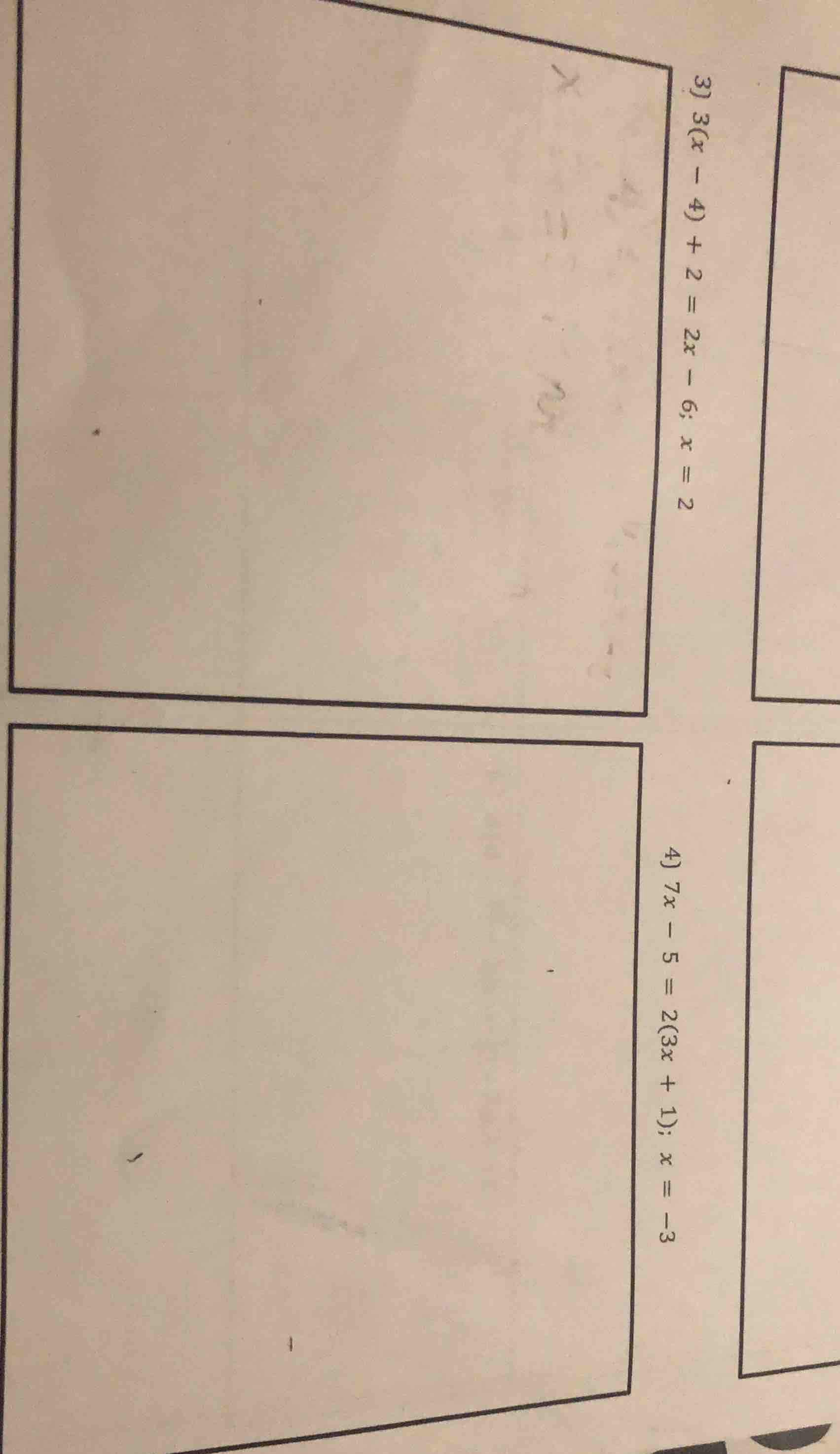
- $3(x - 4) + 2 = 2x - 6$; $x = 2$
- $7x - 5 = 2(3x + 1)$; $x = -3$
Problem 3: \( 3(x - 4)+2 = 2x - 6 \); \( x = 2 \)
Step 1: Substitute \( x = 2 \) into left - hand side (LHS)
Substitute \( x = 2 \) into \( 3(x - 4)+2 \). First, calculate the value inside the parentheses: \( 2-4=-2 \). Then multiply by 3: \( 3\times(-2)=-6 \). Then add 2: \( -6 + 2=-4 \).
Step 2: Substitute \( x = 2 \) into right - hand side (RHS)
Substitute \( x = 2 \) into \( 2x-6 \). Calculate \( 2\times2 = 4 \), then \( 4-6=-2 \). Wait, there is a mistake above. Let's re - do the substitution correctly.
Step 1 (Correct): Substitute \( x = 2 \) into LHS
For \( 3(x - 4)+2 \), when \( x = 2 \), we have \( 3\times(2 - 4)+2=3\times(-2)+2=-6 + 2=-4 \).
Step 2 (Correct): Substitute \( x = 2 \) into RHS
For \( 2x-6 \), when \( x = 2 \), we have \( 2\times2-6 = 4 - 6=-2 \). Wait, this shows a miscalculation. Let's solve the equation properly.
Step 1: Expand the left - hand side
Expand \( 3(x - 4)+2 \): Using the distributive property \( a(b + c)=ab+ac \), we get \( 3x-12 + 2=3x-10 \).
Step 2: Solve the equation \( 3x-10=2x - 6 \)
Subtract \( 2x \) from both sides: \( 3x-2x-10=2x-2x - 6 \), which simplifies to \( x-10=-6 \).
Then add 10 to both sides: \( x-10 + 10=-6 + 10 \), so \( x = 4 \). But if we check \( x = 2 \):
LHS: \( 3\times(2 - 4)+2=3\times(-2)+2=-6 + 2=-4 \)
RHS: \( 2\times2-6=4 - 6=-2 \)
Since \( -4
eq-2 \), \( x = 2 \) is not a solution. Wait, maybe the original problem is to verify if \( x = 2 \) is a solution. Let's do that again.
LHS: \( 3(2 - 4)+2=3\times(-2)+2=-6 + 2=-4 \)
RHS: \( 2\times2-6=4 - 6=-2 \)
Since \( -4
eq-2 \), \( x = 2 \) is not a solution. But if we solve the equation \( 3(x - 4)+2=2x - 6 \):
Expand LHS: \( 3x-12 + 2=3x-10 \)
Set equal to RHS: \( 3x-10=2x - 6 \)
Subtract \( 2x \) from both sides: \( x-10=-6 \)
Add 10 to both sides: \( x = 4 \)
Problem 4: \( 7x-5 = 2(3x + 1) \); \( x=-3 \)
Step 1: Substitute \( x=-3 \) into LHS
Substitute \( x = - 3 \) into \( 7x-5 \). Calculate \( 7\times(-3)-5=-21-5=-26 \).
Step 2: Substitute \( x=-3 \) into RHS
First, expand \( 2(3x + 1)=6x + 2 \). Then substitute \( x=-3 \): \( 6\times(-3)+2=-18 + 2=-16 \). Wait, let's solve the equation properly.
Step 1: Expand the right - hand side
Expand \( 2(3x + 1) \) to get \( 6x+2 \). The equation becomes \( 7x-5=6x + 2 \).
Step 2: Solve for \( x \)
Subtract \( 6x \) from both sides: \( 7x-6x-5=6x-6x + 2 \), which simplifies to \( x-5=2 \).
Then add 5 to both sides: \( x-5 + 5=2 + 5 \), so \( x = 7 \).
Now, check \( x=-3 \):
LHS: \( 7\times(-3)-5=-21-5=-26 \)
RHS: \( 2\times(3\times(-3)+1)=2\times(-9 + 1)=2\times(-8)=-16 \)
Since \( -26
eq-16 \), \( x=-3 \) is not a solution.
(If the problem is to verify the solutions):
For problem 3, \( x = 2 \) is not a solution. The correct solution is \( x = 4 \).
For problem 4, \( x=-3 \) is not a solution. The correct solution is \( x = 7 \).
(If the problem is to solve the equations):
Solution for \( 3(x - 4)+2 = 2x - 6 \)
Step 1: Expand the left - hand side
Using the distributive property \( a(b - c)=ab-ac \), \( 3(x - 4)+2=3x-12 + 2=3x-10 \).
Step 2: Solve the linear equation
We have the equation \( 3x-10=2x - 6 \). Subtract \( 2x \) from both sides: \( 3x-2x-10=2x-2x - 6 \), which gives \( x-10=-6 \). Then add 10 to both sides: \( x-10 + 10=-6 + 10 \), so \( x = 4 \).

Snap & solve any problem in the app
Get step-by-step solutions on Sovi AI
Photo-based solutions with guided steps
Explore more problems and detailed explanations
\( x = 4 \)