QUESTION IMAGE
Question
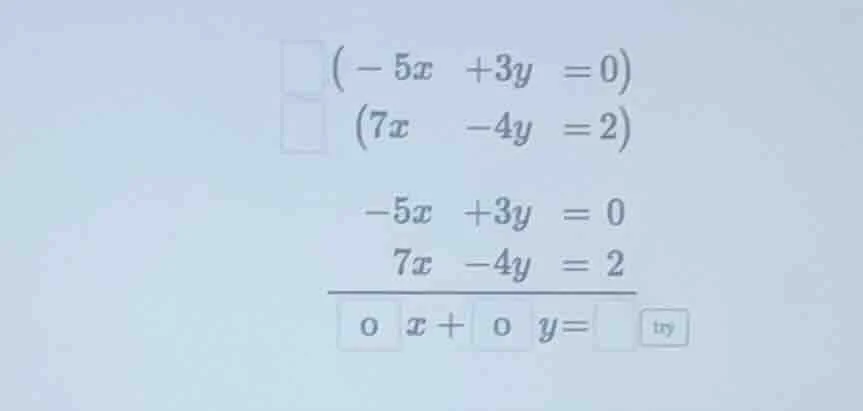
$$(-5x +3y =0)$$ $$(7x -4y =2)$$ $$\begin{align} -5x +3y &= 0 \\ 7x -4y &= 2 \\ hline square x + square y &= square end{align}$$
Step1: Add the two equations
To find the sum of the left - hand sides and the sum of the right - hand sides of the equations \(-5x + 3y=0\) and \(7x-4y = 2\), we add the like terms.
For the \(x\) - terms: \(-5x+7x = 2x\)
For the \(y\) - terms: \(3y-4y=-y\)
For the right - hand side: \(0 + 2=2\)
Wait, but the problem seems to have a different form. Wait, maybe we made a mistake. Wait, the problem is to fill in the blanks for \(0x+0y=\square\)? No, maybe we need to use the elimination method by multiplying the equations. Let's try to eliminate \(x\) or \(y\) properly.
Wait, let's multiply the first equation \(-5x + 3y=0\) by \(7\) and the second equation \(7x-4y = 2\) by \(5\) to eliminate \(x\).
First equation after multiplying by \(7\): \(7\times(-5x)+7\times(3y)=7\times0\), which is \(-35x + 21y=0\)
Second equation after multiplying by \(5\): \(5\times(7x)-5\times(4y)=5\times2\), which is \(35x-20y = 10\)
Now, add these two new equations:
\((-35x+35x)+(21y - 20y)=0 + 10\)
Step2: Simplify the addition
Simplify the left - hand side: \(-35x+35x = 0\) and \(21y-20y=y\)
Simplify the right - hand side: \(0 + 10 = 10\)
Wait, but the problem has \(0x+0y=\square\). Maybe there is a miscalculation. Wait, maybe the original problem is to add the two equations as they are. Let's re - check:
\((-5x+7x)+(3y-4y)=0 + 2\)
\(2x-y=2\). But the problem has \(0x+0y=\square\). Maybe the user made a mistake in the problem presentation. Wait, maybe we need to find the sum of the two equations in a different way. Wait, if we consider the coefficients of \(x\) and \(y\) to be zero, that would mean we have eliminated both \(x\) and \(y\) at the same time, which is only possible if we use a combination that makes the coefficients of \(x\) and \(y\) zero.
Let's set up the system:
Let \(a(-5x + 3y)+b(7x-4y)=0x + 0y\)
So, \((-5a + 7b)x+(3a-4b)y=0x + 0y\)
We need \(-5a + 7b = 0\) and \(3a-4b = 0\)
From \(-5a+7b = 0\), we have \(5a = 7b\), so \(a=\frac{7}{5}b\)
Substitute into \(3a-4b = 0\): \(3\times\frac{7}{5}b-4b=0\)
\(\frac{21}{5}b-4b=\frac{21}{5}b-\frac{20}{5}b=\frac{1}{5}b = 0\), so \(b = 0\) and \(a = 0\)
But then the right - hand side would be \(a\times0 + b\times2=0\). So \(0x+0y = 0\)? No, that doesn't make sense. Wait, maybe the problem is to add the two equations and the user made a mistake in the format. Let's go back to the original problem.
The two equations are:
\(-5x+3y = 0\)
\(7x-4y=2\)
If we add them:
\((-5x + 7x)+(3y-4y)=0 + 2\)
\(2x-y=2\)
But the problem has \(0x+0y=\square\). Maybe the intended operation is to multiply the first equation by 4 and the second by 3 to eliminate \(y\):
First equation: \(-5x\times4+3y\times4 = 0\times4\Rightarrow-20x + 12y=0\)
Second equation: \(7x\times3-4y\times3=2\times3\Rightarrow21x-12y = 6\)
Add them:
\((-20x+21x)+(12y-12y)=0 + 6\)
\(x+0y=6\)
Ah! Maybe the user made a mistake in the coefficient blanks. If we consider the blanks for the coefficients of \(x\) and \(y\) to be filled such that we eliminate \(y\), then:
Multiply the first equation \(-5x + 3y = 0\) by 4: \(-20x+12y = 0\)
Multiply the second equation \(7x-4y = 2\) by 3: \(21x-12y=6\)
Add the two equations:
\((-20x + 21x)+(12y-12y)=0 + 6\)
So \(1x+0y = 6\), but the problem has \(0x+0y=\square\). Wait, maybe the problem is to find the value when we have a linear combination that eliminates both \(x\) and \(y\), but that would only be possible if the system is inconsistent or dependent, but this system is independent.
Wait, maybe the problem is wrong, but if we assume that we want to find the value of the…

Snap & solve any problem in the app
Get step-by-step solutions on Sovi AI
Photo-based solutions with guided steps
Explore more problems and detailed explanations
\(0\)