QUESTION IMAGE
Question
solve.
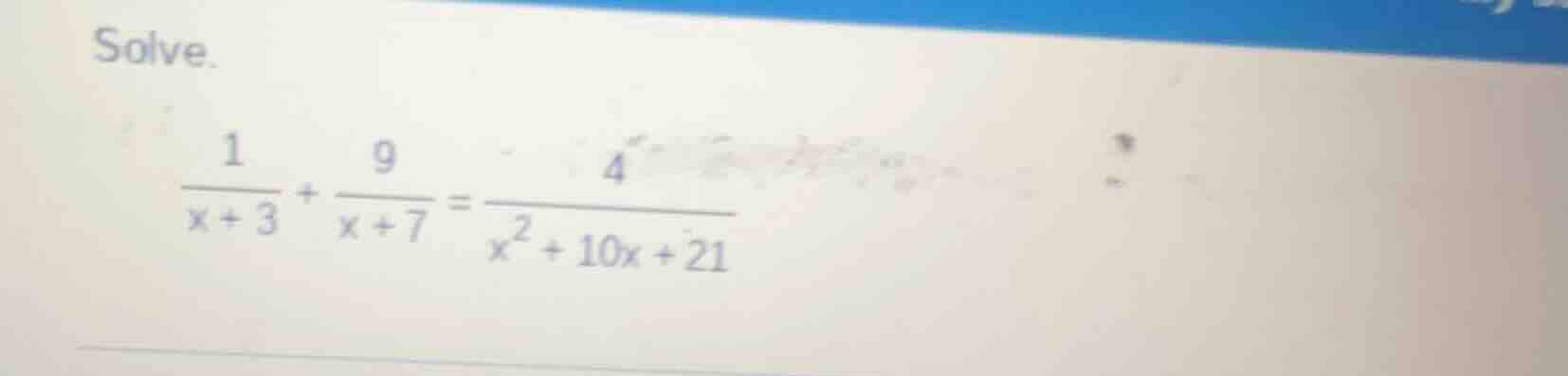
\\(\frac{1}{x + 3} + \frac{9}{x + 7} = \frac{4}{x^2 + 10x + 21}\\)
Step1: Factor the denominator
First, factor the quadratic denominator \(x^2 + 10x + 21\). We know that \(x^2 + 10x + 21=(x + 3)(x + 7)\) since \(3\times7 = 21\) and \(3 + 7 = 10\). So the equation becomes \(\frac{1}{x + 3}+\frac{9}{x + 7}=\frac{4}{(x + 3)(x + 7)}\).
Step2: Multiply through by the LCD
The least common denominator (LCD) of the fractions is \((x + 3)(x + 7)\). Multiply each term by \((x + 3)(x + 7)\) to eliminate the denominators:
\[
\]
Step3: Simplify and solve for x
Expand the left - hand side: \(x+7 + 9x+27 = 4\).
Combine like terms: \(10x+34 = 4\).
Subtract 34 from both sides: \(10x=4 - 34=-30\).
Divide both sides by 10: \(x=\frac{-30}{10}=-3\).
Step4: Check for extraneous solutions
We need to check if \(x = - 3\) makes the original denominators zero. When \(x=-3\), the denominators \(x + 3=-3 + 3 = 0\) and \(x^2+10x + 21=(-3)^2+10\times(-3)+21=9-30 + 21 = 0\). So \(x=-3\) is an extraneous solution.
Let's go back to the equation after multiplying by the LCD. We had \((x + 7)+9(x + 3)=4\). Let's re - solve it carefully.
Expand: \(x + 7+9x + 27=4\)
Combine like terms: \(10x+34 = 4\)
\(10x=4 - 34=-30\)
\(x=-3\). But since \(x=-3\) makes the original denominators zero, we check if we made a mistake in the algebra. Wait, let's re - examine the step of multiplying by the LCD.
Wait, when we multiply \(\frac{1}{x + 3}\times(x + 3)(x + 7)\) we get \((x + 7)\), \(\frac{9}{x + 7}\times(x + 3)(x + 7)\) we get \(9(x + 3)\), and \(\frac{4}{(x + 3)(x + 7)}\times(x + 3)(x + 7)\) we get 4. So the equation after multiplying is correct. But since \(x=-3\) is not in the domain of the original function (because it makes the denominators \(x + 3\) and \(x^2+10x + 21\) zero), we need to check if there was an error in the solving process.
Wait, let's start over.
Original equation: \(\frac{1}{x + 3}+\frac{9}{x + 7}=\frac{4}{(x + 3)(x + 7)}\)
Multiply both sides by \((x + 3)(x + 7)\) (\(x
eq - 3,x
eq - 7\)):
\((x + 7)+9(x + 3)=4\)
\(x+7 + 9x+27 = 4\)
\(10x+34 = 4\)
\(10x=-30\)
\(x=-3\)
But \(x=-3\) is excluded from the domain (because \(x+3 = 0\) when \(x=-3\)), so there is no solution? Wait, that can't be right. Wait, maybe I made a mistake in the sign when moving terms. Let's check the arithmetic again.
\(x+7+9x + 27=4\)
\((x + 9x)+(7 + 27)=4\)
\(10x+34 = 4\)
\(10x=4 - 34=-30\)
\(x=-3\). So since \(x=-3\) is not in the domain, the equation has no solution. But wait, maybe I made a mistake in the problem - solving. Let's check with another approach.
Let's combine the left - hand side: \(\frac{1\times(x + 7)+9\times(x + 3)}{(x + 3)(x + 7)}=\frac{4}{(x + 3)(x + 7)}\)
Since the denominators are the same (for \(x
eq - 3,x
eq - 7\)), we can set the numerators equal:
\(x + 7+9x + 3\times9=4\)
\(x + 7+9x+27 = 4\)
\(10x+34 = 4\)
\(10x=-30\)
\(x=-3\)
But \(x=-3\) is not in the domain, so the equation has no solution.
Wait, but maybe I made a mistake in the sign when expanding \(9(x + 3)\). \(9(x + 3)=9x + 27\), which is correct. And \(x + 7+9x+27=10x + 34\), which is correct. Then \(10x+34 = 4\) gives \(10x=-30\), \(x=-3\). Since \(x=-3\) is not in the domain, the solution set is empty.

Snap & solve any problem in the app
Get step-by-step solutions on Sovi AI
Photo-based solutions with guided steps
Explore more problems and detailed explanations
No solution (or \(\boxed{\text{No solution}}\))