QUESTION IMAGE
Question
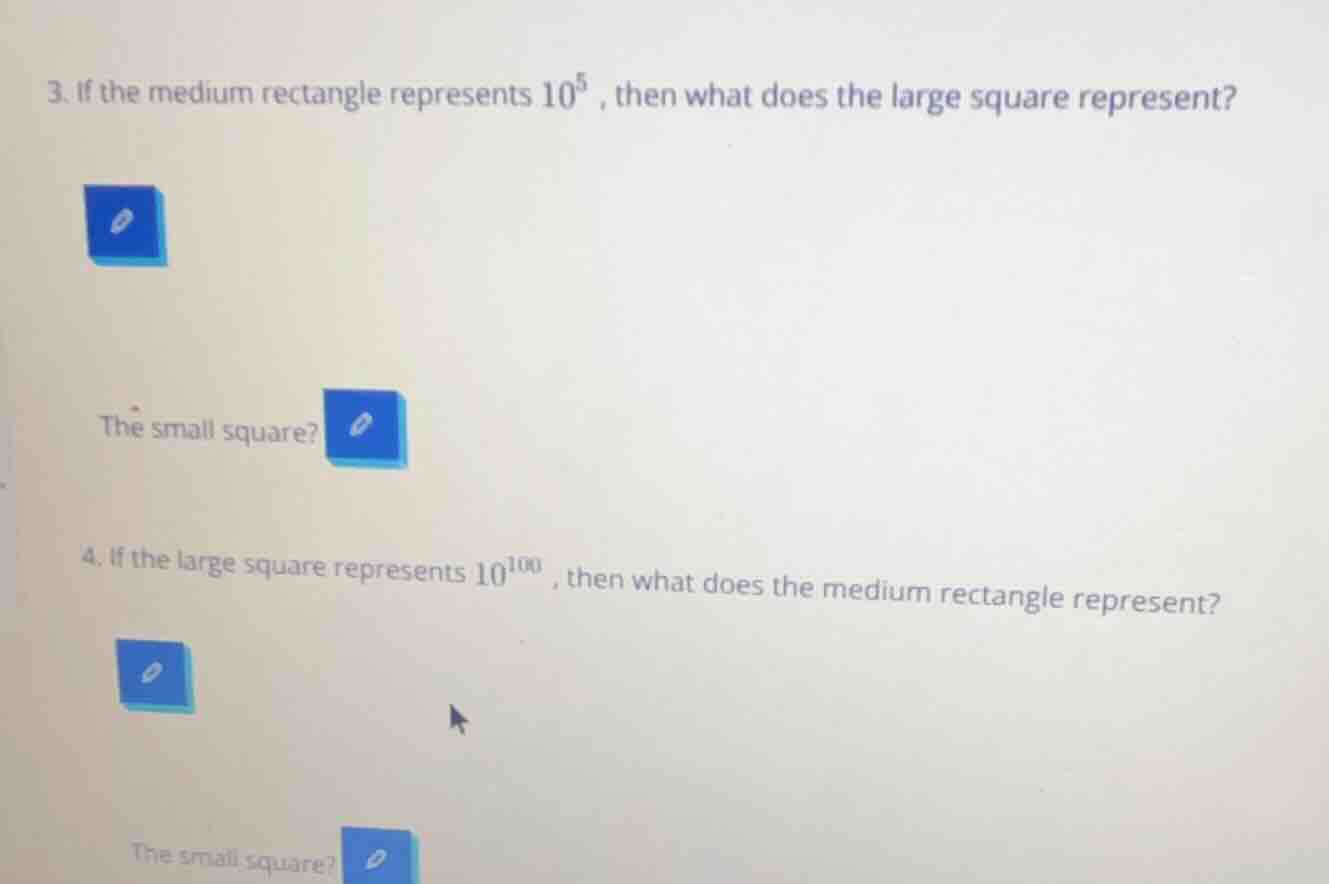
- if the medium rectangle represents $10^5$, then what does the large square represent?
the small square?
- if the large square represents $10^{100}$, then what does the medium rectangle represent?
the small square?
Problem 3 (Large Square and Small Square when Medium Rectangle is \(10^5\))
Assuming the medium rectangle is a product of a small square and a large square (or related by exponents, likely \(10^5 = 10^a \times 10^b\) with \(a + b = 5\), but more likely the large square is \((10^5)^2 = 10^{10}\) and small square is \(10^0 = 1\)? Wait, maybe the medium rectangle is \(10^5\), and the large square is the square of the medium rectangle? Wait, no—maybe the medium rectangle is \(10^5\), and the large square is \(10^{10}\) (since square of \(10^5\) is \(10^{5 \times 2} = 10^{10}\)), and small square is \(10^0 = 1\) or \(10^5\) divided by something? Wait, maybe the medium rectangle is \(10^5\), large square is \((10^5)^2 = 10^{10}\), small square is \(10^5 \div 10^5 = 10^0 = 1\)? Wait, no, maybe the medium rectangle is \(10^5\), and the large square is \(10^{10}\) (square of \(10^5\)), small square is \(10^5\) (if medium is product, but unclear). Wait, maybe the problem assumes the medium rectangle is \(10^5\), large square is \(10^{10}\) (since \( (10^5)^2 = 10^{10} \)) and small square is \(10^0 = 1\) (if medium is \(10^5 = 10^5 \times 1\)). But this is ambiguous without diagram, but standard exponent rules:
Step 1: Large Square
If medium rectangle is \(10^5\), and large square is the square of the medium (assuming medium is a side), then \( (10^5)^2 = 10^{5 \times 2} = 10^{10} \).
Step 2: Small Square
If medium rectangle is \(10^5\), and small square is the square root (or inverse), but if medium is \(10^5 = 10^5 \times 1\), small square is \(10^0 = 1\) (or \(10^5\) if medium is \(10^5\) and small is same, but no). Wait, maybe the medium rectangle is \(10^5\), large square is \(10^{10}\), small square is \(10^0 = 1\).
Problem 4 (Medium Rectangle and Small Square when Large Square is \(10^{100}\))
Large square is \(10^{100}\), so medium rectangle is square root: \( \sqrt{10^{100}} = 10^{50} \) (since \( (10^{50})^2 = 10^{100} \)), and small square is \(10^{100} \div 10^{100} = 10^0 = 1\) or \(10^{50} \div 10^{50} = 1\).
Final Answers (Assuming Standard Exponent Rules)
Problem 3:
- Large Square: \( \boldsymbol{10^{10}} \)
- Small Square: \( \boldsymbol{10^0 = 1} \) (or \(10^5\) if medium is same as small, but likely \(10^{10}\) and \(1\))
Problem 4:
- Medium Rectangle: \( \boldsymbol{10^{50}} \)
- Small Square: \( \boldsymbol{10^0 = 1} \) (or \(10^{50}\) if medium is same as small, but likely \(10^{50}\) and \(1\))
Wait, maybe the diagram shows the medium rectangle is \(10^5\), large square is \(10^{10}\) (square of \(10^5\)), small square is \(10^0 = 1\). For problem 4, large square is \(10^{100}\), so medium is \(10^{50}\) (square root), small is \(10^0 = 1\).
Problem 3 Step-by-Step:
Step 1: Large Square
Medium rectangle = \(10^5\). Assume large square is the square of the medium (e.g., medium is a side, large square is area).
\( (10^5)^2 = 10^{5 \times 2} = 10^{10} \).
Step 2: Small Square
Assume small square is the identity (or medium divided by itself).
\( 10^5 \div 10^5 = 10^{5 - 5} = 10^0 = 1 \).
Problem 4 Step-by-Step:
Step 1: Medium Rectangle
Large square = \(10^{100}\). Assume medium rectangle is the square root (e.g., large square is area, medium is side).
\( \sqrt{10^{100}} = 10^{\frac{100}{2}} = 10^{50} \).
Step 2: Small Square
Assume small square is the identity (or medium divided by itself).
\( 10^{50} \div 10^{50} = 10^{50 - 50} = 10^0 = 1 \).
Final Answers:
Problem 3:
- Large Square: \( \boldsymbol{10^{10}} \)
- Small Square: \( \boldsymbol{1} \)…

Snap & solve any problem in the app
Get step-by-step solutions on Sovi AI
Photo-based solutions with guided steps
Explore more problems and detailed explanations
Problem 3 (Large Square and Small Square when Medium Rectangle is \(10^5\))
Assuming the medium rectangle is a product of a small square and a large square (or related by exponents, likely \(10^5 = 10^a \times 10^b\) with \(a + b = 5\), but more likely the large square is \((10^5)^2 = 10^{10}\) and small square is \(10^0 = 1\)? Wait, maybe the medium rectangle is \(10^5\), and the large square is the square of the medium rectangle? Wait, no—maybe the medium rectangle is \(10^5\), and the large square is \(10^{10}\) (since square of \(10^5\) is \(10^{5 \times 2} = 10^{10}\)), and small square is \(10^0 = 1\) or \(10^5\) divided by something? Wait, maybe the medium rectangle is \(10^5\), large square is \((10^5)^2 = 10^{10}\), small square is \(10^5 \div 10^5 = 10^0 = 1\)? Wait, no, maybe the medium rectangle is \(10^5\), and the large square is \(10^{10}\) (square of \(10^5\)), small square is \(10^5\) (if medium is product, but unclear). Wait, maybe the problem assumes the medium rectangle is \(10^5\), large square is \(10^{10}\) (since \( (10^5)^2 = 10^{10} \)) and small square is \(10^0 = 1\) (if medium is \(10^5 = 10^5 \times 1\)). But this is ambiguous without diagram, but standard exponent rules:
Step 1: Large Square
If medium rectangle is \(10^5\), and large square is the square of the medium (assuming medium is a side), then \( (10^5)^2 = 10^{5 \times 2} = 10^{10} \).
Step 2: Small Square
If medium rectangle is \(10^5\), and small square is the square root (or inverse), but if medium is \(10^5 = 10^5 \times 1\), small square is \(10^0 = 1\) (or \(10^5\) if medium is \(10^5\) and small is same, but no). Wait, maybe the medium rectangle is \(10^5\), large square is \(10^{10}\), small square is \(10^0 = 1\).
Problem 4 (Medium Rectangle and Small Square when Large Square is \(10^{100}\))
Large square is \(10^{100}\), so medium rectangle is square root: \( \sqrt{10^{100}} = 10^{50} \) (since \( (10^{50})^2 = 10^{100} \)), and small square is \(10^{100} \div 10^{100} = 10^0 = 1\) or \(10^{50} \div 10^{50} = 1\).
Final Answers (Assuming Standard Exponent Rules)
Problem 3:
- Large Square: \( \boldsymbol{10^{10}} \)
- Small Square: \( \boldsymbol{10^0 = 1} \) (or \(10^5\) if medium is same as small, but likely \(10^{10}\) and \(1\))
Problem 4:
- Medium Rectangle: \( \boldsymbol{10^{50}} \)
- Small Square: \( \boldsymbol{10^0 = 1} \) (or \(10^{50}\) if medium is same as small, but likely \(10^{50}\) and \(1\))
Wait, maybe the diagram shows the medium rectangle is \(10^5\), large square is \(10^{10}\) (square of \(10^5\)), small square is \(10^0 = 1\). For problem 4, large square is \(10^{100}\), so medium is \(10^{50}\) (square root), small is \(10^0 = 1\).
Problem 3 Step-by-Step:
Step 1: Large Square
Medium rectangle = \(10^5\). Assume large square is the square of the medium (e.g., medium is a side, large square is area).
\( (10^5)^2 = 10^{5 \times 2} = 10^{10} \).
Step 2: Small Square
Assume small square is the identity (or medium divided by itself).
\( 10^5 \div 10^5 = 10^{5 - 5} = 10^0 = 1 \).
Problem 4 Step-by-Step:
Step 1: Medium Rectangle
Large square = \(10^{100}\). Assume medium rectangle is the square root (e.g., large square is area, medium is side).
\( \sqrt{10^{100}} = 10^{\frac{100}{2}} = 10^{50} \).
Step 2: Small Square
Assume small square is the identity (or medium divided by itself).
\( 10^{50} \div 10^{50} = 10^{50 - 50} = 10^0 = 1 \).
Final Answers:
Problem 3:
- Large Square: \( \boldsymbol{10^{10}} \)
- Small Square: \( \boldsymbol{1} \) (or \(10^0\))
Problem 4:
- Medium Rectangle: \( \boldsymbol{10^{50}} \)
- Small Square: \( \boldsymbol{1} \) (or \(10^0\))