QUESTION IMAGE
Question
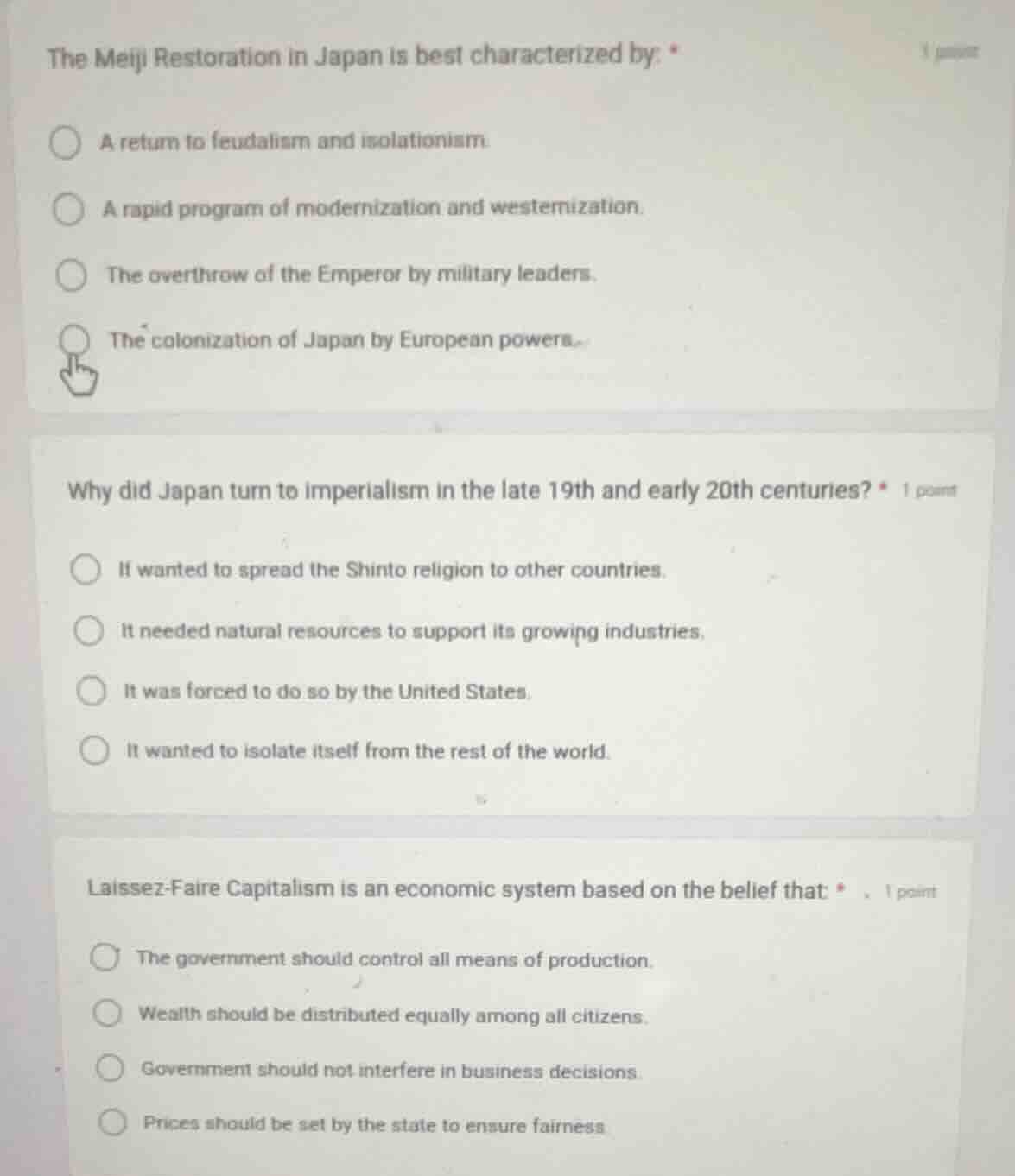
the meiji restoration in japan is best characterized by:
a return to feudalism and isolationism.
a rapid program of modernization and westernization.
the overthrow of the emperor by military leaders.
the colonization of japan by european powers.
why did japan turn to imperialism in the late 19th and early 20th centuries?
it wanted to spread the shinto religion to other countries.
it needed natural resources to support its growing industries.
it was forced to do so by the united states.
it wanted to isolate itself from the rest of the world.
laissez - faire capitalism is an economic system based on the belief that:
the government should control all means of production.
wealth should be distributed equally among all citizens.
government should not interfere in business decisions.
prices should be set by the state to ensure fairness
First Question (The Meiji Restoration in Japan is best characterized by):
- Option A: The Meiji Restoration moved Japan away from feudalism, so this is incorrect.
- Option B: The Meiji Restoration involved Japan rapidly modernizing and adopting Western ideas, technologies, and institutions, so this is correct.
- Option C: The Emperor's power was restored (and modernized), not overthrown, so this is incorrect.
- Option D: Japan was not colonized by European powers; it was more about self - modernization to avoid colonization, so this is incorrect.
- Option A: Spreading Shinto was not the main driver of Japanese imperialism; economic and strategic factors were more important.
- Option B: After modernization, Japan's industries needed natural resources (like raw materials) that it lacked domestically, so imperialism was a way to secure these resources, so this is correct.
- Option C: The US forced Japan to open up earlier (via Perry), but did not force it to be imperialistic. Japan's imperialism was self - driven.
- Option D: Japan was moving towards engagement with the world, not isolation, during this period.
- Option A: Government control of production is more associated with socialism/communism, not laissez - faire.
- Option B: Equal wealth distribution is a socialist ideal, not part of laissez - faire capitalism.
- Option C: Laissez - faire capitalism is based on the idea of minimal government intervention in business, letting the market operate freely, so this is correct.
- Option D: State - set prices are more in line with planned economies, not laissez - faire.

Snap & solve any problem in the app
Get step-by-step solutions on Sovi AI
Photo-based solutions with guided steps
Explore more problems and detailed explanations
B. A rapid program of modernization and westernization.