QUESTION IMAGE
Question
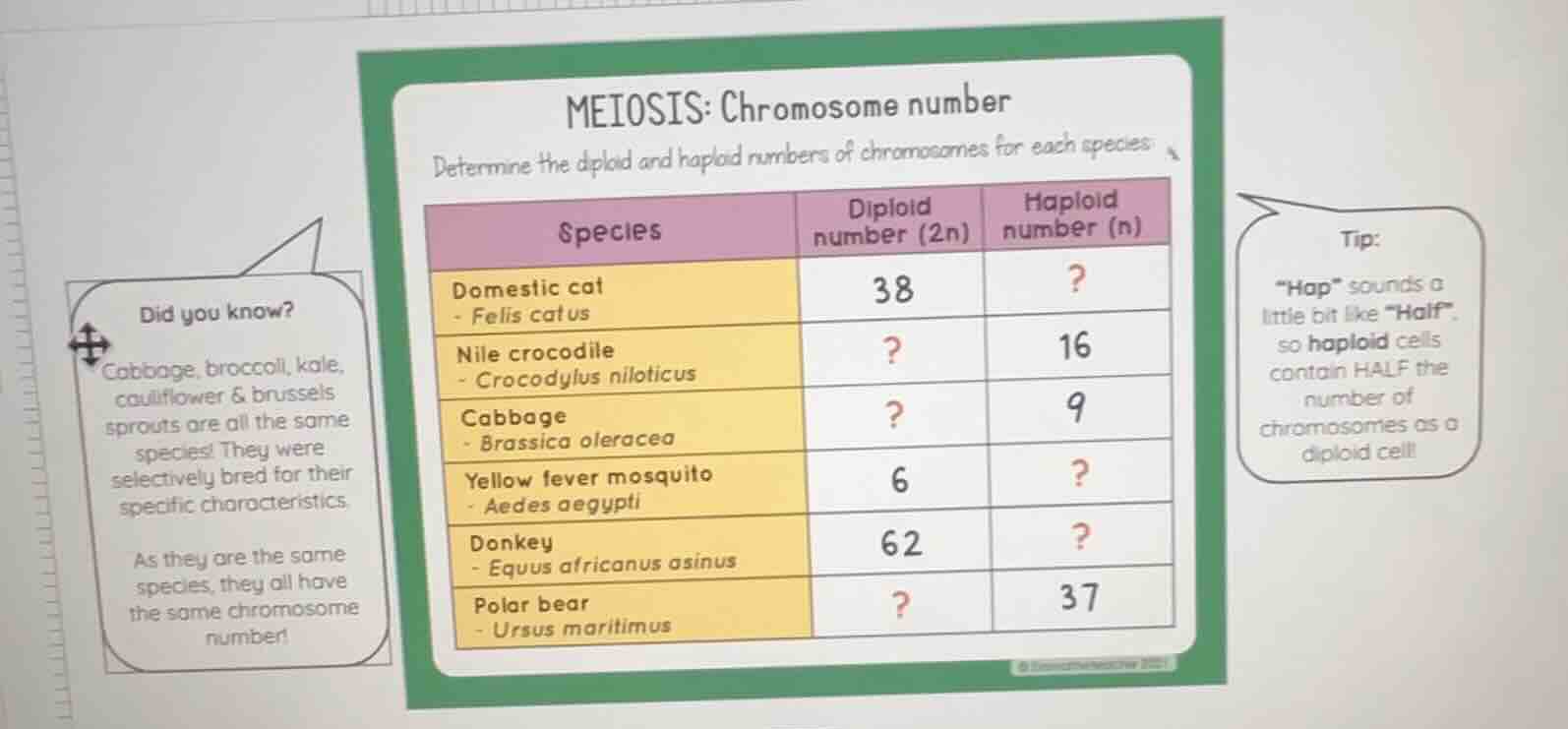
meiosis: chromosome number
determine the diploid and haploid numbers of chromosomes for each species:
| species | diploid number (2n) | haploid number (n) | ---- | ---- | ---- | domestic cat - felis catus | 38 | ? | nile crocodile - crocodylus niloticus | ? | 16 | cabbage - brassica oleracea | ? | 9 | yellow fever mosquito - aedes aegypti | 6 | ? | donkey - equus africanus asinus | 62 | ? | polar bear - ursus maritimus | ? | 37 | did you know?cabbage, broccoli, kale, cauliflower & brussels sprouts are all the same species! they were selectively bred for their specific characteristics.as they are the same species, they all have the same chromosome number!tip:\hap\ sounds a little bit like \half\, so haploid cells contain half the number of chromosomes as a diploid cell |
Step1: Recall ploidy relationship
The key relationship is: $n = \frac{2n}{2}$ and $2n = 2 \times n$, where $2n$ = diploid number, $n$ = haploid number.
Step2: Solve for Domestic cat haploid
Divide diploid by 2.
$n = \frac{38}{2} = 19$
Step3: Solve for Nile crocodile diploid
Multiply haploid by 2.
$2n = 2 \times 16 = 32$
Step4: Solve for Cabbage diploid
Multiply haploid by 2.
$2n = 2 \times 9 = 18$
Step5: Solve for Yellow fever mosquito haploid
Divide diploid by 2.
$n = \frac{6}{2} = 3$
Step6: Solve for Donkey haploid
Divide diploid by 2.
$n = \frac{62}{2} = 31$
Step7: Solve for Polar bear diploid
Multiply haploid by 2.
$2n = 2 \times 37 = 74$

Snap & solve any problem in the app
Get step-by-step solutions on Sovi AI
Photo-based solutions with guided steps
Explore more problems and detailed explanations
| Species | Diploid number (2n) | Haploid number (n) |
|---|---|---|
| Nile crocodile - Crocodylus niloticus | 32 | 16 |
| Cabbage - Brassica oleracea | 18 | 9 |
| Yellow fever mosquito - Aedes aegypti | 6 | 3 |
| Donkey - Equus africanus asinus | 62 | 31 |
| Polar bear - Ursus maritimus | 74 | 37 |