QUESTION IMAGE
Question
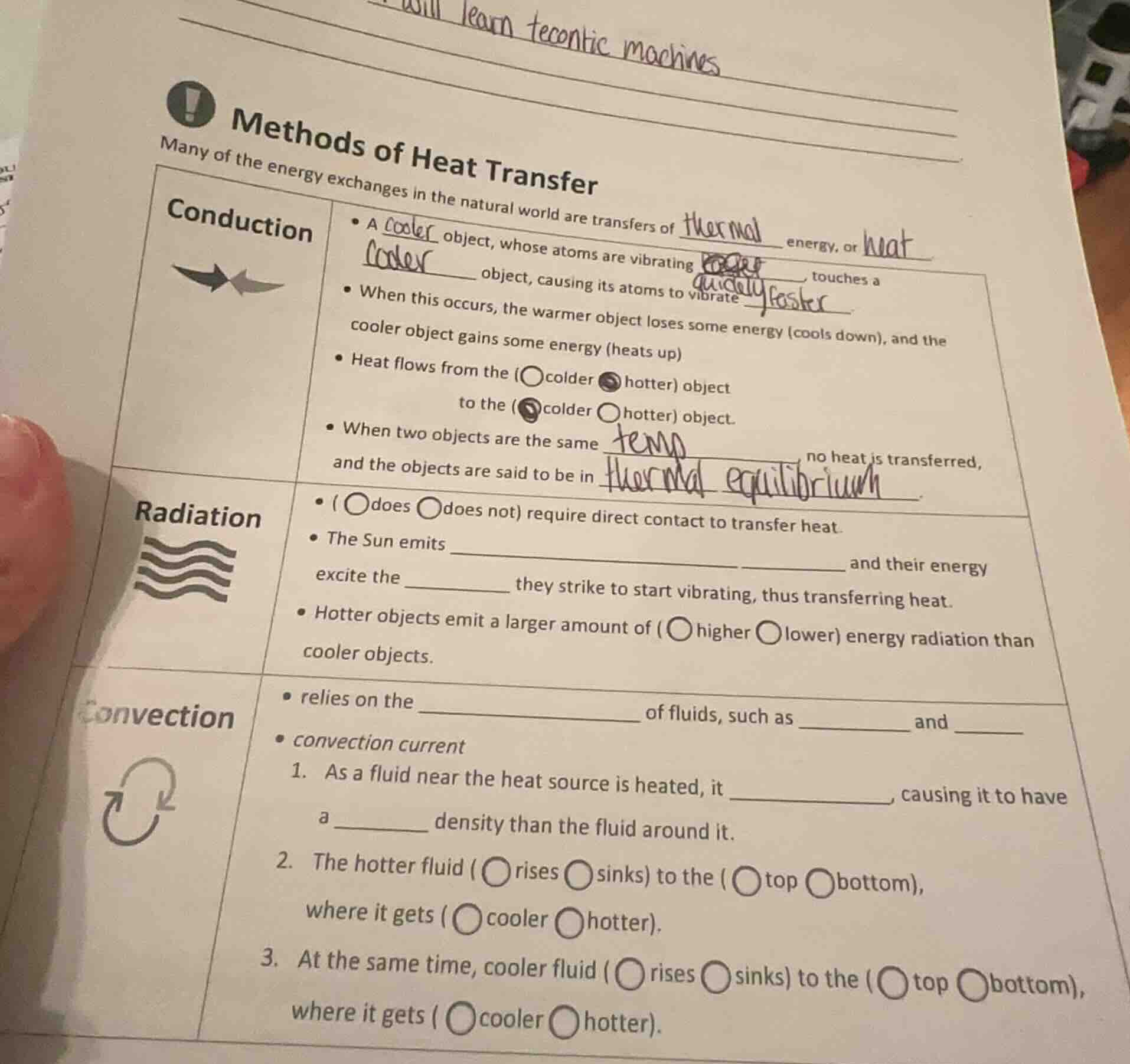
methods of heat transfer
many of the energy exchanges in the natural world are transfers of ____ energy, or ____
conduction
- a ____ object, whose atoms are vibrating __, touches a __ object, causing its atoms to vibrate ____.
- when this occurs, the warmer object loses some energy (cools down), and the cooler object gains some energy (heats up)
- heat flows from the (○colder ●hotter) object to the (●colder ○hotter) object.
- when two objects are the same ____ no heat is transferred, and the objects are said to be in ____.
radiation
- ( ○does ○does not) require direct contact to transfer heat.
- the sun emits ____ __ and their energy excite the ____ they strike to start vibrating, thus transferring heat.
- hotter objects emit a larger amount of (○higher ○lower) energy radiation than cooler objects.
convection
- relies on the ____ of fluids, such as __ and ____
- convection current
- as a fluid near the heat source is heated, it ____, causing it to have a ____ density than the fluid around it.
- the hotter fluid (○rises ○sinks) to the (○top ○bottom), where it gets (○cooler ○hotter).
- at the same time, cooler fluid (○rises ○sinks) to the (○top ○bottom), where it gets (○cooler ○hotter).
Response
To solve the fill - in - the - blanks related to heat transfer methods, we analyze each section based on the principles of heat transfer:
Conduction Section
- The first two blanks: In the natural world, many energy exchanges are transfers of thermal energy, or heat. This is the basic definition of heat transfer, where thermal energy (heat) is transferred between objects.
- For the next blanks: A warmer object (with atoms vibrating more vigorously) touches a cooler object. When this happens, the atoms of the cooler object start to vibrate faster as heat is transferred from the warmer to the cooler object.
- Regarding the direction of heat flow: Heat flows from the hotter object to the colder object. This is a fundamental principle of heat conduction - heat moves from a region of higher temperature to lower temperature.
- When two objects have the same temperature, no heat is transferred, and they are in thermal equilibrium. Thermal equilibrium is the state where there is no net heat transfer between two objects.
Radiation Section
- The first blank: Radiation does not require direct contact to transfer heat. Unlike conduction (which needs direct contact) and convection (which needs a fluid medium), radiation can transfer heat through empty space.
- The Sun emits electromagnetic waves (specifically, infrared radiation among others), and these waves excite the atoms of the objects they strike. The energy of the electromagnetic waves makes the atoms vibrate, thus transferring heat.
- Hotter objects emit a larger amount of higher energy radiation than cooler objects. According to the Stefan - Boltzmann law, the power radiated by a black - body is proportional to the fourth power of its absolute temperature, so hotter objects radiate more high - energy (short - wavelength) radiation.
Convection Section
- Convection relies on the movement of fluids, such as liquids and gases.
- Convection current steps:
- As a fluid near the heat source is heated, it expands, causing it to have a lower density than the fluid around it. Heating a fluid increases the distance between its particles, so it expands and becomes less dense.
- The hotter (less dense) fluid rises to the top, where it gets cooler (as it moves away from the heat source and loses heat to the surroundings).
- At the same time, cooler (more dense) fluid sinks to the bottom, where it gets hotter (as it comes in contact with the heat source).
Final Answers (Filled Blanks)
Conduction
- Many of the energy exchanges in the natural world are transfers of \(\boldsymbol{\text{thermal}}\) energy, or \(\boldsymbol{\text{heat}}\).
- A \(\boldsymbol{\text{warmer}}\) object, whose atoms are vibrating \(\boldsymbol{\text{more vigorously}}\), touches a \(\boldsymbol{\text{cooler}}\) object, causing its atoms to vibrate \(\boldsymbol{\text{faster}}\).
- Heat flows from the (\(\boldsymbol{\text{hotter}}\)) object to the (\(\boldsymbol{\text{colder}}\)) object.
- When two objects are the same \(\boldsymbol{\text{temperature}}\) no heat is transferred, and the objects are said to be in \(\boldsymbol{\text{thermal equilibrium}}\).
Radiation
- (\(\boldsymbol{\text{does not}}\)) require direct contact to transfer heat.
- The Sun emits \(\boldsymbol{\text{electromagnetic waves}}\) and their energy excite the \(\boldsymbol{\text{atoms}}\) they strike to start vibrating, thus transferring heat.
- Hotter objects emit a larger amount of (\(\boldsymbol{\text{higher}}\)) energy ra…

Snap & solve any problem in the app
Get step-by-step solutions on Sovi AI
Photo-based solutions with guided steps
Explore more problems and detailed explanations
To solve the fill - in - the - blanks related to heat transfer methods, we analyze each section based on the principles of heat transfer:
Conduction Section
- The first two blanks: In the natural world, many energy exchanges are transfers of thermal energy, or heat. This is the basic definition of heat transfer, where thermal energy (heat) is transferred between objects.
- For the next blanks: A warmer object (with atoms vibrating more vigorously) touches a cooler object. When this happens, the atoms of the cooler object start to vibrate faster as heat is transferred from the warmer to the cooler object.
- Regarding the direction of heat flow: Heat flows from the hotter object to the colder object. This is a fundamental principle of heat conduction - heat moves from a region of higher temperature to lower temperature.
- When two objects have the same temperature, no heat is transferred, and they are in thermal equilibrium. Thermal equilibrium is the state where there is no net heat transfer between two objects.
Radiation Section
- The first blank: Radiation does not require direct contact to transfer heat. Unlike conduction (which needs direct contact) and convection (which needs a fluid medium), radiation can transfer heat through empty space.
- The Sun emits electromagnetic waves (specifically, infrared radiation among others), and these waves excite the atoms of the objects they strike. The energy of the electromagnetic waves makes the atoms vibrate, thus transferring heat.
- Hotter objects emit a larger amount of higher energy radiation than cooler objects. According to the Stefan - Boltzmann law, the power radiated by a black - body is proportional to the fourth power of its absolute temperature, so hotter objects radiate more high - energy (short - wavelength) radiation.
Convection Section
- Convection relies on the movement of fluids, such as liquids and gases.
- Convection current steps:
- As a fluid near the heat source is heated, it expands, causing it to have a lower density than the fluid around it. Heating a fluid increases the distance between its particles, so it expands and becomes less dense.
- The hotter (less dense) fluid rises to the top, where it gets cooler (as it moves away from the heat source and loses heat to the surroundings).
- At the same time, cooler (more dense) fluid sinks to the bottom, where it gets hotter (as it comes in contact with the heat source).
Final Answers (Filled Blanks)
Conduction
- Many of the energy exchanges in the natural world are transfers of \(\boldsymbol{\text{thermal}}\) energy, or \(\boldsymbol{\text{heat}}\).
- A \(\boldsymbol{\text{warmer}}\) object, whose atoms are vibrating \(\boldsymbol{\text{more vigorously}}\), touches a \(\boldsymbol{\text{cooler}}\) object, causing its atoms to vibrate \(\boldsymbol{\text{faster}}\).
- Heat flows from the (\(\boldsymbol{\text{hotter}}\)) object to the (\(\boldsymbol{\text{colder}}\)) object.
- When two objects are the same \(\boldsymbol{\text{temperature}}\) no heat is transferred, and the objects are said to be in \(\boldsymbol{\text{thermal equilibrium}}\).
Radiation
- (\(\boldsymbol{\text{does not}}\)) require direct contact to transfer heat.
- The Sun emits \(\boldsymbol{\text{electromagnetic waves}}\) and their energy excite the \(\boldsymbol{\text{atoms}}\) they strike to start vibrating, thus transferring heat.
- Hotter objects emit a larger amount of (\(\boldsymbol{\text{higher}}\)) energy radiation than cooler objects.
Convection
- relies on the \(\boldsymbol{\text{movement}}\) of fluids, such as \(\boldsymbol{\text{liquids}}\) and \(\boldsymbol{\text{gases}}\)
- convection current
- As a fluid near the heat source is heated, it \(\boldsymbol{\text{expands}}\), causing it to have a \(\boldsymbol{\text{lower}}\) density than the fluid around it.
- The hotter fluid (\(\boldsymbol{\text{rises}}\)) to the (\(\boldsymbol{\text{top}}\)), where it gets (\(\boldsymbol{\text{cooler}}\)).
- At the same time, cooler fluid (\(\boldsymbol{\text{sinks}}\)) to the (\(\boldsymbol{\text{bottom}}\)), where it gets (\(\boldsymbol{\text{hotter}}\)).