QUESTION IMAGE
Question
michael is finding the area of parallelogram abcd. to do this, he follows the steps in the table
step 1: draw a rectangle around parallelogram abcd.
step 2: find the area of the rectangle
step 3: find the area of the four right triangles created in the corners of the rectangle
step 4: subtract the area of the right triangles from the area of the rectangle
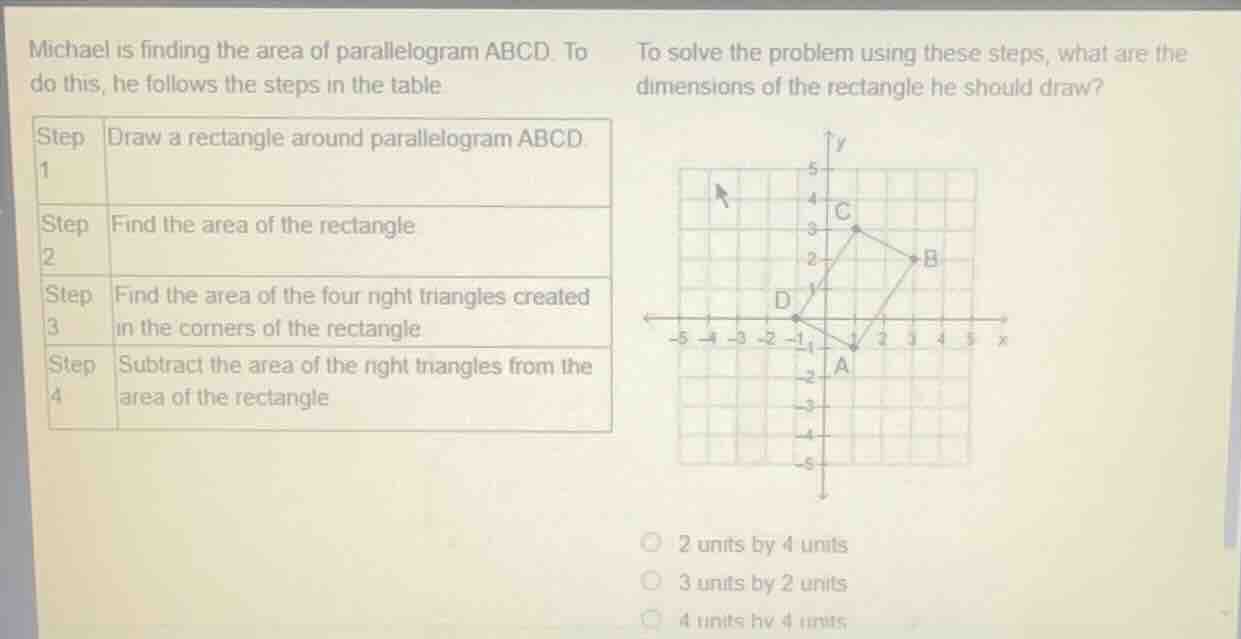
to solve the problem using these steps, what are the dimensions of the rectangle he should draw?
options:
2 units by 4 units
3 units by 2 units
4 units by 4 units
Step1: Identify coordinates of vertices
First, we identify the coordinates of the vertices of the parallelogram \(ABCD\). From the graph:
- \(D(-1, 0)\)
- \(C(1, 3)\) (Wait, no, looking at the graph again: Let's re - check the coordinates. Let's list the coordinates of the parallelogram vertices properly. Let's assume the points: \(D(-1,0)\), \(A(1, - 1)\), \(B(3,2)\), \(C(1,3)\)? Wait, maybe a better way is to find the minimum and maximum \(x\) and \(y\) values to determine the rectangle around the parallelogram.
The \(x\) - coordinates of the parallelogram vertices: Let's find the left - most and right - most \(x\) values. The left - most \(x\) is \(-1\) (from point \(D\)) and the right - most \(x\) is \(3\) (from point \(B\)). The length in the \(x\) - direction is \(3-(-1)=4\) units.
The \(y\) - coordinates: The bottom - most \(y\) is \(-1\) (from point \(A\)) and the top - most \(y\) is \(3\) (from point \(C\)). The length in the \(y\) - direction is \(3 - (-1)=4\)? Wait, no, maybe I made a mistake. Wait, let's look at the answer options. Wait, maybe the correct way is to find the horizontal and vertical distances.
Wait, another approach: When we draw a rectangle around the parallelogram, the length and width of the rectangle can be found by looking at the horizontal and vertical spans. Let's find the horizontal distance between the left - most and right - most points. The left - most \(x\) is \(-1\) and the right - most \(x\) is \(3\), so the horizontal length is \(3-(-1) = 4\)? No, wait the answer options have \(4\) units by \(4\) units? Wait, no, let's re - examine the graph.
Wait, the points: Let's list the coordinates correctly. From the graph:
- \(D\) is at \((-1,0)\)
- \(A\) is at \((1, - 1)\)
- \(B\) is at \((3,2)\)
- \(C\) is at \((1,3)\)
To draw a rectangle around the parallelogram, we need to find the minimum and maximum \(x\) and \(y\) values.
Minimum \(x\) - coordinate: \(-1\) (from \(D\))
Maximum \(x\) - coordinate: \(3\) (from \(B\))
So the horizontal length of the rectangle is \(3-(-1)=4\) units.
Minimum \(y\) - coordinate: \(-1\) (from \(A\))
Maximum \(y\) - coordinate: \(3\) (from \(C\))
So the vertical length of the rectangle is \(3-(-1) = 4\)? Wait, no, \(3-(-1)=4\), but the answer options have \(4\) units by \(4\) units? Wait, maybe I made a mistake. Wait, let's check the answer options again. The options are:
- 2 units by 4 units
- 3 units by 2 units
- 4 units by 4 units (maybe a typo, but let's proceed)
Wait, the horizontal distance between the left - most \(x=-1\) and right - most \(x = 3\) is \(3-(-1)=4\). The vertical distance between the bottom - most \(y=-1\) and top - most \(y = 3\) is \(3-(-1)=4\). But wait, the other way: Let's calculate the length and width of the rectangle.
Alternatively, the base of the parallelogram and the height. But when we draw the rectangle around the parallelogram, the rectangle's length and width are determined by the outermost \(x\) and \(y\) values.
Wait, maybe the correct dimensions are \(4\) units by \(4\) units? Wait, no, let's check the answer options. Wait, the third option is "4 units by 4 units" (assuming the typo "4 units hv 4 units" is "4 units by 4 units").
Wait, let's re - calculate:
The \(x\) - range: From \(x=-1\) to \(x = 3\), so the length is \(3-(-1)=4\) units.
The \(y\) - range: From \(y=-1\) to \(y = 3\), so the height is \(3-(-1)=4\) units.
So the rectangle should have dimensions \(4\) units by \(4\) units. But wait, let's check the other options. The first option is \(2\) units by \(4\) units, the second is \(3\) units by \(2\) unit…

Snap & solve any problem in the app
Get step-by-step solutions on Sovi AI
Photo-based solutions with guided steps
Explore more problems and detailed explanations
4 units by 4 units (assuming the option with "4 units hv 4 units" is "4 units by 4 units")