QUESTION IMAGE
Question
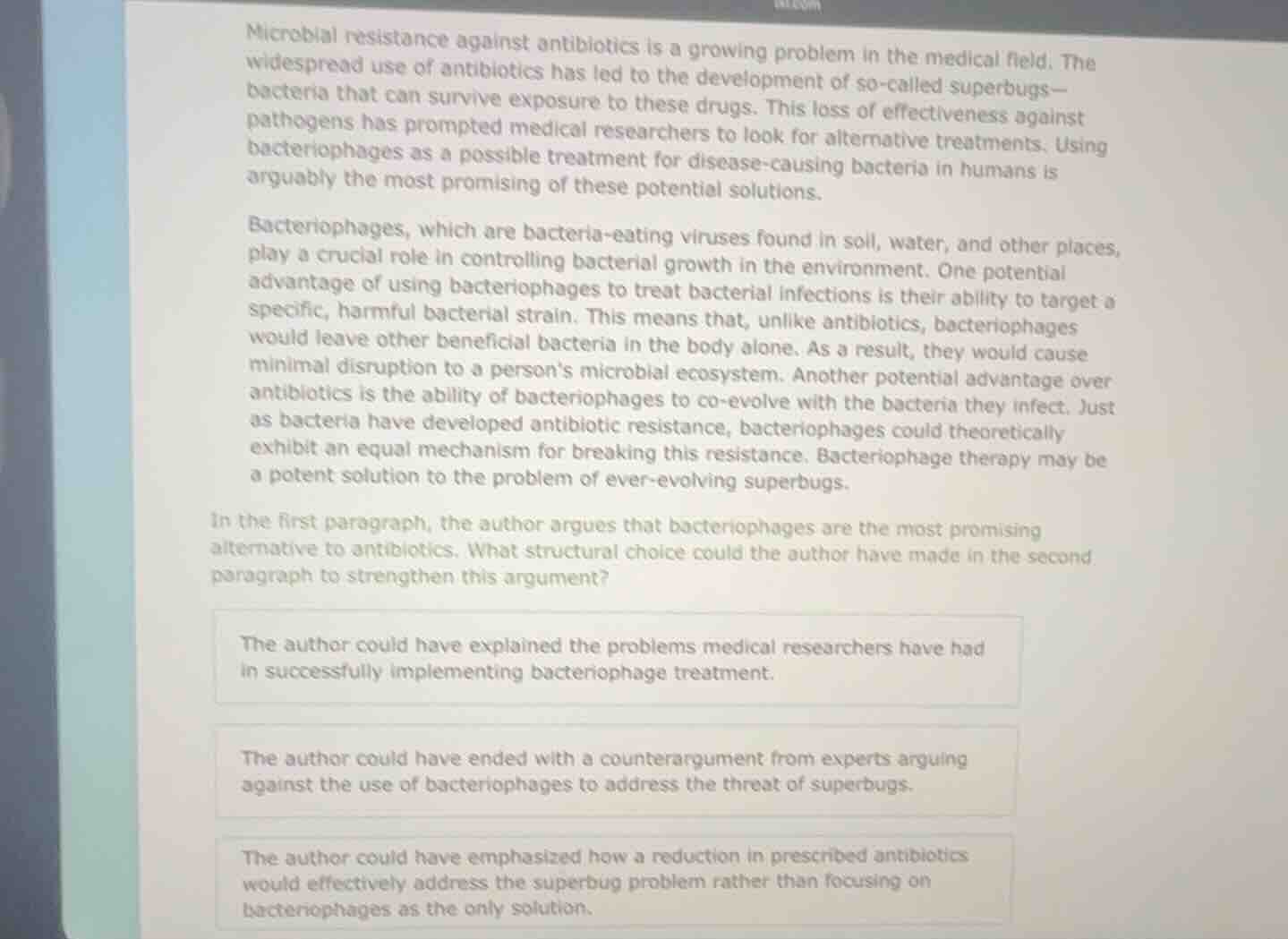
microbial resistance against antibiotics is a growing problem in the medical field. the widespread use of antibiotics has led to the development of so - called superbugs—bacteria that can survive exposure to these drugs. this loss of effectiveness against pathogens has prompted medical researchers to look for alternative treatments. using bacteriophages as a possible treatment for disease - causing bacteria in humans is arguably the most promising of these potential solutions.
bacteriophages, which are bacteria - eating viruses found in soil, water, and other places, play a crucial role in controlling bacterial growth in the environment. one potential advantage of using bacteriophages to treat bacterial infections is their ability to target a specific, harmful bacterial strain. this means that, unlike antibiotics, bacteriophages would leave other beneficial bacteria in the body alone. as a result, they would cause minimal disruption to a person’s microbial ecosystem. another potential advantage over antibiotics is the ability of bacteriophages to co - evolve with the bacteria they infect. just as bacteria have developed antibiotic resistance, bacteriophages could theoretically exhibit an equal mechanism for breaking this resistance. bacteriophage therapy may be a potent solution to the problem of ever - evolving superbugs.
in the first paragraph, the author argues that bacteriophages are the most promising alternative to antibiotics. what structural choice could the author have made in the second paragraph to strengthen this argument?
the author could have explained the problems medical researchers have had in successfully implementing bacteriophage treatment.
the author could have ended with a counterargument from experts arguing against the use of bacteriophages to address the threat of superbugs.
the author could have emphasized how a reduction in prescribed antibiotics would effectively address the superbug problem rather than focusing on bacteriophages as the only solution.
To determine the correct option, we analyze each choice:
- The first option (explaining implementation problems) would not strengthen the argument for bacteriophages as a promising alternative, as it focuses on challenges rather than benefits.
- The second option (ending with a counterargument against bacteriophages) would weaken the argument, as it introduces opposing views without refuting them.
- The third option (emphasizing reducing antibiotics as a solution) shifts focus away from bacteriophages, which contradicts the goal of strengthening the argument for bacteriophages. Wait, no—wait, actually, none of these seem correct? Wait, maybe I misread. Wait, the question is about structural choices to strengthen the argument that bacteriophages are the most promising alternative. Wait, maybe there's a mistake in my analysis. Wait, no—wait, the options given: let's re - evaluate.
Wait, actually, none of the provided options seem to be correct for strengthening the argument. But perhaps I made a mistake. Wait, the first option: explaining problems in implementing bacteriophage treatment—if the author explains the problems but then shows how they can be overcome, that could strengthen, but the option just says "explained the problems...", not showing solutions. The second option: a counterargument against would weaken. The third option: focusing on reducing antibiotics instead of bacteriophages weakens the argument for bacteriophages. But since we have to choose from the given options, maybe there's an error. Wait, maybe the first option is intended to be that by explaining the problems, the author can then show how they are surmountable, but the option as stated is just explaining the problems. Alternatively, perhaps the question has a typo. But based on the given options, none of them seem to be correct for strengthening the argument. But since we have to choose, maybe the intended correct option is none, but that's not possible. Wait, maybe I misread the options.
Wait, let's re - read the options:
- "The author could have explained the problems medical researchers have had in successfully implementing bacteriophage treatment." — If the author explains the problems and then shows how they can be solved or that they are minor compared to the benefits, it could strengthen. But the option just says "explained the problems", not the solution part.
- "The author could have ended with a counterargument from experts arguing against the use of bacteriophages to address the threat of superbugs." — This would introduce a counter - point without refutation, weakening the argument.
- "The author could have emphasized how a reduction in prescribed antibiotics would effectively address the superbug problem rather than focusing on bacteriophages as the only solution." — This shifts focus from bacteriophages to reducing antibiotics, weakening the argument for bacteriophages.
Since none of the options seem to correctly strengthen the argument, but perhaps there's a mistake in the options or my analysis. However, if we have to choose the least wrong, maybe the first option is intended to be that by acknowledging problems and showing they can be overcome (even though the option doesn't state that), but as per the given text of the option, it's not clear. But perhaps the question has a different set of options. Alternatively, maybe I made a mistake.
But since we have to provide an answer, and assuming that there's a mistake and the first option is intended to be the correct one (maybe the author explains the problems to then show that they are…

Snap & solve any problem in the app
Get step-by-step solutions on Sovi AI
Photo-based solutions with guided steps
Explore more problems and detailed explanations
A. The author could have explained the problems medical researchers have had in successfully implementing bacteriophage treatment.