QUESTION IMAGE
Question
microplastic
monomer
mutualistic
p parasitic
photosynthesis
plastic
plasticizer
polymer
predator - prey graph
predator - prey relationship
producer
r resilience
Brief Explanations
Each term is defined with concise, standard academic definitions relevant to biological and environmental science contexts.

Snap & solve any problem in the app
Get step-by-step solutions on Sovi AI
Photo-based solutions with guided steps
Explore more problems and detailed explanations
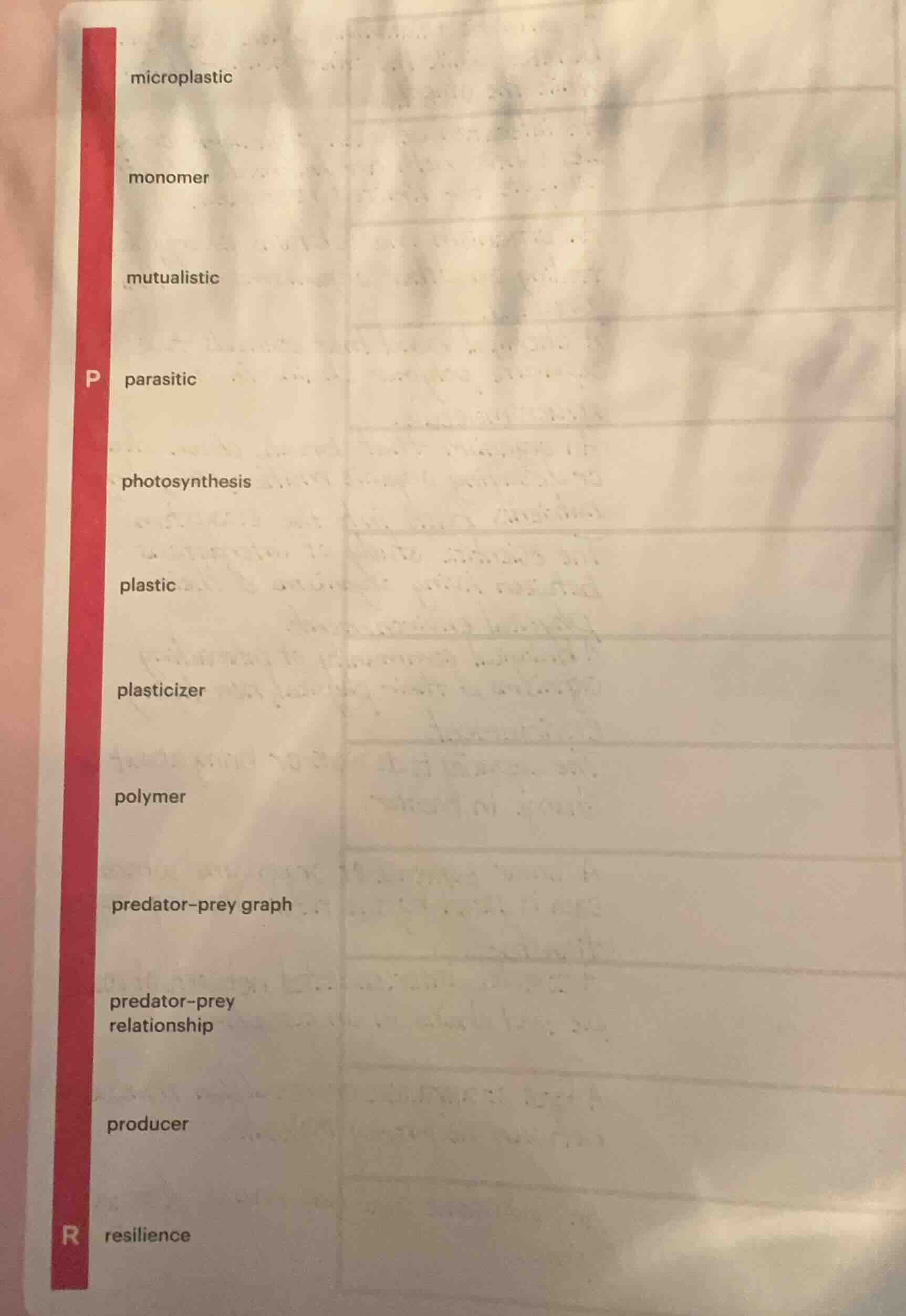
- microplastic: Tiny plastic fragment (<5mm) from broken-down plastic products or microbeads, a widespread environmental pollutant.
- monomer: A small molecular unit that can chemically bond with other identical units to form a polymer.
- mutualistic: Describes a symbiotic relationship where both interacting species benefit.
- parasitic: Describes a symbiotic relationship where one organism (parasite) benefits at the expense of another (host), which is harmed.
- photosynthesis: The biological process where producers (plants, algae) use sunlight, $\text{CO}_2$, and water to make glucose ($\text{C}_6\text{H}_{12}\text{O}_6$) and oxygen, via the reaction: $$6\text{CO}_2 + 6\text{H}_2\text{O} \xrightarrow{\text{sunlight, chlorophyll}} \text{C}_6\text{H}_{12}\text{O}_6 + 6\text{O}_2$$
- plastic: A synthetic or semi-synthetic polymer material that is moldable and durable, derived from petrochemicals.
- plasticizer: A chemical added to plastics to increase flexibility, durability, or workability by reducing polymer chain rigidity.
- polymer: A large molecule made of repeated linked monomer units (e.g., plastic, DNA).
- predator-prey graph: A line graph that tracks the cyclic population changes of predator and prey species over time, showing their interdependent fluctuations.
- predator-prey relationship: An ecological interaction where a predator hunts, kills, and consumes a prey organism for energy.
- producer: An autotrophic organism (e.g., plants, cyanobacteria) that makes its own food via photosynthesis or chemosynthesis, forming the base of a food web.
- resilience: The ability of an ecosystem or organism to recover and return to its original state after a disturbance (e.g., drought, pollution).