QUESTION IMAGE
Question
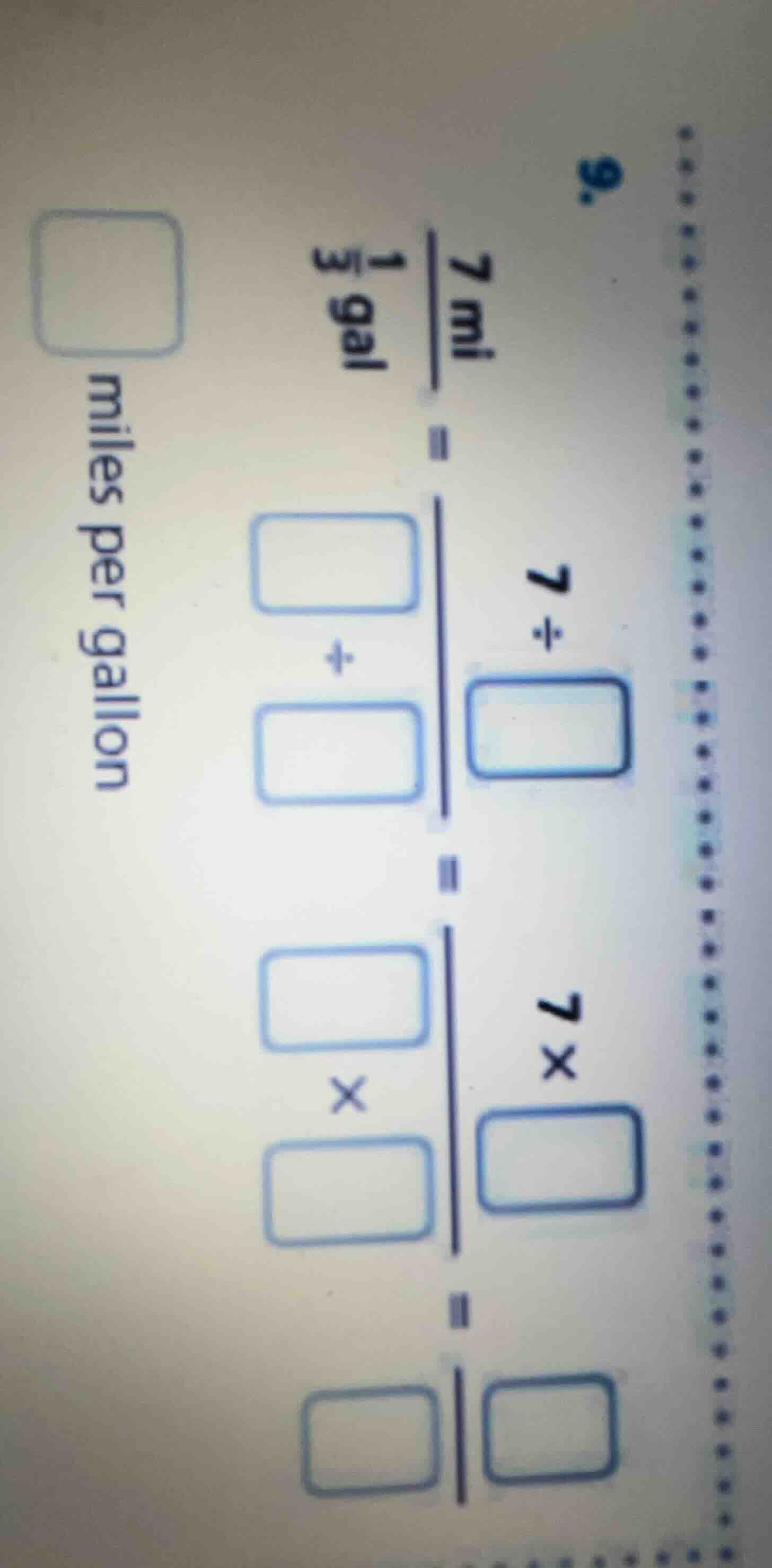
- \frac{7\text{ mi}}{1\frac{1}{3}\text{ gal}} = 7 \div \frac{\square}{\square} = 7 \times \frac{\square}{\square} = \frac{\square}{\square} miles per gallon
Step1: Recall dividing by a fraction rule
To divide by a fraction, we multiply by its reciprocal. So, \(7\div\frac{1}{3}\) becomes \(7\times\frac{3}{1}\).
Step2: Identify the fraction and its reciprocal
The fraction is \(\frac{1}{3}\), and its reciprocal is \(\frac{3}{1}\) (or 3). So in the division step \(7\div\frac{1}{3}\), the first box (dividend's denominator - but here we are dividing by \(\frac{1}{3}\)): the division of a number by a fraction \(\frac{a}{b}\) is number \(\times\frac{b}{a}\). So \(7\div\frac{1}{3}=7\times\frac{3}{1}\). So the first division step: \(7\div\frac{1}{3}\) is \(7\times\frac{3}{1}\). Then calculating \(7\times3 = 21\), and denominator 1. So filling the boxes:
First, the division step: \(7\div\frac{1}{3}\) is \(7\times\frac{3}{1}\) (because dividing by \(\frac{1}{3}\) is multiplying by 3/1). Then \(7\times3 = 21\), so the last fraction is \(\frac{21}{1}\) (or 21).
Breaking down:
- The first division: \(7\div\frac{1}{3}\) is equivalent to \(7\times\frac{3}{1}\) (since dividing by a fraction is multiplying by its reciprocal). So in the division step \(7\div\frac{\boldsymbol{1}}{\boldsymbol{3}}\) (the box for the numerator of the divisor is 1, denominator is 3). Then the multiplication step: \(7\times\frac{\boldsymbol{3}}{\boldsymbol{1}}\) (reciprocal of \(\frac{1}{3}\) is \(\frac{3}{1}\)). Then \(7\times3 = 21\), so the final fraction is \(\frac{\boldsymbol{21}}{\boldsymbol{1}}\) (or 21, but as a fraction, numerator 21, denominator 1).
So filling the boxes:
- In the division step: \(7\div\frac{1}{3}\) (so the first box in division is 1, second is 3? Wait, the problem's structure: \(\frac{7\ \text{mi}}{\frac{1}{3}\ \text{gal}} = 7\div\frac{1}{3}=\frac{7}{\frac{1}{3}} = 7\times\frac{3}{1}=\frac{21}{1}\) miles per gallon.
So step by step:
- \(\frac{7\ \text{mi}}{\frac{1}{3}\ \text{gal}} = 7\div\frac{1}{3}\)
- \(7\div\frac{1}{3}=7\times\frac{3}{1}\) (because dividing by \(\frac{a}{b}\) is multiplying by \(\frac{b}{a}\))
- \(7\times3 = 21\), so \(\frac{21}{1}\)
So the boxes:
- In the division: \(7\div\frac{1}{3}\) (so the divisor's numerator is 1, denominator is 3)
- Then \(7\times\frac{3}{1}\) (reciprocal: numerator 3, denominator 1)
- Then \(7\times3 = 21\), so the final fraction is \(\frac{21}{1}\)
So filling the boxes:
First division step: \(7\div\frac{1}{3}\) (so the first box in the division fraction is 1, second is 3? Wait, the problem's layout:
\(\frac{7\ \text{mi}}{\frac{1}{3}\ \text{gal}} = 7\div\frac{1}{3}=\frac{7}{\frac{1}{3}} = 7\times\frac{3}{1}=\frac{21}{1}\)
So:
- \(7\div\frac{1}{3}\): the divisor is \(\frac{1}{3}\), so in the division \(\frac{7}{\frac{1}{3}}\), it's \(7\div1\times3\) (since dividing by \(\frac{1}{3}\) is multiplying by 3). Wait, maybe simpler:
Dividing by a fraction \(\frac{a}{b}\) is equal to multiplying by \(\frac{b}{a}\). So \(\frac{7}{\frac{1}{3}} = 7\times\frac{3}{1} = 21\).
So the steps:
- \(\frac{7\ \text{mi}}{\frac{1}{3}\ \text{gal}} = 7\div\frac{1}{3}\)
- \(7\div\frac{1}{3} = 7\times\frac{3}{1}\) (reciprocal of \(\frac{1}{3}\) is \(\frac{3}{1}\))
- \(7\times3 = 21\), so \(\frac{21}{1}\)
So filling the boxes:
- In the division step: \(7\div\frac{1}{3}\) (so the numerator of the divisor is 1, denominator is 3)
- Then the multiplication step: \(7\times\frac{3}{1}\) (numerator 3, denominator 1)
- Then the result: \(\frac{21}{1}\)
So the boxes:
- Division step: \(7\div\frac{1}{3}\) (so the first box in the divisor's numerator is 1, denominator is 3)
- Multiplication step: \(7\times\frac{3}{1}\) (numerator 3, denominator 1)
- Result: \(\frac{…

Snap & solve any problem in the app
Get step-by-step solutions on Sovi AI
Photo-based solutions with guided steps
Explore more problems and detailed explanations
- Division step: \(7\div\frac{\boldsymbol{1}}{\boldsymbol{3}}\)
- Multiplication step: \(7\times\frac{\boldsymbol{3}}{\boldsymbol{1}}\)
- Result: \(\frac{\boldsymbol{21}}{\boldsymbol{1}}\) (or 21 miles per gallon)