QUESTION IMAGE
Question
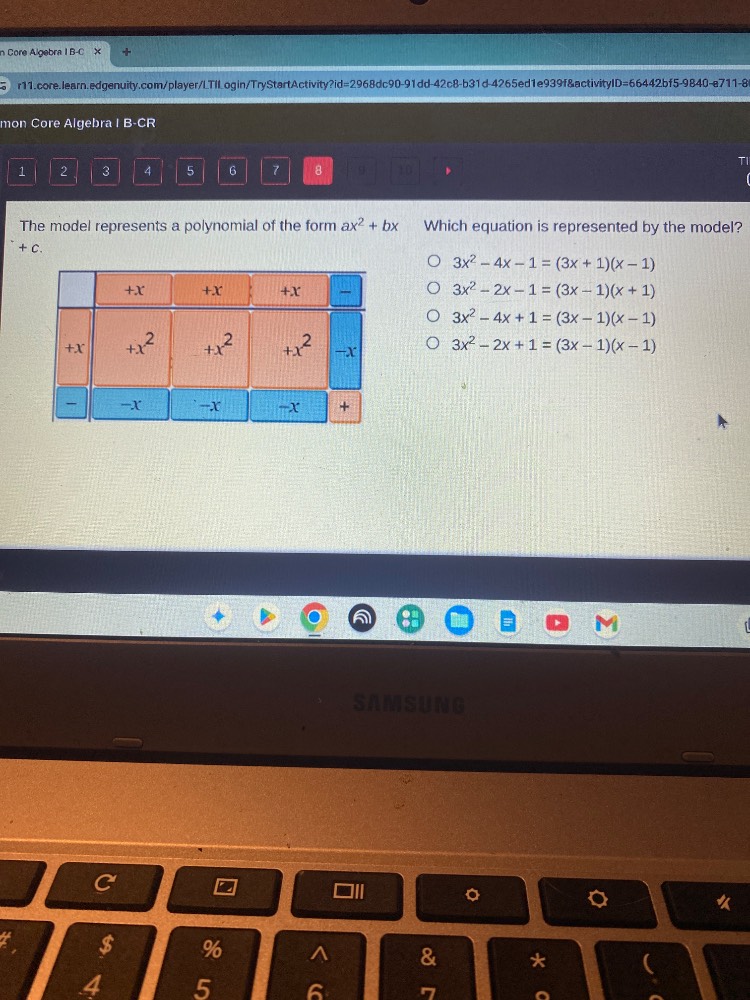
the model represents a polynomial of the form ( ax^2 + bx + c ). which equation is represented by the model?
options:
( 3x^2 - 4x - 1 = (3x + 1)(x - 1) )
( 3x^2 - 2x - 1 = (3x - 1)(x + 1) )
( 3x^2 - 4x + 1 = (3x - 1)(x - 1) )
( 3x^2 - 2x + 1 = (3x - 1)(x - 1) )
Step1: Count the number of each term
- For \(x^2\) terms: There are 3 orange \(+x^2\) tiles, so coefficient of \(x^2\) is 3.
- For \(x\) terms: Let's count the linear terms. The \(+x\) tiles: 1 (left) + 3 (top) = 4, but the \(-x\) tiles: 1 (right) + 3 (bottom) = 4. Wait, no, let's check again. Wait, the top row: 3 \(+x\) and 1 \(-\) (constant? Wait, no, the tiles: let's list all terms:
- \(x^2\): 3 (three \(+x^2\) tiles)
- \(x\): \(+x\) (left) + \(+x\) (top, 3) + \(-x\) (right) + \(-x\) (bottom, 3) = \(x + 3x - x - 3x = 0x\)? Wait, no, maybe I miscounted. Wait, the left tile: \(+x\), top row: three \(+x\) and one \(-\) (constant? Wait, the bottom row: three \(-x\) and one \(+\) (constant). The right column: \(+x\) (wait, no, the right column: top is \(-\) (constant), middle is \(-x\), bottom is \(+\) (constant). Wait, maybe better to calculate the polynomial from the model.
Wait, the standard way: in algebra tile models, each tile: \(x^2\) (large square), \(x\) (rectangle), and constant (small square). So let's count:
- \(x^2\) tiles: 3 (three orange large squares) → \(3x^2\)
- \(x\) tiles: Let's count the linear terms (rectangles):
- Positive \(x\) (orange rectangles): left (1) + top (3) = 4? Wait, no, the left is a \(+x\) (orange rectangle), top row: three \(+x\) (orange rectangles), middle right: \(-x\) (blue rectangle), bottom row: three \(-x\) (blue rectangles). So \(+x\) (left) + \(3x\) (top) + \(-x\) (right) + \(-3x\) (bottom) = \(x + 3x - x - 3x = 0x\)? That can't be. Wait, maybe the constants:
- Constant terms (small squares): top right \(-\) (blue small square), bottom right \(+\) (orange small square), and maybe others? Wait, the top row: 3 \(+x\) (rectangles) and 1 \(-\) (small square, constant: -1). The bottom row: 3 \(-x\) (rectangles) and 1 \(+\) (small square, constant: +1). The left: 1 \(+x\) (rectangle), right: 1 \(-x\) (rectangle). Wait, this is confusing. Maybe instead, let's expand each option and see which one matches.
Let's expand each option:
- \( (3x + 1)(x - 1) = 3x^2 - 3x + x - 1 = 3x^2 - 2x - 1 \)
- \( (3x - 1)(x + 1) = 3x^2 + 3x - x - 1 = 3x^2 + 2x - 1 \)
- \( (3x - 1)(x - 1) = 3x^2 - 3x - x + 1 = 3x^2 - 4x + 1 \)
- \( (3x - 1)(x - 1) \) same as above? Wait, no, option 3: \(3x^2 - 4x + 1 = (3x - 1)(x - 1)\), option 4: \(3x^2 - 2x + 1 = (3x - 1)(x - 1)\)? Wait, no, expand \( (3x - 1)(x - 1) \):
\( (3x - 1)(x - 1) = 3x \cdot x + 3x \cdot (-1) - 1 \cdot x + (-1) \cdot (-1) = 3x^2 - 3x - x + 1 = 3x^2 - 4x + 1 \)
Now let's check the options:
Option 1: \(3x^2 - 4x - 1 = (3x + 1)(x - 1)\) → expand RHS: \(3x^2 - 3x + x - 1 = 3x^2 - 2x - 1\) → not equal to LHS (LHS is \(3x^2 -4x -1\)) → wrong.
Option 2: \(3x^2 - 2x - 1 = (3x - 1)(x + 1)\) → expand RHS: \(3x^2 + 3x - x - 1 = 3x^2 + 2x - 1\) → LHS is \(3x^2 -2x -1\), RHS is \(3x^2 +2x -1\) → wrong.
Option 3: \(3x^2 - 4x + 1 = (3x - 1)(x - 1)\) → expand RHS: \(3x^2 - 3x - x + 1 = 3x^2 -4x +1\) → matches LHS.
Option 4: \(3x^2 - 2x + 1 = (3x - 1)(x - 1)\) → RHS is \(3x^2 -4x +1\), LHS is \(3x^2 -2x +1\) → not equal.
Wait, but let's check the polynomial from the model again. The \(x^2\) terms: 3 (so \(3x^2\)). The \(x\) terms: let's count the linear terms. If we have 3 \(x^2\), then the linear coefficient: let's see, the correct expansion for option 3 is \(3x^2 -4x +1\), which would mean the linear term is \(-4x\) and constant is \(+1\). Let's check the constant terms: the small squares: top right is \(-\) (so \(-1\)), bottom right is \(+\) (so \(+1\)), and maybe another? Wait, the top row has a \(-\) (constant: -1), bottom row has a \(+\) (cons…

Snap & solve any problem in the app
Get step-by-step solutions on Sovi AI
Photo-based solutions with guided steps
Explore more problems and detailed explanations
\( 3x^2 - 4x + 1 = (3x - 1)(x - 1) \) (Option 3)