QUESTION IMAGE
Question
module 7 - exam
question 1 of 15 (1 point) | question attempt: 1 of 1
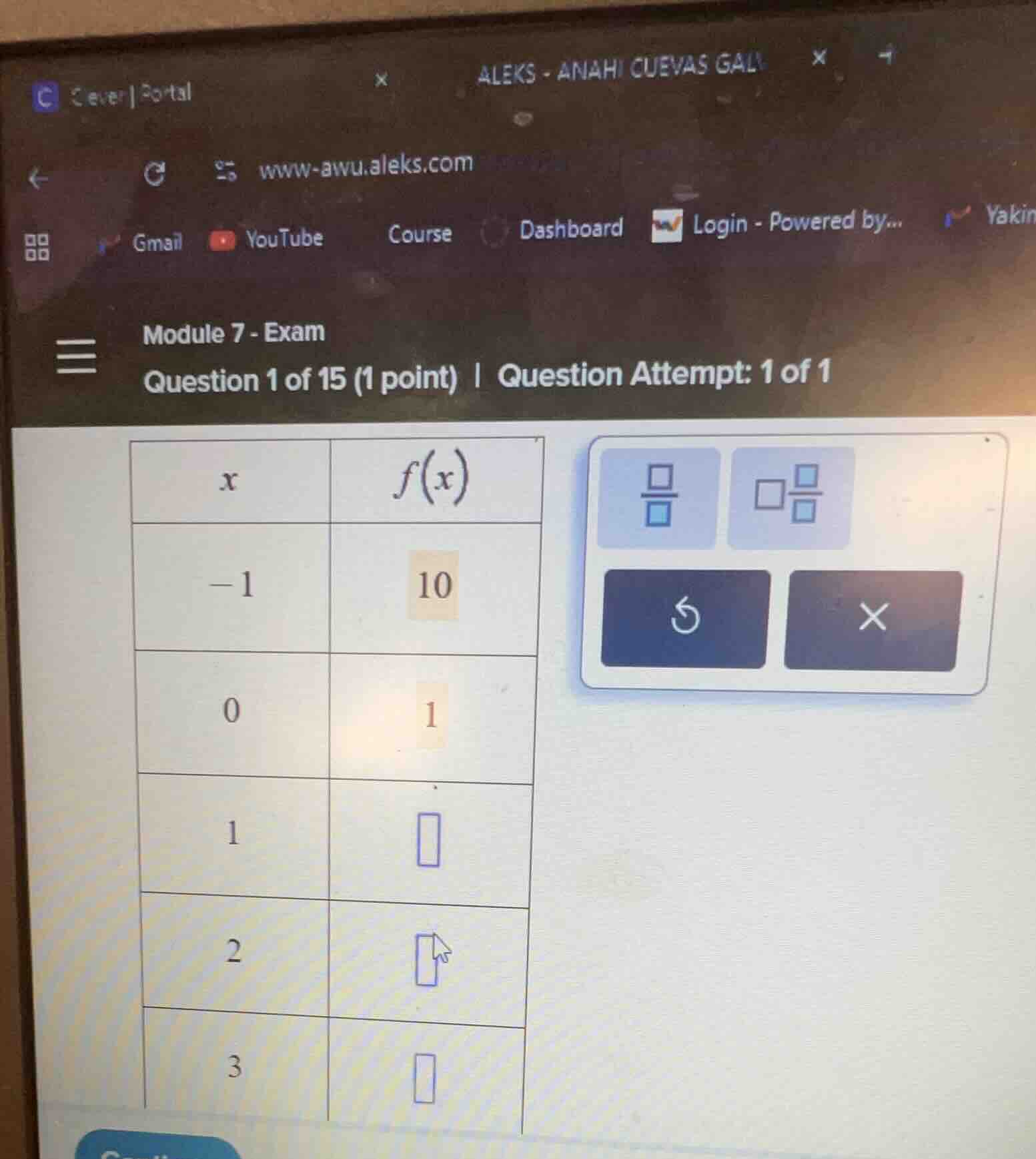
x | f(x)
-1 | 10
0 | 1
1 |
2 |
3 |
To determine the pattern of the function \( f(x) \), we analyze the given values:
Step 1: Identify the pattern from known points
We have \( x = -1 \) with \( f(-1) = 10 \), and \( x = 0 \) with \( f(0) = 1 \). Let's check if this is a geometric sequence (exponential function) since the change between \( f(-1) \) and \( f(0) \) suggests a common ratio.
For a geometric sequence, the formula is \( f(x) = a \cdot r^x \), where \( a \) is the initial term (when \( x = 0 \)) and \( r \) is the common ratio.
When \( x = 0 \), \( f(0) = a \cdot r^0 = a \cdot 1 = a \). So \( a = 1 \) (since \( f(0) = 1 \)).
Now, use \( x = -1 \): \( f(-1) = 1 \cdot r^{-1} = \frac{1}{r} \). We know \( f(-1) = 10 \), so:
\[
\frac{1}{r} = 10 \implies r = \frac{1}{10} = 0.1
\]
Step 2: Find \( f(1) \)
Using the formula \( f(x) = 1 \cdot (0.1)^x \), for \( x = 1 \):
\[
f(1) = (0.1)^1 = 0.1 = \frac{1}{10}
\]
Step 3: Find \( f(2) \)
For \( x = 2 \):
\[
f(2) = (0.1)^2 = 0.01 = \frac{1}{100}
\]
Step 4: Find \( f(3) \)
For \( x = 3 \):
\[
f(3) = (0.1)^3 = 0.001 = \frac{1}{1000}
\]
Final Answers (filling the table):
- For \( x = 1 \): \( f(1) = \boldsymbol{\frac{1}{10}} \) (or \( 0.1 \))
- For \( x = 2 \): \( f(2) = \boldsymbol{\frac{1}{100}} \) (or \( 0.01 \))
- For \( x = 3 \): \( f(3) = \boldsymbol{\frac{1}{1000}} \) (or \( 0.001 \))

Snap & solve any problem in the app
Get step-by-step solutions on Sovi AI
Photo-based solutions with guided steps
Explore more problems and detailed explanations
To determine the pattern of the function \( f(x) \), we analyze the given values:
Step 1: Identify the pattern from known points
We have \( x = -1 \) with \( f(-1) = 10 \), and \( x = 0 \) with \( f(0) = 1 \). Let's check if this is a geometric sequence (exponential function) since the change between \( f(-1) \) and \( f(0) \) suggests a common ratio.
For a geometric sequence, the formula is \( f(x) = a \cdot r^x \), where \( a \) is the initial term (when \( x = 0 \)) and \( r \) is the common ratio.
When \( x = 0 \), \( f(0) = a \cdot r^0 = a \cdot 1 = a \). So \( a = 1 \) (since \( f(0) = 1 \)).
Now, use \( x = -1 \): \( f(-1) = 1 \cdot r^{-1} = \frac{1}{r} \). We know \( f(-1) = 10 \), so:
\[
\frac{1}{r} = 10 \implies r = \frac{1}{10} = 0.1
\]
Step 2: Find \( f(1) \)
Using the formula \( f(x) = 1 \cdot (0.1)^x \), for \( x = 1 \):
\[
f(1) = (0.1)^1 = 0.1 = \frac{1}{10}
\]
Step 3: Find \( f(2) \)
For \( x = 2 \):
\[
f(2) = (0.1)^2 = 0.01 = \frac{1}{100}
\]
Step 4: Find \( f(3) \)
For \( x = 3 \):
\[
f(3) = (0.1)^3 = 0.001 = \frac{1}{1000}
\]
Final Answers (filling the table):
- For \( x = 1 \): \( f(1) = \boldsymbol{\frac{1}{10}} \) (or \( 0.1 \))
- For \( x = 2 \): \( f(2) = \boldsymbol{\frac{1}{100}} \) (or \( 0.01 \))
- For \( x = 3 \): \( f(3) = \boldsymbol{\frac{1}{1000}} \) (or \( 0.001 \))