QUESTION IMAGE
Question
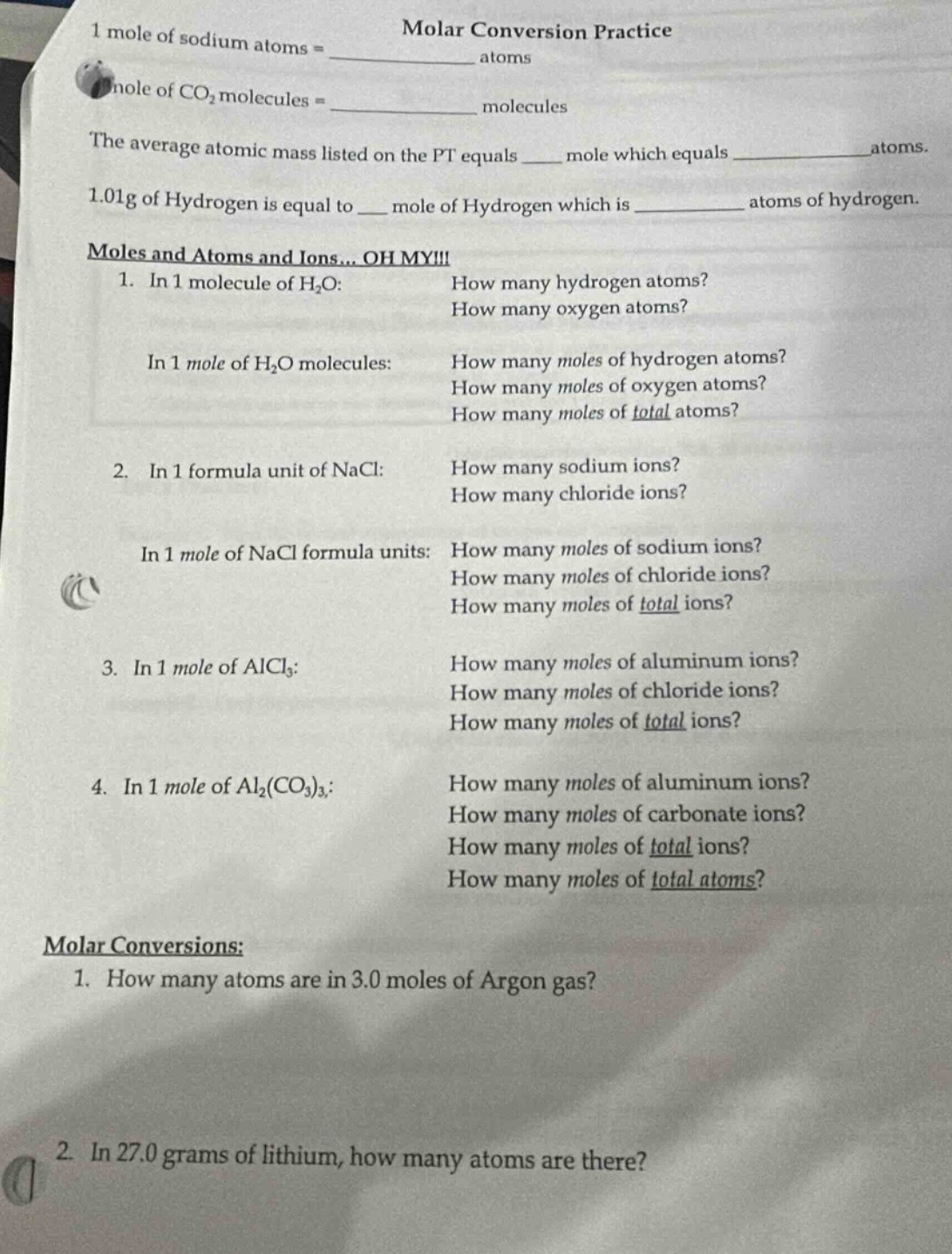
molar conversion practice
1 mole of sodium atoms = ______ atoms
nole of co₂ molecules = ______ molecules
the average atomic mass listed on the pt equals __ mole which equals ____ atoms.
1.01g of hydrogen is equal to __ mole of hydrogen which is ____ atoms of hydrogen.
moles and atoms and ions... oh my!!!
- in 1 molecule of h₂o: how many hydrogen atoms?
how many oxygen atoms?
in 1 mole of h₂o molecules: how many moles of hydrogen atoms?
how many moles of oxygen atoms?
how many moles of total atoms?
- in 1 formula unit of nacl: how many sodium ions?
how many chloride ions?
in 1 mole of nacl formula units: how many moles of sodium ions?
how many moles of chloride ions?
how many moles of total ions?
- in 1 mole of alcl₃: how many moles of aluminum ions?
how many moles of chloride ions?
how many moles of total ions?
- in 1 mole of al₂(co₃)₃: how many moles of aluminum ions?
how many moles of carbonate ions?
how many moles of total ions?
how many moles of total atoms?
molar conversions:
- how many atoms are in 3.0 moles of argon gas?
- in 27.0 grams of lithium, how many atoms are there?
1. Molar Conversion Practice (First part)
1 mole of sodium atoms = ______ atoms
Step1: Recall Avogadro's number
Avogadro's number is \( 6.022 \times 10^{23} \) particles per mole. For sodium atoms, 1 mole of any substance contains \( 6.022 \times 10^{23} \) particles (atoms, molecules, etc.).
So, 1 mole of sodium atoms = \( 6.022 \times 10^{23} \) atoms.
1 mole of \( CO_2 \) molecules = ______ molecules
Step1: Apply Avogadro's number
1 mole of any molecular substance contains \( 6.022 \times 10^{23} \) molecules. So, 1 mole of \( CO_2 \) molecules = \( 6.022 \times 10^{23} \) molecules.
The average atomic mass listed on the PT equals __ mole which equals ____ atoms.
Step1: Understand molar mass and Avogadro's number
The average atomic mass (in grams per mole) of an element is equal to 1 mole of that element, and 1 mole contains \( 6.022 \times 10^{23} \) atoms. So, the average atomic mass (in g/mol) equals 1 mole which equals \( 6.022 \times 10^{23} \) atoms.
1.01g of Hydrogen is equal to __ mole of Hydrogen which is ____ atoms of hydrogen.
Step1: Calculate moles of Hydrogen
The molar mass of Hydrogen (\( H_2 \)) is approximately 2.02 g/mol, but for atomic hydrogen (H), molar mass is approximately 1.01 g/mol. Using the formula \( n=\frac{m}{M} \), where \( m = 1.01 \) g and \( M = 1.01 \) g/mol.
\( n=\frac{1.01\ \text{g}}{1.01\ \text{g/mol}} = 1\ \text{mole} \)
Step2: Calculate number of atoms
Using Avogadro's number, number of atoms \( = n\times N_A = 1\ \text{mole} \times 6.022 \times 10^{23}\ \text{atoms/mol} = 6.022 \times 10^{23}\ \text{atoms} \)
So, 1.01g of Hydrogen is equal to 1 mole of Hydrogen which is \( 6.022 \times 10^{23} \) atoms of hydrogen.
2. Moles and Atoms and Ions... OH MY!!!
1. In 1 molecule of \( H_2O \):
- How many hydrogen atoms?
In one \( H_2O \) molecule, the subscript of H is 2, so there are 2 hydrogen atoms.
- How many oxygen atoms?
The subscript of O is 1, so there is 1 oxygen atom.
In 1 mole of \( H_2O \) molecules:
- How many moles of hydrogen atoms?
From the formula \( H_2O \), each mole of \( H_2O \) has 2 moles of H atoms (since 1 mole of \( H_2O \) has 2 moles of H, as per the ratio 2:1:1 for H:O:molecule).
- How many moles of oxygen atoms?
Each mole of \( H_2O \) has 1 mole of O atoms.
- How many moles of total atoms?
Moles of H + Moles of O = \( 2 + 1 = 3 \) moles of total atoms.
2. In 1 formula unit of \( NaCl \):
- How many sodium ions?
In one \( NaCl \) formula unit, there is 1 \( Na^+ \) ion.
- How many chloride ions?
In one \( NaCl \) formula unit, there is 1 \( Cl^- \) ion.
In 1 mole of \( NaCl \) formula units:
- How many moles of sodium ions?
1 mole of \( NaCl \) formula units contains 1 mole of \( Na^+ \) ions (1:1 ratio of \( NaCl \) to \( Na^+ \)).
- How many moles of chloride ions?
1 mole of \( NaCl \) formula units contains 1 mole of \( Cl^- \) ions (1:1 ratio of \( NaCl \) to \( Cl^- \)).
- How many moles of total ions?
Moles of \( Na^+ \) + Moles of \( Cl^- \) = \( 1 + 1 = 2 \) moles of total ions.
3. In 1 mole of \( AlCl_3 \):
- How many moles of aluminum ions?
In \( AlCl_3 \), the ratio of \( Al^{3+} \) to \( AlCl_3 \) is 1:1. So, 1 mole of \( AlCl_3 \) contains 1 mole of \( Al^{3+} \) ions.
- How many moles of chloride ions?
The ratio of \( Cl^- \) to \( AlCl_3 \) is 3:1. So, 1 mole of \( AlCl_3 \) contains \( 3 \) moles of \( Cl^- \) ions.
- How many moles of total ions?
Moles of \( Al^{3+} \) + Moles of \( Cl^- \) = \( 1 + 3 = 4 \) moles of total ions.
4. In 1 mole of \( Al_2(CO_3)_3 \):
- How many moles of aluminum ions?
In \( Al_2(CO_3)_3 \), the subscript…
Step1: Recall Avogadro's number
Argon is a monatomic gas, so 1 mole of Ar contains \( 6.022 \times 10^{23} \) atoms.
Step2: Calculate number of atoms
Number of atoms \( = n \times N_A \), where \( n = 3.0 \) moles and \( N_A = 6.022 \times 10^{23}\ \text{atoms/mol} \).
\( \text{Number of atoms} = 3.0\ \text{moles} \times 6.022 \times 10^{23}\ \text{atoms/mol} = 1.8066 \times 10^{24}\ \text{atoms} \) (approx \( 1.8 \times 10^{24} \) atoms)
Step1: Calculate moles of Lithium
Molar mass of Li is approximately 6.94 g/mol. Using \( n = \frac{m}{M} \), where \( m = 27.0 \) g and \( M = 6.94 \) g/mol.
\( n = \frac{27.0\ \text{g}}{6.94\ \text{g/mol}} \approx 3.89\ \text{moles} \)
Step2: Calculate number of atoms
Using Avogadro's number, number of atoms \( = n \times N_A = 3.89\ \text{moles} \times 6.022 \times 10^{23}\ \text{atoms/mol} \approx 2.34 \times 10^{24}\ \text{atoms} \)

Snap & solve any problem in the app
Get step-by-step solutions on Sovi AI
Photo-based solutions with guided steps
Explore more problems and detailed explanations
\( 1.8 \times 10^{24} \) atoms (or \( 1.8066 \times 10^{24} \) atoms)