QUESTION IMAGE
Question
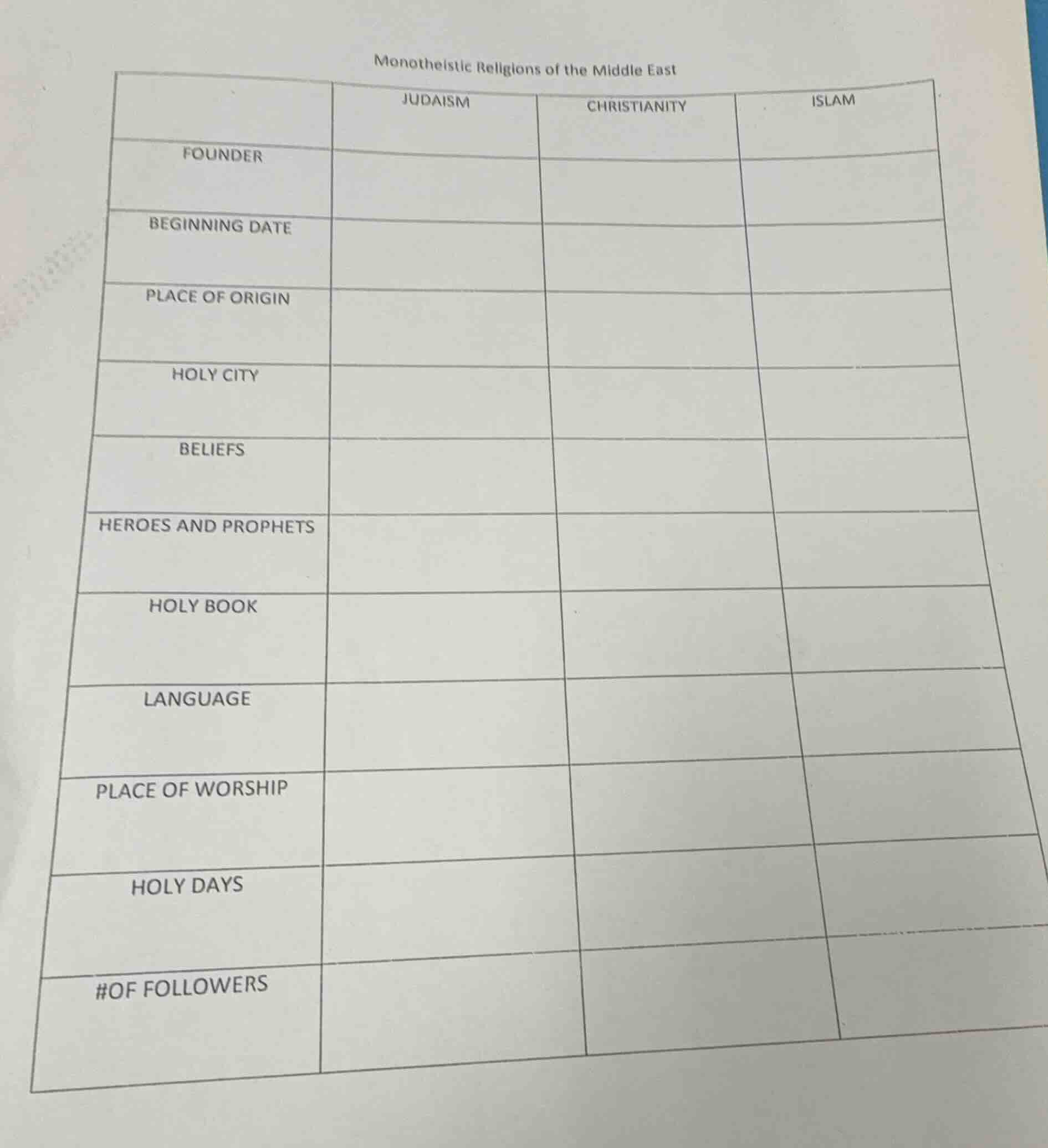
monotheistic religions of the middle east
| judaism | christianity | islam | |
|---|---|---|---|
| beginning date | |||
| place of origin | |||
| holy city | |||
| beliefs | |||
| heroes and prophets | |||
| holy book | |||
| language | |||
| place of worship | |||
| holy days | |||
| #of followers |
Response
To fill the table about Monotheistic Religions of the Middle East (Judaism, Christianity, Islam), we analyze each category:
1. FOUNDER
- Judaism: Traditionally traced to Abraham (patriarch) and developed through Hebrew prophets; no single founder in the same way as others.
- Christianity: Jesus Christ (central figure, believed by followers to be the Son of God).
- Islam: Muhammad (prophet who received revelations from Allah).
2. BEGINNING DATE
- Judaism: ~1200–1500 BCE (emergence of Hebrew traditions in the Levant).
- Christianity: 1st century CE (based on Jesus’ life and teachings).
- Islam: 7th century CE (Muhammad’s revelations in Mecca/Medina).
3. PLACE OF ORIGIN
- Judaism: Ancient Israel (Levant) (modern-day Israel/Palestine region).
- Christianity: Jerusalem (and surrounding region) (1st-century Roman province of Judea).
- Islam: Mecca (and Medina) (western Arabian Peninsula).
4. HOLY CITY
- Judaism: Jerusalem (site of the Temple, central to Jewish history).
- Christianity: Jerusalem (site of Jesus’ ministry, crucifixion, and resurrection).
- Islam: Jerusalem (3rd holiest, for Al-Aqsa Mosque) and Mecca (1st, for Kaaba) and Medina (2nd, Prophet’s Mosque).
5. BELIEFS
- Judaism: Monotheism (one God, Yahweh), covenant with Abraham, Torah as law, focus on ethical living and Jewish identity.
- Christianity: Monotheism (Trinity: Father, Son, Holy Spirit), salvation through Jesus’ sacrifice, Bible as holy text, belief in resurrection.
- Islam: Monotheism (Allah is the only God, Muhammad is His prophet), Five Pillars (Shahada, Salat, Zakat, Sawm, Hajj), Quran as God’s word.
6. HEROES AND PROPHETS
- Judaism: Abraham, Moses (led Exodus), David, Solomon, prophets like Isaiah, Jeremiah.
- Christianity: Jesus, apostles (Peter, Paul), Old Testament prophets (recognized as part of faith).
- Islam: Muhammad, Abraham, Moses, Jesus (all recognized as prophets), other prophets like Noah, David.
7. HOLY BOOK
- Judaism: Torah (first five books of Hebrew Bible, plus Tanakh).
- Christianity: Bible (Old Testament + New Testament).
- Islam: Quran (revelations to Muhammad) + Hadith (teachings of Muhammad, supplementary).
8. LANGUAGE
- Judaism: Hebrew (liturgical, biblical) + modern Hebrew; Aramaic (historical).
- Christianity: Originally Aramaic (Jesus’ language) + Greek (New Testament); local languages (e.g., Latin, English, Spanish) in practice.
- Islam: Arabic (Quran is in Classical Arabic; local languages for practice, but Quran recited in Arabic).
9. PLACE OF WORSHIP
- Judaism: Synagogue (or Temple, historically).
- Christianity: Church (or Cathedral, Chapel).
- Islam: Mosque (or Masjid).
10. HOLY DAYS
- Judaism: Yom Kippur (Day of Atonement), Rosh Hashanah (New Year), Passover (Exodus commemoration).
- Christianity: Christmas (Jesus’ birth), Easter (Resurrection), Lent, Pentecost.
- Islam: Eid al-Fitr (end of Ramadan), Eid al-Adha (Feast of Sacrifice), Ramadan (month of fasting).
11. # OF FOLLOWERS
- Judaism: ~15 million (global).
- Christianity: ~2.4 billion (largest religion).
- Islam: ~1.9 billion (second-largest religion).
Filled Table (Summary):
| Category | JUDAISM | CHRISTIANITY | ISLAM |
| ------------------------ | ---------------------------------- | ------------------… |

Snap & solve any problem in the app
Get step-by-step solutions on Sovi AI
Photo-based solutions with guided steps
Explore more problems and detailed explanations
To fill the table about Monotheistic Religions of the Middle East (Judaism, Christianity, Islam), we analyze each category:
1. FOUNDER
- Judaism: Traditionally traced to Abraham (patriarch) and developed through Hebrew prophets; no single founder in the same way as others.
- Christianity: Jesus Christ (central figure, believed by followers to be the Son of God).
- Islam: Muhammad (prophet who received revelations from Allah).
2. BEGINNING DATE
- Judaism: ~1200–1500 BCE (emergence of Hebrew traditions in the Levant).
- Christianity: 1st century CE (based on Jesus’ life and teachings).
- Islam: 7th century CE (Muhammad’s revelations in Mecca/Medina).
3. PLACE OF ORIGIN
- Judaism: Ancient Israel (Levant) (modern-day Israel/Palestine region).
- Christianity: Jerusalem (and surrounding region) (1st-century Roman province of Judea).
- Islam: Mecca (and Medina) (western Arabian Peninsula).
4. HOLY CITY
- Judaism: Jerusalem (site of the Temple, central to Jewish history).
- Christianity: Jerusalem (site of Jesus’ ministry, crucifixion, and resurrection).
- Islam: Jerusalem (3rd holiest, for Al-Aqsa Mosque) and Mecca (1st, for Kaaba) and Medina (2nd, Prophet’s Mosque).
5. BELIEFS
- Judaism: Monotheism (one God, Yahweh), covenant with Abraham, Torah as law, focus on ethical living and Jewish identity.
- Christianity: Monotheism (Trinity: Father, Son, Holy Spirit), salvation through Jesus’ sacrifice, Bible as holy text, belief in resurrection.
- Islam: Monotheism (Allah is the only God, Muhammad is His prophet), Five Pillars (Shahada, Salat, Zakat, Sawm, Hajj), Quran as God’s word.
6. HEROES AND PROPHETS
- Judaism: Abraham, Moses (led Exodus), David, Solomon, prophets like Isaiah, Jeremiah.
- Christianity: Jesus, apostles (Peter, Paul), Old Testament prophets (recognized as part of faith).
- Islam: Muhammad, Abraham, Moses, Jesus (all recognized as prophets), other prophets like Noah, David.
7. HOLY BOOK
- Judaism: Torah (first five books of Hebrew Bible, plus Tanakh).
- Christianity: Bible (Old Testament + New Testament).
- Islam: Quran (revelations to Muhammad) + Hadith (teachings of Muhammad, supplementary).
8. LANGUAGE
- Judaism: Hebrew (liturgical, biblical) + modern Hebrew; Aramaic (historical).
- Christianity: Originally Aramaic (Jesus’ language) + Greek (New Testament); local languages (e.g., Latin, English, Spanish) in practice.
- Islam: Arabic (Quran is in Classical Arabic; local languages for practice, but Quran recited in Arabic).
9. PLACE OF WORSHIP
- Judaism: Synagogue (or Temple, historically).
- Christianity: Church (or Cathedral, Chapel).
- Islam: Mosque (or Masjid).
10. HOLY DAYS
- Judaism: Yom Kippur (Day of Atonement), Rosh Hashanah (New Year), Passover (Exodus commemoration).
- Christianity: Christmas (Jesus’ birth), Easter (Resurrection), Lent, Pentecost.
- Islam: Eid al-Fitr (end of Ramadan), Eid al-Adha (Feast of Sacrifice), Ramadan (month of fasting).
11. # OF FOLLOWERS
- Judaism: ~15 million (global).
- Christianity: ~2.4 billion (largest religion).
- Islam: ~1.9 billion (second-largest religion).
Filled Table (Summary):
| Category | JUDAISM | CHRISTIANITY | ISLAM |
|---|---|---|---|
| BEGINNING DATE | ~1200–1500 BCE | 1st century CE | 7th century CE |
| PLACE OF ORIGIN | Ancient Israel (Levant) | Jerusalem (Judea) | Mecca/Medina (Arabian Peninsula) |
| HOLY CITY | Jerusalem | Jerusalem | Jerusalem, Mecca, Medina |
| BELIEFS | Monotheism (Yahweh), Torah law | Trinity, salvation via Jesus | Monotheism (Allah), Five Pillars |
| HEROES/PROPHETS | Abraham, Moses, David, prophets | Jesus, apostles, OT prophets | Muhammad, Abraham, Moses, Jesus |
| HOLY BOOK | Torah (Tanakh) | Bible (OT + NT) | Quran (Hadith supplementary) |
| LANGUAGE | Hebrew (liturgical), Aramaic | Aramaic (original), local langs | Arabic (Quran), local langs |
| PLACE OF WORSHIP | Synagogue | Church | Mosque (Masjid) |
| HOLY DAYS | Yom Kippur, Rosh Hashanah, Passover | Christmas, Easter, Lent | Eid al-Fitr, Eid al-Adha, Ramadan |
| # OF FOLLOWERS | ~15 million | ~2.4 billion | ~1.9 billion |
This table synthesizes core information about the three monotheistic faiths, highlighting their origins, beliefs, and practices.