QUESTION IMAGE
Question
montgomery county public schools draft 2018
hs ngss chemistry
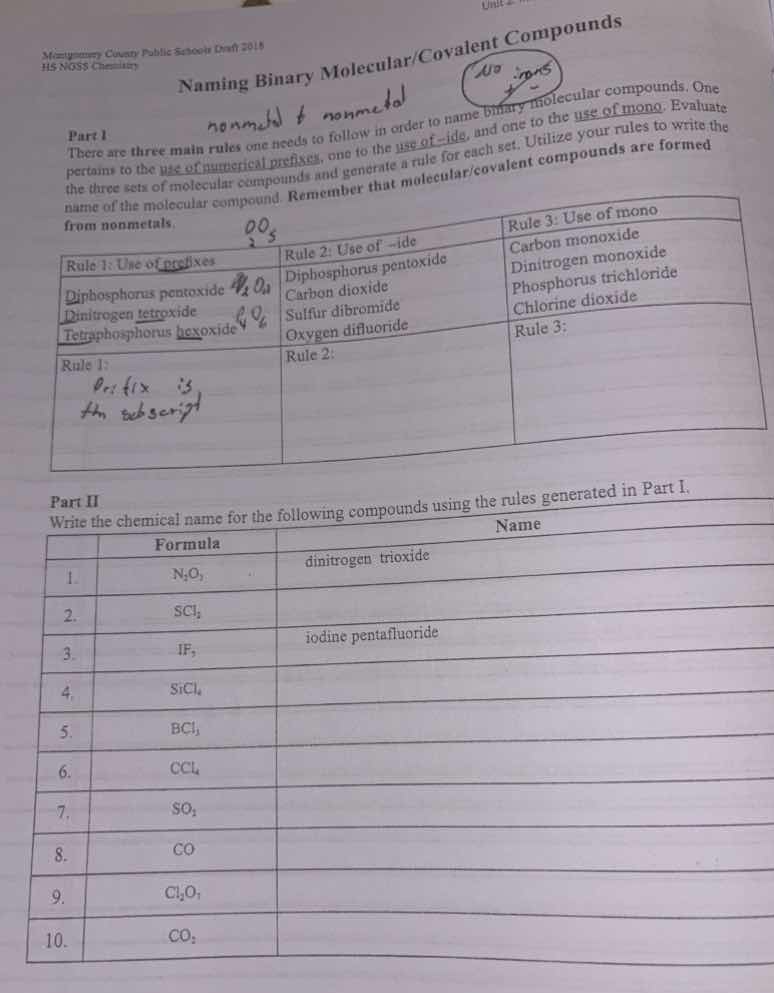
naming binary molecular/covalent compounds
part i
nonmetal & nonmetal
there are three main rules one needs to follow in order to name binary molecular compounds. one pertains to the use of numerical prefixes, one to the use of -ide, and one to the use of mono. evaluate the three sets of molecular compounds and generate a rule for each set. utilize your rules to write the name of the molecular compound. remember that molecular/covalent compounds are formed from nonmetals.
rule 1: use of prefixes
diphosphorus pentoxide
dinitrogen tetroxide
tetraphosphorus hexoxide
rule 1:
prefix is the subscript
rule 2: use of -ide
diphosphorus pentoxide
carbon dioxide
sulfur dibromide
oxygen difluoride
rule 2:
rule 3: use of mono
carbon monoxide
dinitrogen monoxide
phosphorus trichloride
chlorine dioxide
rule 3:
part ii
write the chemical name for the following compounds using the rules generated in part i.
| formula | name | |
| 1. | n₂o₃ | dinitrogen trioxide |
| 2. | scl₂ | |
| 3. | if₅ | iodine pentafluoride |
| 4. | sicl₄ | |
| 5. | bcl₃ | |
| 6. | ccl₄ | |
| 7. | so₂ | |
| 8. | co | |
| 9. | cl₂o₇ | |
| 10. | co₂ |
Step1: Apply prefix & -ide rule
For $\text{SCl}_2$: S (sulfur, no mono), 2 Cl = di + chloride.
Step2: Apply prefix & -ide rule
For $\text{SiCl}_4$: Si (silicon, no mono), 4 Cl = tetra + chloride.
Step3: Apply prefix & -ide rule
For $\text{BCl}_3$: B (boron, no mono), 3 Cl = tri + chloride.
Step4: Apply prefix & -ide rule
For $\text{CCl}_4$: C (carbon, no mono), 4 Cl = tetra + chloride.
Step5: Apply prefix & -ide rule
For $\text{SO}_2$: S (sulfur, no mono), 2 O = di + oxide.
Step6: Apply mono & -ide rule
For $\text{CO}$: C (carbon, no mono), 1 O = mono + oxide.
Step7: Apply prefix & -ide rule
For $\text{Cl}_2\text{O}_7$: 2 Cl = di + chlorine, 7 O = hepta + oxide.
Step8: Apply prefix & -ide rule
For $\text{CO}_2$: C (carbon, no mono), 2 O = di + oxide.

Snap & solve any problem in the app
Get step-by-step solutions on Sovi AI
Photo-based solutions with guided steps
Explore more problems and detailed explanations
- $\text{N}_2\text{O}_3$: dinitrogen trioxide
- $\text{SCl}_2$: sulfur dichloride
- $\text{IF}_5$: iodine pentafluoride
- $\text{SiCl}_4$: silicon tetrachloride
- $\text{BCl}_3$: boron trichloride
- $\text{CCl}_4$: carbon tetrachloride
- $\text{SO}_2$: sulfur dioxide
- $\text{CO}$: carbon monoxide
- $\text{Cl}_2\text{O}_7$: dichlorine heptoxide
- $\text{CO}_2$: carbon dioxide