QUESTION IMAGE
Question
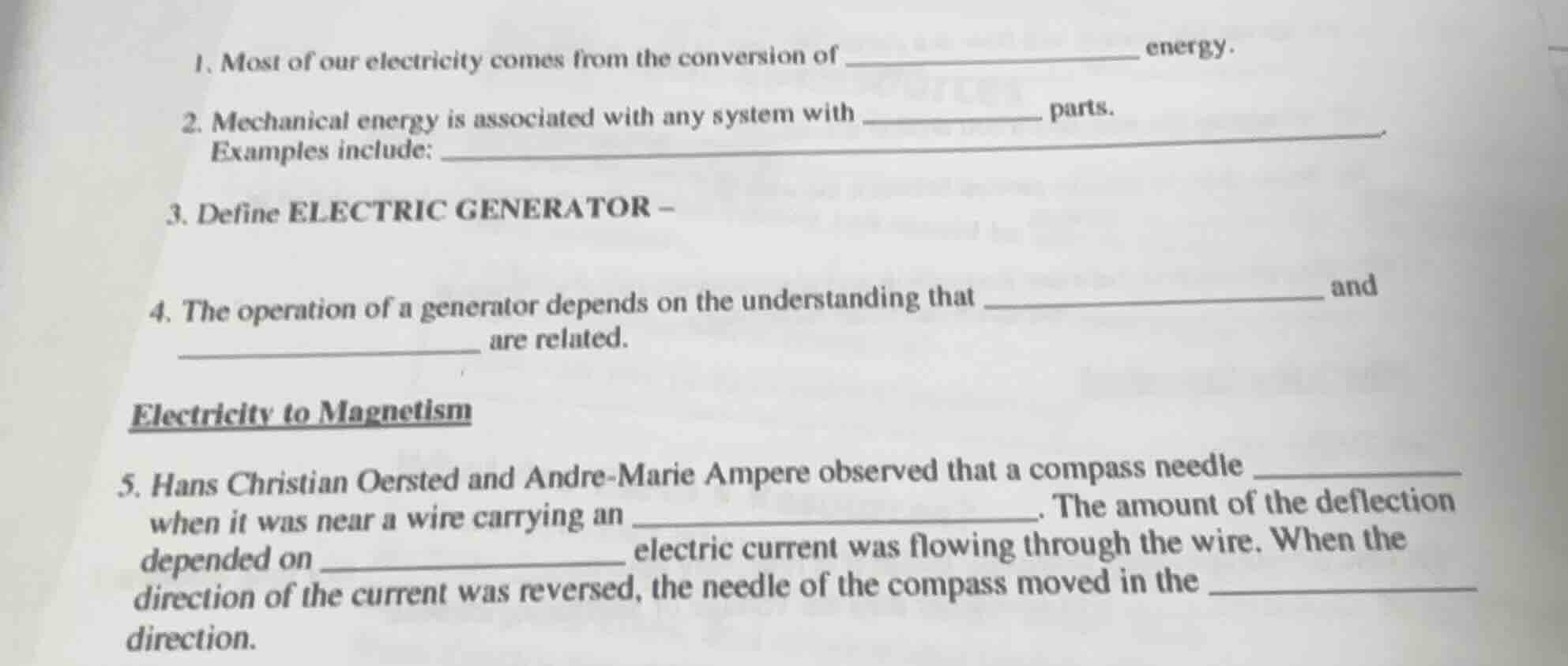
- most of our electricity comes from the conversion of _______________ energy.
- mechanical energy is associated with any system with _________ parts.
examples include: ___________________________________________
- define electric generator –
- the operation of a generator depends on the understanding that ________________ and
________________ are related.
electricity to magnetism
- hans christian oersted and andre - marie ampere observed that a compass needle _________
when it was near a wire carrying an ____________________. the amount of the deflection
depended on _______________ electric current was flowing through the wire. when the
direction of the current was reversed, the needle of the compass moved in the ____________
direction.
Question 1
Most of our electricity comes from the conversion of fossil fuel (or "chemical", "mechanical", etc. – but most commonly fossil fuel - based, or more precisely, "chemical" or "mechanical" in broader terms; however, the most typical source is from the conversion of chemical energy in fossil fuels, or mechanical energy from turbines, but the standard answer here is often "chemical" (from fossil fuels like coal, oil, gas) or "mechanical" (from moving water, wind, etc. to turn turbines). But the most common fill - in is "chemical" (from fossil fuels) or "mechanical". However, the most accurate general answer is that most electricity comes from the conversion of chemical (in fossil fuels) or mechanical** energy. But the most common answer expected here is "chemical" (from burning fossil fuels to produce heat, then mechanical, then electrical) or "mechanical" (from turbines). But the standard answer for this question is often "chemical" (as fossil fuels are chemical energy sources) or "mechanical". Let's go with the most common: "chemical" (or "fossil fuel" - related, but in terms of energy type, "chemical").
Mechanical energy is associated with any system with moving parts. Examples include: a car (with moving wheels, engine parts), a pendulum (the bob moves), a windmill (the blades move), etc. The key here is that mechanical energy involves kinetic (motion) and potential (position) energy, so systems with moving parts.
An electric generator is a device that converts mechanical energy (or other forms of energy) into electrical energy. It works on the principle of electromagnetic induction, where a conductor is moved through a magnetic field (or a magnetic field is moved around a conductor) to induce an electric current.

Snap & solve any problem in the app
Get step-by-step solutions on Sovi AI
Photo-based solutions with guided steps
Explore more problems and detailed explanations
chemical (or mechanical, depending on context; but most common is chemical)