QUESTION IMAGE
Question
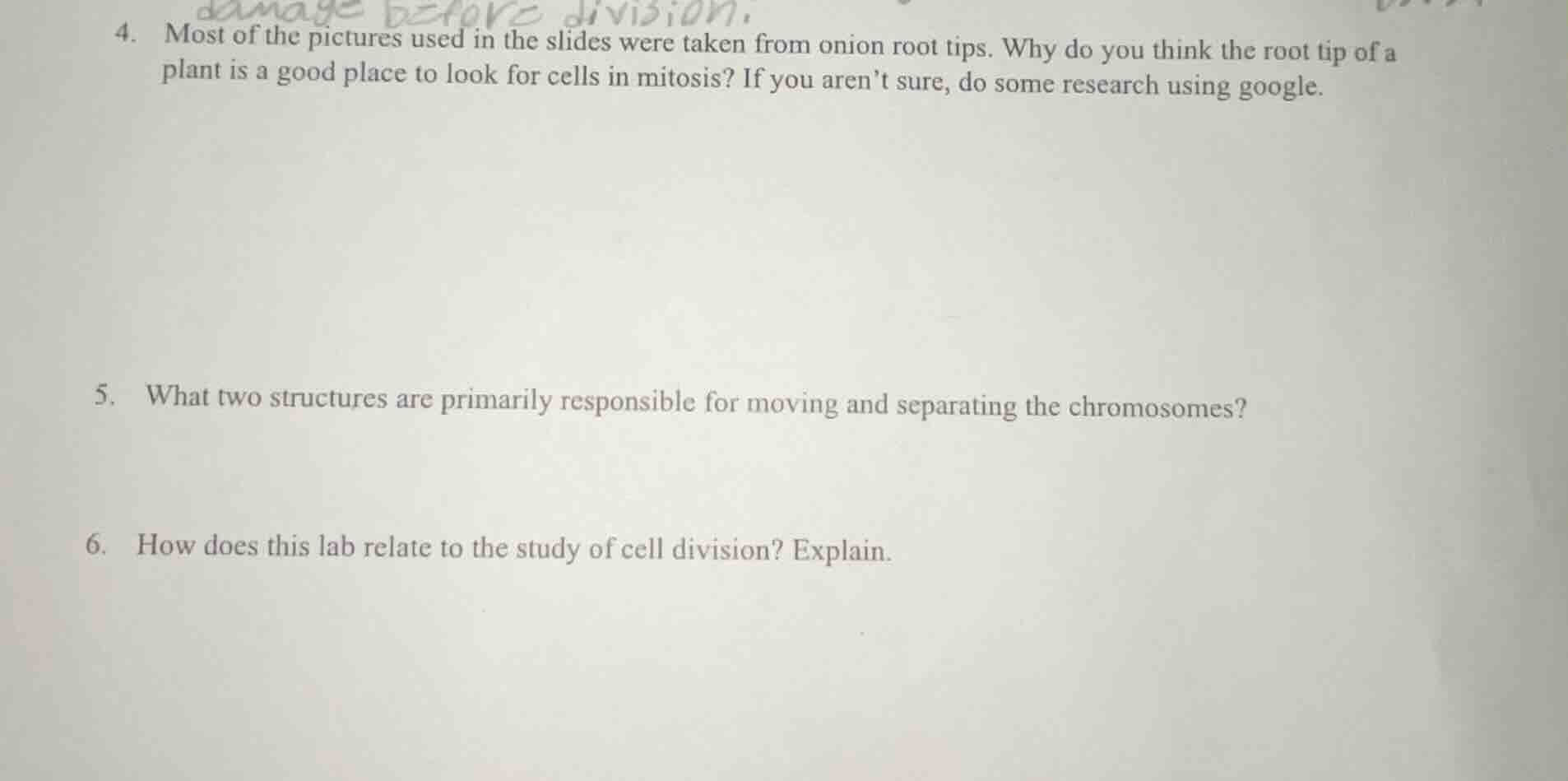
- most of the pictures used in the slides were taken from onion root tips. why do you think the root tip of a plant is a good place to look for cells in mitosis? if you arent sure, do some research using google.
- what two structures are primarily responsible for moving and separating the chromosomes?
- how does this lab relate to the study of cell division? explain.
For Question 4:
Plant root tips have an apical meristem, a region of undifferentiated cells that rapidly undergo mitosis to enable root growth. This high rate of cell division means a large proportion of cells are in some stage of mitosis at any given time, making it easy to observe these cells under a microscope.
For Question 5:
Spindle fibers (microtubules) attach to chromosomes at their kinetochores, and the centrosomes (spindle poles) organize and anchor the spindle fibers. Together, they generate the force to align, move, and separate chromosomes during mitosis and meiosis.
For Question 6:
This lab involves observing cells in mitosis (likely from onion root tips), which directly lets learners visualize the distinct stages of cell division, identify key structures involved, and confirm the sequence of events in mitosis. It bridges theoretical knowledge of cell division with concrete, observable evidence, helping to reinforce understanding of how cells replicate and grow.

Snap & solve any problem in the app
Get step-by-step solutions on Sovi AI
Photo-based solutions with guided steps
Explore more problems and detailed explanations
- The root tip has an apical meristem with rapidly dividing cells, so many cells are in mitosis at any time, making observation easy.
- Spindle fibers (microtubules) and centrosomes (spindle poles)
- The lab lets learners directly observe the stages and structures of mitosis, bridging theoretical knowledge of cell division with tangible visual evidence to reinforce understanding of how cells replicate.