QUESTION IMAGE
Question
mount fuji
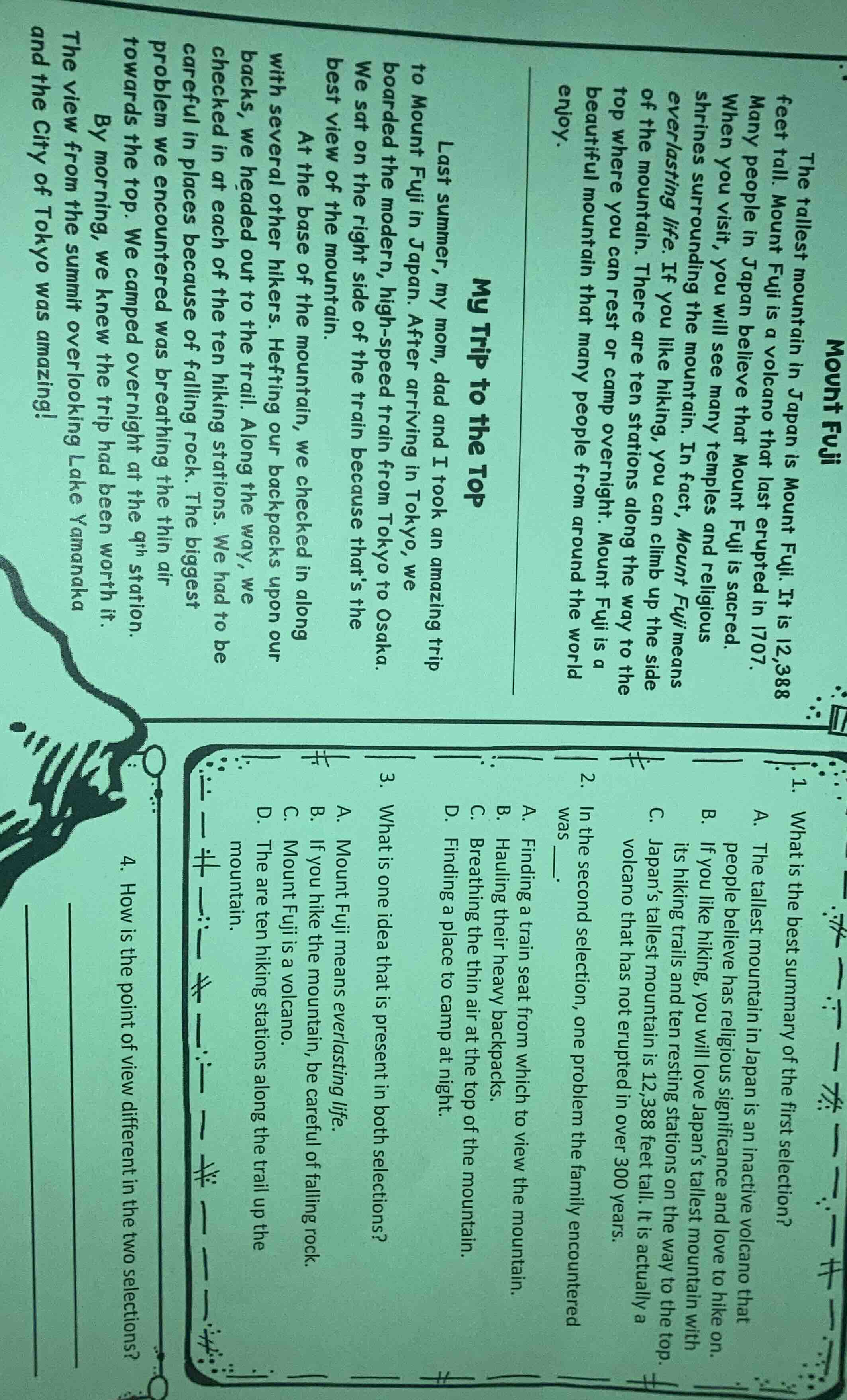
the tallest mountain in japan is mount fuji. it is 12,388 feet tall. mount fuji is a volcano that last erupted in 1707. many people in japan believe that mount fuji is sacred. when you visit, you will see many temples and religious shrines surrounding the mountain. in fact, mount fuji means everlasting life. if you like hiking, you can climb up the side of the mountain. there are ten stations along the way to the top where you can rest or camp overnight. mount fuji is a beautiful mountain that many people from around the world enjoy.
my trip to the top
last summer, my mom, dad and i took an amazing trip to mount fuji in japan. after arriving in tokyo, we boarded the modern, high - speed train from tokyo to osaka. we sat on the right side of the train because thats the best view of the mountain.
at the base of the mountain, we checked in along with several other hikers. hefting our backpacks upon our backs, we headed out to the trail. along the way, we checked in at each of the ten hiking stations. we had to be careful in places because of falling rock. the biggest problem we encountered was breathing the thin air towards the top. we camped overnight at the 9th station.
by morning, we knew the trip had been worth it. the view from the summit overlooking lake yamanaka and the city of tokyo was amazing!
- what is the best summary of the first selection?
a. the tallest mountain in japan is an inactive volcano that people believe has religious significance and love to hike on.
b. if you like hiking, you will love japan’s tallest mountain with its hiking trails and ten resting stations on the way to the top.
c. japan’s tallest mountain is 12,388 feet tall. it is actually a volcano that has not erupted in over 300 years.
- in the second selection, one problem the family encountered was ____.
a. finding a train seat from which to view the mountain.
b. hauling their heavy backpacks.
c. breathing the thin air at the top of the mountain.
d. finding a place to camp at night.
- what is one idea that is present in both selections?
a. mount fuji means everlasting life.
b. if you hike the mountain, be careful of falling rock.
c. mount fuji is a volcano.
d. the are ten hiking stations along the trail up the mountain.
- how is the point of view different in the two selections?
Question 1
To determine the best summary, we analyze each option:
- Option A: The first selection states Mount Fuji is the tallest mountain in Japan and a volcano that erupted in 1707 (so active? No, 1707 was last eruption, but the option says "inactive" which is incorrect). Also, the religious significance and hiking part is from the second selection. So A is wrong.
- Option B: The first selection has info about it being a volcano, tallest in Japan, last eruption. The second has hiking trails, ten stations. So B combines info from both? Wait, no, the question is "best summary of the first selection". Wait, maybe I misread. Wait, the first selection (left column?) Wait, the first selection (the text on the right: "The tallest mountain... enjoy.") Let's re - read the first text: It says Mount Fuji is the tallest in Japan, a volcano (last erupted 1707), many people in Japan believe it's sacred, has temples/shrines, means everlasting life, ten stations for hiking/camping, beautiful. Now the options for question 1:
Option C: "Japan’s tallest mountain is 12,388 feet tall. It is actually a volcano that has not erupted in over 300 years." The text says it's 12,388 feet, erupted in 1707 (so over 300 years ago). So this matches the first text's facts.
Option B: Talks about hiking trails and ten stations, which is also in the first text? Wait, the first text says "there are ten stations along the way to the top...". Wait, maybe the options are for summarizing the first text. Let's check each option again.
Option A: Says "inactive volcano" but the text just says last erupted in 1707, not that it's inactive. And the religious significance is there, but the "people believe has religious significance" is in the first text. But the "inactive" is wrong.
Option C: Correctly states height, volcano, and no eruption in over 300 years (1707 to now is over 300). So C is correct.
From the second text ("My Trip to the Top"): "Hefting our backpacks upon our backs, we headed out to the trail." Hefting means hauling, so the problem they encountered was hauling their heavy backpacks. Let's check options:
Option A: Finding a train seat - they sat on the right side for best view, no problem with finding a seat.
Option B: "Hauling their heavy backpacks." This matches the "Hefting our backpacks" part, which was a problem? Wait, the question is "one problem the family encountered was...". The text says "the biggest problem we encountered was breathing the thin air" - wait, no, wait the second text: "At the base... feet. By morning... amazing!". Wait, the problem was breathing thin air? Wait, no, the options:
Option C: "Breathing the thin air at the top of the mountain." The text says "the biggest problem we encountered was breathing the thin air towards the top." So C is correct? Wait, no, the options for question 2:
Wait, the second text: "We sat... best view. At the base... hikers. Hefting... trail. Along the way... falling rock. The biggest problem... breathing the thin air towards the top. We camped... morning... view... amazing!". So the problem was breathing thin air at the top. So option C. But wait, the options are:
A. Finding a train seat... - no, they sat on the right for view.
B. Hauling their heavy backpacks - hefting backpacks was at the base, not a problem. The problem was breathing thin air.
C. Breathing the thin air at the top... - yes.
D. Finding a place to camp... - they camped at the 9th station, no problem finding.
So the answer is C.
We need an idea present in both selections. Let's check each option:
Option A: "Mount Fuji means everlasting life." This is only in the first selection (the right text: "Mount Fuji means everlasting life"). Not in the second (the trip text).
Option B: "If you hike the mountain, be careful of falling rock." Only in the second selection ( "we had to be careful in places because of falling rock").
Option C: "Mount Fuji is a volcano." Only in the first selection ( "Mount Fuji is a volcano that last erupted in 1707").
Option D: "There are ten hiking stations along the trail up the mountain." Both selections: first text (right) says "there are ten stations along the way to the top...", second text (trip) says "we checked in at each of the ten hiking stations". So D is present in both.

Snap & solve any problem in the app
Get step-by-step solutions on Sovi AI
Photo-based solutions with guided steps
Explore more problems and detailed explanations
C. Japan’s tallest mountain is 12,388 feet tall. It is actually a volcano that has not erupted in over 300 years.