QUESTION IMAGE
Question
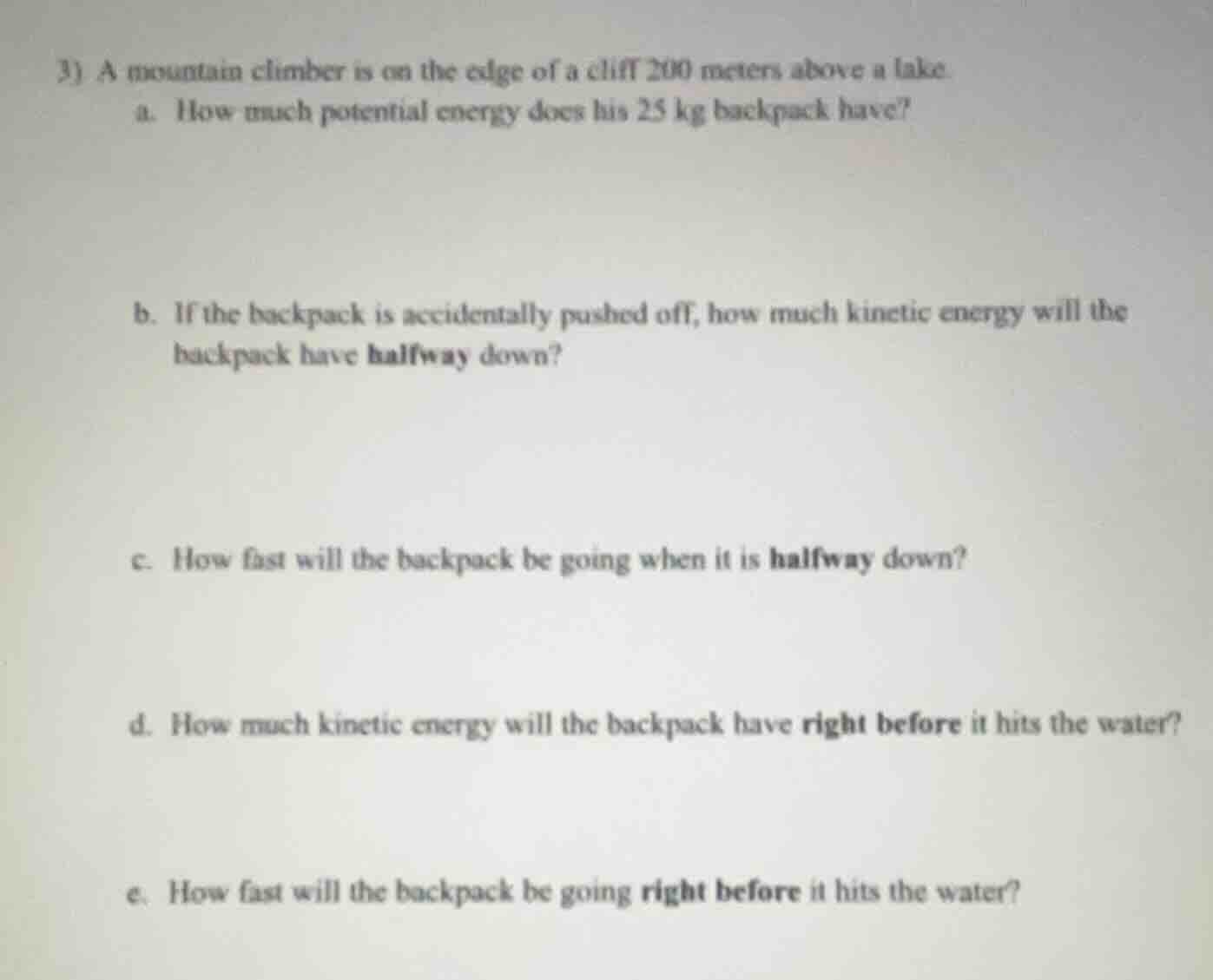
- a mountain climber is on the edge of a cliff 200 meters above a lake.
a. how much potential energy does his 25 kg backpack have?
b. if the backpack is accidentally pushed off, how much kinetic energy will the backpack have halfway down?
c. how fast will the backpack be going when it is halfway down?
d. how much kinetic energy will the backpack have right before it hits the water?
e. how fast will the backpack be going right before it hits the water?
Part a
Step1: Recall the formula for gravitational potential energy
The formula for gravitational potential energy is \( PE = mgh \), where \( m \) is the mass, \( g \) is the acceleration due to gravity (we'll use \( g = 9.8 \, \text{m/s}^2 \)), and \( h \) is the height.
Step2: Substitute the given values
We have \( m = 25 \, \text{kg} \), \( g = 9.8 \, \text{m/s}^2 \), and \( h = 200 \, \text{m} \). Plugging these into the formula:
\( PE = 25 \times 9.8 \times 200 \)
Step3: Calculate the result
First, calculate \( 25 \times 9.8 = 245 \). Then, \( 245 \times 200 = 49000 \, \text{J} \).
Step1: Understand the conservation of mechanical energy
Assuming no air resistance, the total mechanical energy (potential + kinetic) is conserved. At the top, the kinetic energy \( KE_{top} = 0 \), so the total mechanical energy \( E_{total} = PE_{top} \). Halfway down, the height is \( h_{half} = \frac{200}{2} = 100 \, \text{m} \). The potential energy at halfway is \( PE_{half} = mgh_{half} \), and the kinetic energy \( KE_{half} = E_{total} - PE_{half} \).
Step2: Calculate \( PE_{top} \) (which is \( E_{total} \))
From part a, \( PE_{top} = 49000 \, \text{J} \), so \( E_{total} = 49000 \, \text{J} \).
Step3: Calculate \( PE_{half} \)
Using \( PE = mgh \) with \( m = 25 \, \text{kg} \), \( g = 9.8 \, \text{m/s}^2 \), and \( h = 100 \, \text{m} \):
\( PE_{half} = 25 \times 9.8 \times 100 = 24500 \, \text{J} \)
Step4: Calculate \( KE_{half} \)
\( KE_{half} = E_{total} - PE_{half} = 49000 - 24500 = 24500 \, \text{J} \)
Step1: Recall the formula for kinetic energy
The formula for kinetic energy is \( KE = \frac{1}{2}mv^2 \), where \( m \) is the mass and \( v \) is the velocity. We know \( KE_{half} = 24500 \, \text{J} \) from part b and \( m = 25 \, \text{kg} \). We need to solve for \( v \).
Step2: Rearrange the kinetic energy formula to solve for \( v \)
Starting with \( KE = \frac{1}{2}mv^2 \), multiply both sides by 2: \( 2KE = mv^2 \). Then divide both sides by \( m \): \( v^2 = \frac{2KE}{m} \). Take the square root of both sides: \( v = \sqrt{\frac{2KE}{m}} \).
Step3: Substitute the values
Substitute \( KE = 24500 \, \text{J} \) and \( m = 25 \, \text{kg} \):
\( v = \sqrt{\frac{2 \times 24500}{25}} \)
Step4: Calculate the result
First, calculate the numerator: \( 2 \times 24500 = 49000 \). Then, \( \frac{49000}{25} = 1960 \). Take the square root of 1960: \( v = \sqrt{1960} \approx 44.27 \, \text{m/s} \) (or we can simplify \( \sqrt{1960} = \sqrt{196 \times 10} = 14\sqrt{10} \approx 44.27 \, \text{m/s} \)).

Snap & solve any problem in the app
Get step-by-step solutions on Sovi AI
Photo-based solutions with guided steps
Explore more problems and detailed explanations
The potential energy of the backpack is \( 49000 \, \text{joules} \) (or \( 4.9 \times 10^4 \, \text{J} \)).