QUESTION IMAGE
Question
the movement of the progress bar may be uneven because questions can be worth more or less (including zero) depending on your answer.
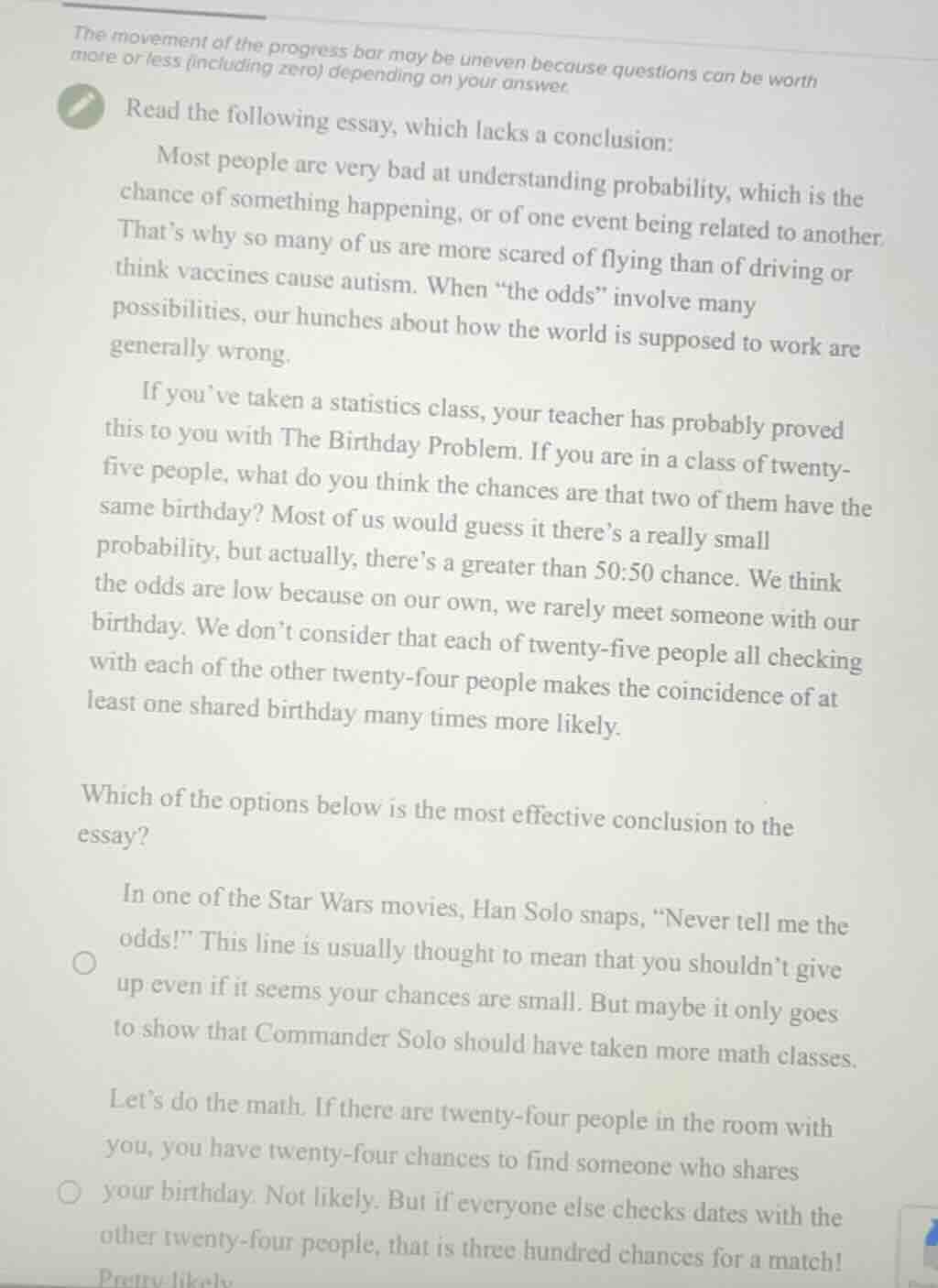
read the following essay, which lacks a conclusion:
most people are very bad at understanding probability, which is the chance of something happening, or of one event being related to another. thats why so many of us are more scared of flying than of driving or think vaccines cause autism. when \the odds\ involve many possibilities, our hunches about how the world is supposed to work are generally wrong.
if youve taken a statistics class, your teacher has probably proved this to you with the birthday problem. if you are in a class of twenty - five people, what do you think the chances are that two of them have the same birthday? most of us would guess it theres a really small probability, but actually, theres a greater than 50:50 chance. we think the odds are low because on our own, we rarely meet someone with our birthday. we dont consider that each of twenty - five people all checking with each of the other twenty - four people makes the coincidence of at least one shared birthday many times more likely.
which of the options below is the most effective conclusion to the essay?
in one of the star wars movies, han solo snaps,
ever tell me the odds!\ this line is usually thought to mean that you shouldnt give up even if it seems your chances are small. but maybe it only goes to show that commander solo should have taken more math classes.
lets do the math. if there are twenty - four people in the room with you, you have twenty - four chances to find someone who shares
your birthday. not likely. but if everyone else checks dates with the other twenty - four people, that is three hundred chances for a match!
To determine the most effective conclusion, we analyze the essay's focus on people's misunderstanding of probability (e.g., the Birthday Problem).
Analyzing Option 1:
This option uses a Star Wars reference. While humorous, it shifts focus to Han Solo’s math skills, which is tangential to the essay’s core (explaining why people misjudge probability). It does not reinforce or conclude the essay’s argument about probability misperceptions.
Analyzing Option 2:
This option directly revisits the Birthday Problem example, breaking down the math (24 vs. 300 chances) to explain why the probability of a shared birthday is high. It aligns with the essay’s goal of illustrating how people’s intuitions about probability are wrong, using the same example to drive the conclusion. It reinforces the essay’s argument clearly.

Snap & solve any problem in the app
Get step-by-step solutions on Sovi AI
Photo-based solutions with guided steps
Explore more problems and detailed explanations
The second option (starting with "Let’s do the math...") is the most effective conclusion. It continues the essay’s focus on the Birthday Problem, explains the probability logic clearly, and reinforces the thesis that people misjudge probability.