QUESTION IMAGE
Question
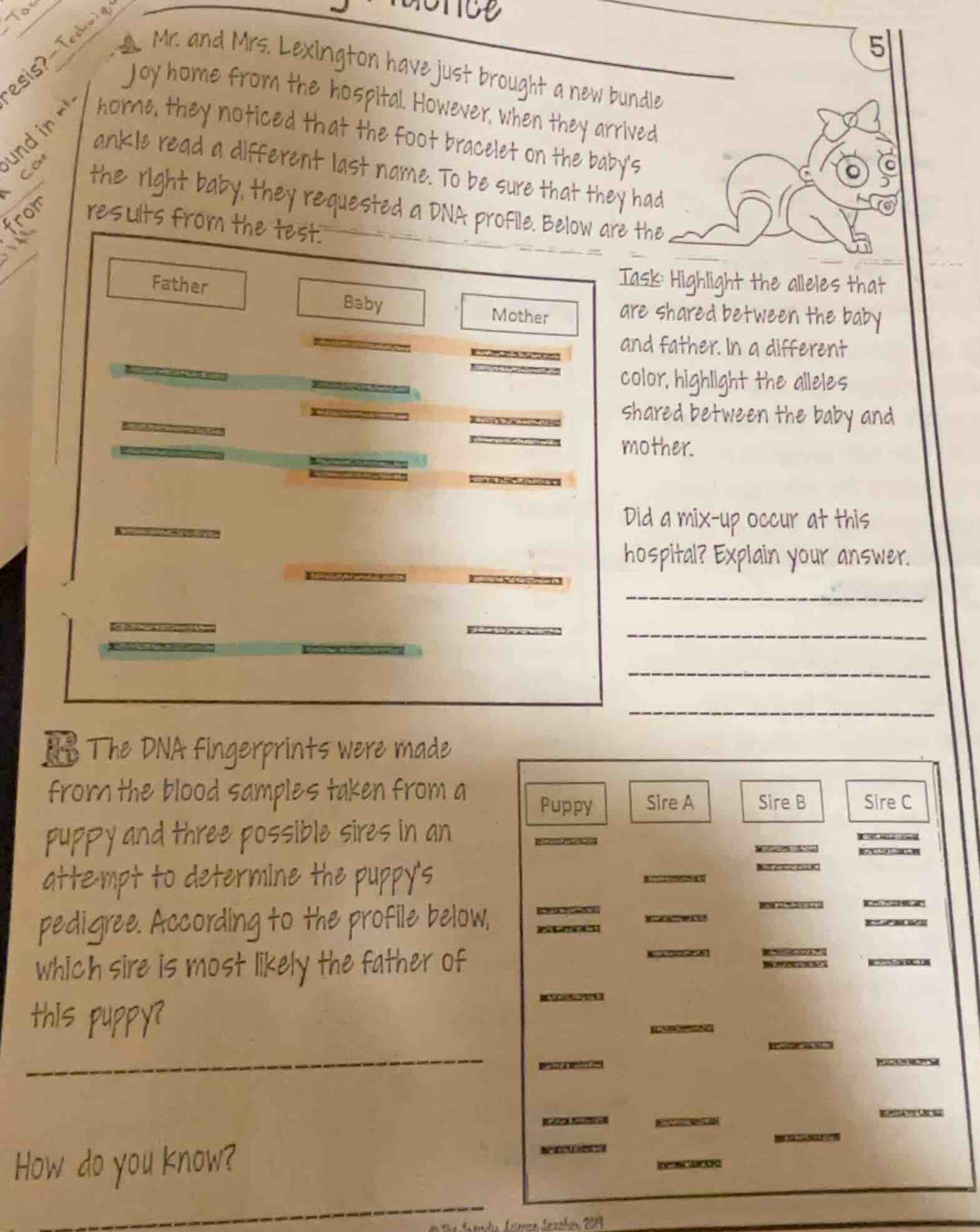
mr. and mrs. lexington have just brought a new bundle joy home from the hospital. however, when they arrived home, they noticed that the foot bracelet on the babys ankle read a different last name. to be sure that they had the right baby, they requested a dna profile. below are the results from the test.
father\tbaby\tmother
task: highlight the alleles that are shared between the baby and father. in a different color, highlight the alleles shared between the baby and mother.
did a mix - up occur at this hospital? explain your answer.
b the dna fingerprints were made from the blood samples taken from a puppy and three possible sires in an attempt to determine the puppys pedigree. according to the profile below, which sire is most likely the father of this puppy?
puppy\tsire a\tsire b\tsire c
how do you know?
Part A: Baby and Parents DNA Analysis
Step 1: Analyze Baby-Father Alleles
- Identify bands (alleles) in the baby’s DNA that match the father’s. Visually, the teal - highlighted bands in the baby’s profile match the father’s teal - highlighted bands. These are the alleles inherited from the father.
Step 2: Analyze Baby-Mother Alleles
- Identify bands (alleles) in the baby’s DNA that match the mother’s. The orange - highlighted bands in the baby’s profile match the mother’s orange - highlighted bands. These are the alleles inherited from the mother.
Step 3: Determine Mix - Up
- A baby’s DNA should have one set of alleles from the father and one from the mother. Here, the baby’s DNA has alleles matching both father (teal bands) and mother (orange bands). So, no mix - up occurred because the baby’s DNA contains alleles from both Mr. and Mrs. Lexington.
Part B: Puppy’s Sire Determination
Step 1: Compare Puppy - Sire Bands
- For each sire (A, B, C), check how many of the puppy’s DNA bands (alleles) match the sire’s.
- Sire C: Visually, most of the puppy’s DNA bands have a corresponding band in Sire C’s profile.
- Sire A: Fewer bands match the puppy’s profile.
- Sire B: Fewer bands match the puppy’s profile compared to Sire C.
Step 2: Conclusion
- Sire C is most likely the father because the puppy’s DNA has the highest number of matching bands (alleles) with Sire C’s DNA profile.

Snap & solve any problem in the app
Get step-by-step solutions on Sovi AI
Photo-based solutions with guided steps
Explore more problems and detailed explanations
s
Part A
- Highlight baby - father alleles (teal - like color) and baby - mother alleles (orange - like color) as per the visual matches.
- No mix - up occurred. The baby’s DNA has alleles from both the father and mother, confirming it is their baby.
Part B
- Most likely sire: Sire C.
- Reason: The puppy’s DNA bands (alleles) have the greatest number of matches with Sire C’s DNA profile, indicating inheritance of alleles from Sire C.