QUESTION IMAGE
Question
¡muchas preguntas!
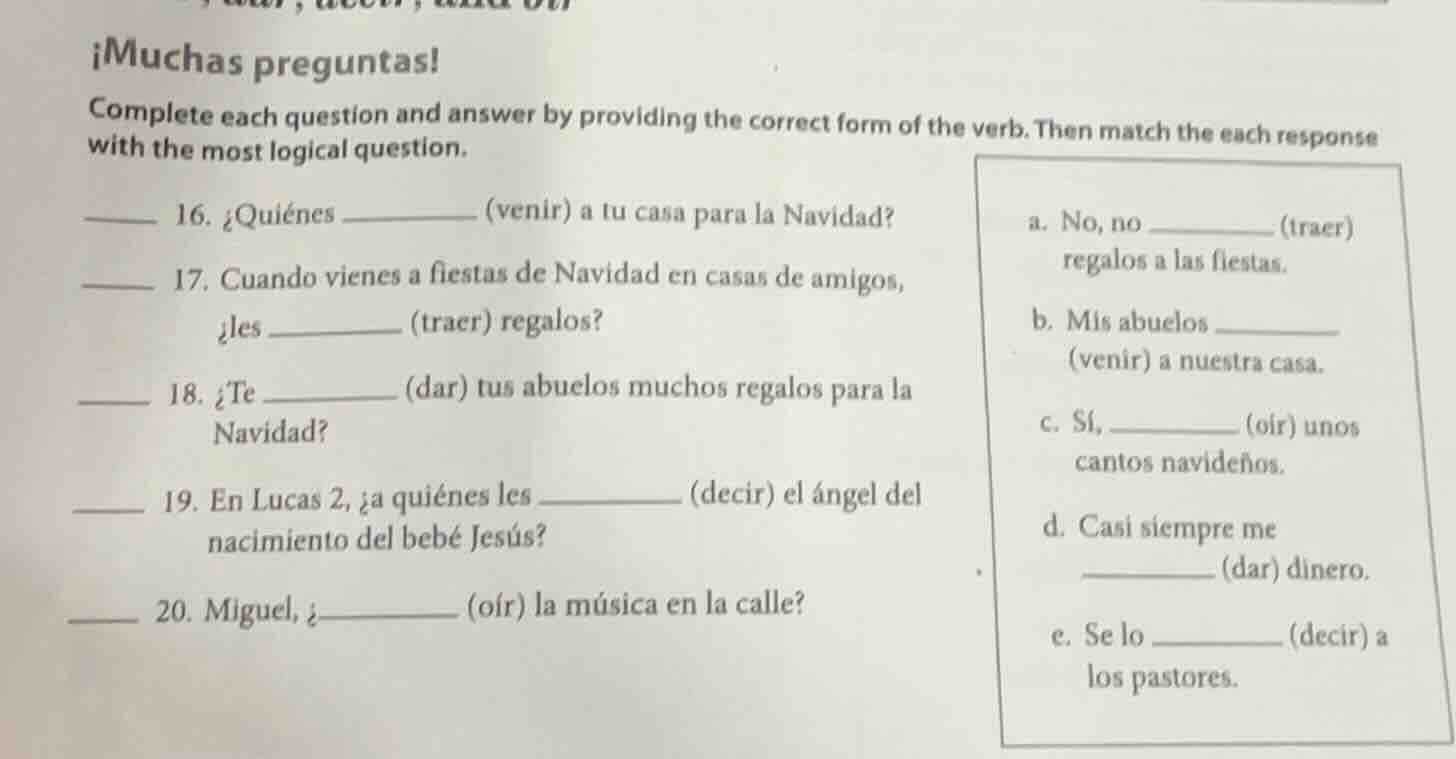
complete each question and answer by providing the correct form of the verb. then match the each response with the most logical question.
__ 16. ¿quiénes __ (venir) a tu casa para la navidad?
__ 17. cuando vienes a fiestas de navidad en casas de amigos, ¿les __ (traer) regalos?
__ 18. ¿te __ (dar) tus abuelos muchos regalos para la navidad?
__ 19. en lucas 2, ¿a quiénes les __ (decir) el ángel del nacimiento del bebé jesús?
__ 20. miguel, ¿__ (oír) la música en la calle?
a. no, no ____ (traer) regalos a las fiestas.
b. mis abuelos ____ (venir) a nuestra casa.
c. sí, ____ (oír) unos cantos navideños.
d. casi siempre me ____ (dar) dinero.
e. se lo ____ (decir) a los pastores.
To solve this, we analyze each question, conjugate the verb, and match with the logical response:
Question 16
- Verb: venir (to come). For "quiénes" (who, plural), present tense conjugation is vienen.
- Response: Option b ("Mis abuelos vienen a nuestra casa") matches (asks who comes, answer says grandparents come).
- So: 16. b; blank: vienen
Question 17
- Verb: traer (to bring). For "tú" (informal you, in the question’s context), present tense conjugation is traes.
- Response: Option a ("No, no traigo regalos...") matches (asks if you bring gifts, answer says no).
- So: 17. a; blank: traes
Question 18
- Verb: dar (to give). For "tus abuelos" (your grandparents, third-person plural), present tense conjugation is dan.
- Response: Option d ("Casi siempre me dan dinero") matches (asks if grandparents give gifts, answer says they give money).
- So: 18. d; blank: dan
Question 19
- Verb: decir (to say). For "el ángel" (the angel, third-person singular), present tense conjugation is dice.
- Response: Option e ("Se lo dice a los pastores") matches (asks who the angel told, answer says shepherds).
- So: 19. e; blank: dice
Question 20
- Verb: oír (to hear). For "tú" (Miguel, informal you), present tense conjugation is oyes.
- Response: Option c ("Sí, oigo unos cantos...") matches (asks if you hear music, answer says yes).
- So: 20. c; blank: oyes
Final Answers
- b; $\boldsymbol{\text{vienen}}$
- a; $\boldsymbol{\text{traes}}$
- d; $\boldsymbol{\text{dan}}$
- e; $\boldsymbol{\text{dice}}$
- c; $\boldsymbol{\text{oyes}}$

Snap & solve any problem in the app
Get step-by-step solutions on Sovi AI
Photo-based solutions with guided steps
Explore more problems and detailed explanations
To solve this, we analyze each question, conjugate the verb, and match with the logical response:
Question 16
- Verb: venir (to come). For "quiénes" (who, plural), present tense conjugation is vienen.
- Response: Option b ("Mis abuelos vienen a nuestra casa") matches (asks who comes, answer says grandparents come).
- So: 16. b; blank: vienen
Question 17
- Verb: traer (to bring). For "tú" (informal you, in the question’s context), present tense conjugation is traes.
- Response: Option a ("No, no traigo regalos...") matches (asks if you bring gifts, answer says no).
- So: 17. a; blank: traes
Question 18
- Verb: dar (to give). For "tus abuelos" (your grandparents, third-person plural), present tense conjugation is dan.
- Response: Option d ("Casi siempre me dan dinero") matches (asks if grandparents give gifts, answer says they give money).
- So: 18. d; blank: dan
Question 19
- Verb: decir (to say). For "el ángel" (the angel, third-person singular), present tense conjugation is dice.
- Response: Option e ("Se lo dice a los pastores") matches (asks who the angel told, answer says shepherds).
- So: 19. e; blank: dice
Question 20
- Verb: oír (to hear). For "tú" (Miguel, informal you), present tense conjugation is oyes.
- Response: Option c ("Sí, oigo unos cantos...") matches (asks if you hear music, answer says yes).
- So: 20. c; blank: oyes
Final Answers
- b; $\boldsymbol{\text{vienen}}$
- a; $\boldsymbol{\text{traes}}$
- d; $\boldsymbol{\text{dan}}$
- e; $\boldsymbol{\text{dice}}$
- c; $\boldsymbol{\text{oyes}}$