QUESTION IMAGE
Question
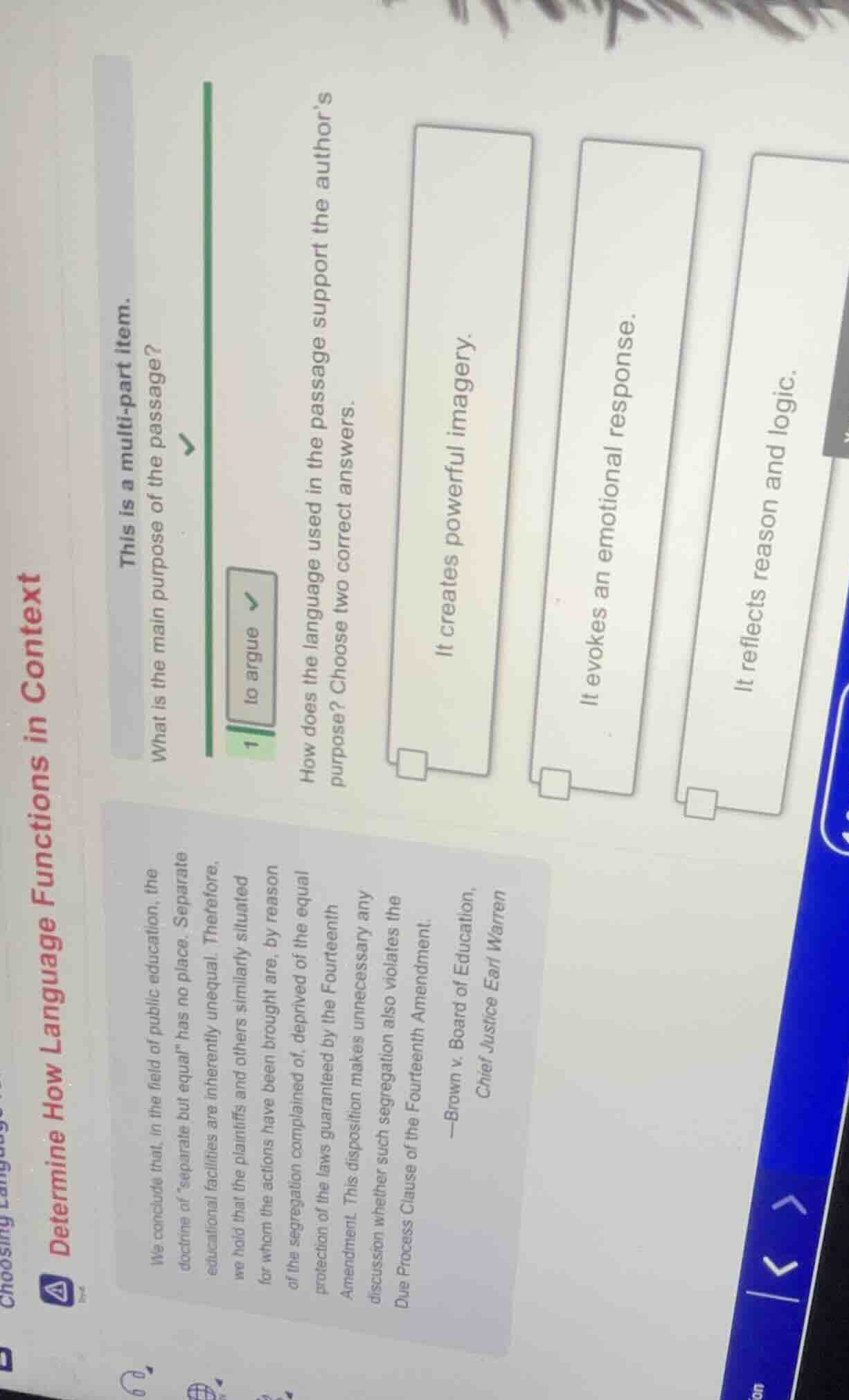
this is a multi - part item. what is the main purpose of the passage? to argue how does the language used in the passage support the author’s purpose? choose two correct answers. it creates powerful imagery. it evokes an emotional response. it reflects reason and logic. we conclude that, in the field of public education, the doctrine of separate but equal has no place. separate educational facilities are inherently unequal. therefore, we hold that the plaintiffs and others similarly situated for whom the actions have been brought are, by reason of the segregation complained of, deprived of the equal protection of the laws guaranteed by the fourteenth amendment. this disposition makes unnecessary any discussion whether such segregation also violates the due process clause of the fourteenth amendment. —brown v. board of education, chief justice earl warren
Part 1: Main Purpose of the Passage
The passage (from Brown v. Board of Education) presents a conclusion about "separate but equal" in public education being inherently unequal, then states the legal reasoning (Fourteenth Amendment) behind why segregation violates rights. The key action word is "conclude" and the reasoning about law/justice, so the main purpose is to argue (as the dropdown suggests) that racial segregation in public education is unconstitutional (violates the Fourteenth Amendment) and inherently unequal.
- "It reflects reason and logic": The passage uses legal reasoning (Fourteenth Amendment, "by reason of segregation... deprived of... equal protection"), structured argumentation (conclusion, legal basis), so this fits.
- "It creates powerful imagery": The passage is formal, legal, and logical—no vivid imagery (e.g., metaphors, descriptive scenes) is used.
- "It evokes an emotional response": The tone is objective and legal, not emotional (no appeals to emotion like empathy or outrage).
Thus, the two correct answers are "It reflects reason and logic" and (note: wait, recheck—wait, the passage is a legal opinion. Wait, maybe I misread. Wait, the options: let's re-express. The author’s purpose is to argue (logical/legal argument). So "It reflects reason and logic" is correct. Is there another? Wait, maybe "It evokes an emotional response" is not, "It creates powerful imagery" is not. Wait, maybe the other correct is... Wait, no—wait, the passage is from a Supreme Court opinion, using logical/legal reasoning. So the two correct are:
- It reflects reason and logic (uses legal reasoning, structured argument).
- Wait, maybe I made a mistake. Wait, the options: let's list them again:
- It creates powerful imagery. (No, formal legal text, no imagery.)
- It evokes an emotional response. (No, objective tone.)
- It reflects reason and logic. (Yes, legal reasoning, logical conclusion.)
Wait, maybe the second correct is... Wait, the passage says "we hold that the plaintiffs... are, by reason of the segregation... deprived of... equal protection"—so logical/legal. So the two correct are "It reflects reason and logic" and maybe another? Wait, maybe the question allows two, so:

Snap & solve any problem in the app
Get step-by-step solutions on Sovi AI
Photo-based solutions with guided steps
Explore more problems and detailed explanations
To argue that racial segregation in public education is inherently unequal and violates the Fourteenth Amendment (or similar summary, but based on the dropdown "to argue" and the passage's content, the main purpose is to argue against "separate but equal" in education and its legal violation).