QUESTION IMAGE
Question
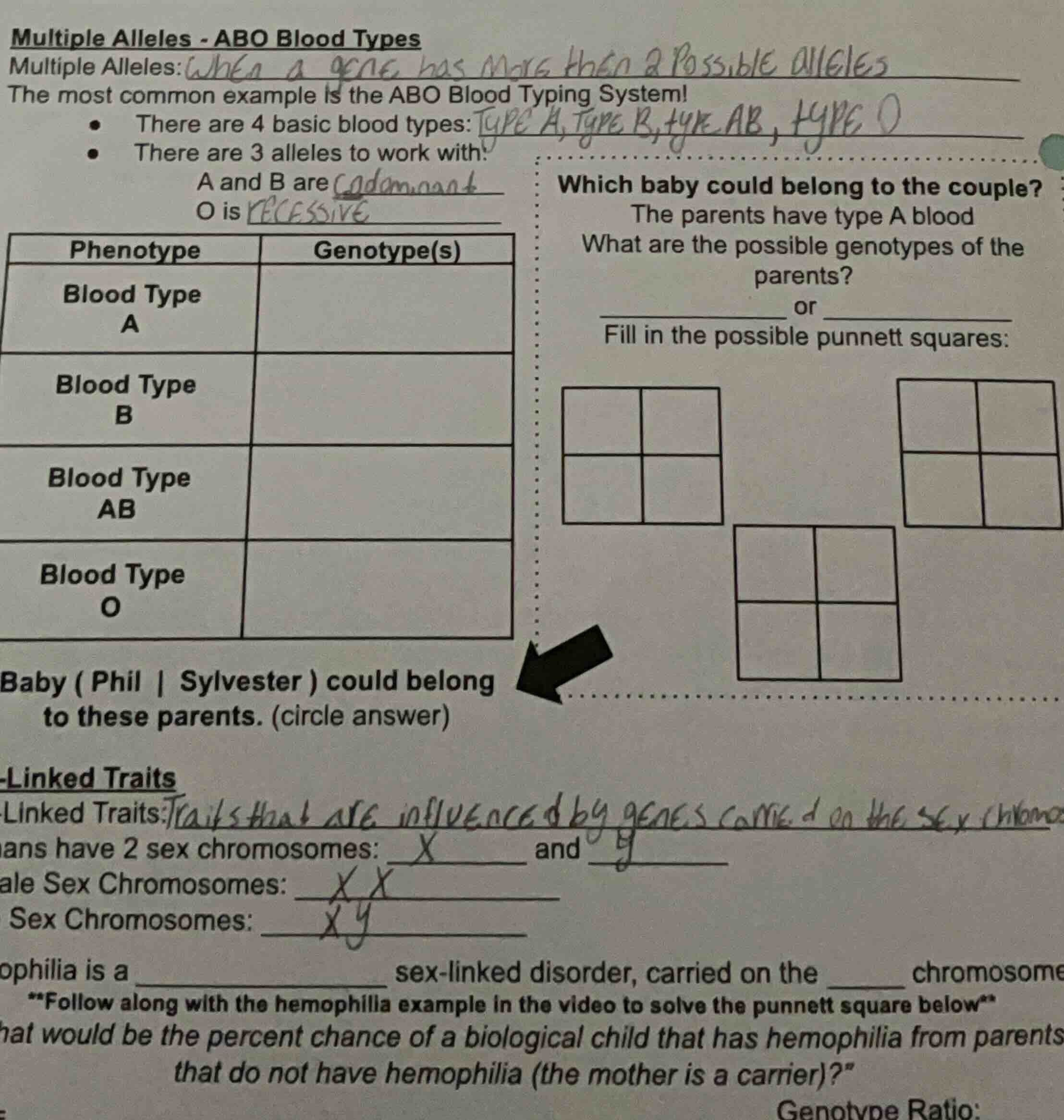
multiple alleles - abo blood types
multiple alleles:
the most common example is the abo blood typing system!
- there are 4 basic blood types:
- there are 3 alleles to work with:
a and b are
o is
| phenotype | genotype(s) |
|---|---|
| blood type b | |
| blood type ab | |
| blood type o |
which baby could belong to the couple?
the parents have type a blood
what are the possible genotypes of the parents?
or
fill in the possible punnett squares:
baby ( phil | sylvester ) could belong to these parents. (circle answer)
-linked traits
linked traits:
ans have 2 sex chromosomes: and
ale sex chromosomes:
sex chromosomes:
ophilia is a sex - linked disorder, carried on the chromosome
follow along with the hemophilia example in the video to solve the punnett square below
hat would be the percent chance of a biological child that has hemophilia from parents that do not have hemophilia (the mother is a carrier)?
genotype ratio:
Part 1: ABO Blood Type Genotypes
Step 1: Recall ABO Blood Type Genetics
In the ABO blood type system:
- Blood Type A can have genotypes \( AA \) (homozygous for A) or \( AO \) (heterozygous, with O recessive).
- Blood Type B can have genotypes \( BB \) or \( BO \).
- Blood Type AB has genotype \( AB \) (A and B are codominant).
- Blood Type O has genotype \( OO \) (homozygous recessive).
Step 2: Determine Parent Genotypes (Type A)
Since both parents have Type A blood, their possible genotypes are \( AA \) or \( AO \) (because A is dominant over O, and O is recessive).
Part 2: Possible Baby Blood Types (Punnett Squares)
Case 1: Both Parents are \( AA \)
- Parent 1 (AA) gametes: \( A \), \( A \)
- Parent 2 (AA) gametes: \( A \), \( A \)
- Punnett Square:
| A | A | |
|---|---|---|
| A | AA | AA |
- All offspring have genotype \( AA \), so blood type A.
Case 2: One Parent \( AA \), One Parent \( AO \)
- Parent 1 (AA) gametes: \( A \), \( A \)
- Parent 2 (AO) gametes: \( A \), \( O \)
- Punnett Square:
| A | A | |
|---|---|---|
| O | AO | AO |
- Offspring genotypes: \( AA \) (50%), \( AO \) (50%) → all blood type A.
Case 3: Both Parents are \( AO \)
- Parent 1 (AO) gametes: \( A \), \( O \)
- Parent 2 (AO) gametes: \( A \), \( O \)
- Punnett Square:
| A | O | |
|---|---|---|
| O | AO | OO |
- Offspring genotypes: \( AA \) (25%), \( AO \) (50%), \( OO \) (25%) → blood types A (75%) or O (25%).
Part 3: Baby Belonging to Parents (Assuming Baby Options)
If the baby (Phil/Sylvester) has a blood type that is A or O (from the Punnett square results), it could belong to Type A parents. For example, if the baby has Type A or O, it is consistent with the parents’ Type A genotypes.
Final Answers (Key Parts)
- Possible parent genotypes: \( \boldsymbol{AA} \) or \( \boldsymbol{AO} \)
- Punnett squares (summarized):
- Both \( AA \): All \( AA \) (Type A)
- Both \( AO \): \( AA \), \( AO \), \( OO \) (Types A, A, O)
- Baby could belong if blood type is A or O (matching Punnett square outcomes).

Snap & solve any problem in the app
Get step-by-step solutions on Sovi AI
Photo-based solutions with guided steps
Explore more problems and detailed explanations
Part 1: ABO Blood Type Genotypes
Step 1: Recall ABO Blood Type Genetics
In the ABO blood type system:
- Blood Type A can have genotypes \( AA \) (homozygous for A) or \( AO \) (heterozygous, with O recessive).
- Blood Type B can have genotypes \( BB \) or \( BO \).
- Blood Type AB has genotype \( AB \) (A and B are codominant).
- Blood Type O has genotype \( OO \) (homozygous recessive).
Step 2: Determine Parent Genotypes (Type A)
Since both parents have Type A blood, their possible genotypes are \( AA \) or \( AO \) (because A is dominant over O, and O is recessive).
Part 2: Possible Baby Blood Types (Punnett Squares)
Case 1: Both Parents are \( AA \)
- Parent 1 (AA) gametes: \( A \), \( A \)
- Parent 2 (AA) gametes: \( A \), \( A \)
- Punnett Square:
| A | A | |
|---|---|---|
| A | AA | AA |
- All offspring have genotype \( AA \), so blood type A.
Case 2: One Parent \( AA \), One Parent \( AO \)
- Parent 1 (AA) gametes: \( A \), \( A \)
- Parent 2 (AO) gametes: \( A \), \( O \)
- Punnett Square:
| A | A | |
|---|---|---|
| O | AO | AO |
- Offspring genotypes: \( AA \) (50%), \( AO \) (50%) → all blood type A.
Case 3: Both Parents are \( AO \)
- Parent 1 (AO) gametes: \( A \), \( O \)
- Parent 2 (AO) gametes: \( A \), \( O \)
- Punnett Square:
| A | O | |
|---|---|---|
| O | AO | OO |
- Offspring genotypes: \( AA \) (25%), \( AO \) (50%), \( OO \) (25%) → blood types A (75%) or O (25%).
Part 3: Baby Belonging to Parents (Assuming Baby Options)
If the baby (Phil/Sylvester) has a blood type that is A or O (from the Punnett square results), it could belong to Type A parents. For example, if the baby has Type A or O, it is consistent with the parents’ Type A genotypes.
Final Answers (Key Parts)
- Possible parent genotypes: \( \boldsymbol{AA} \) or \( \boldsymbol{AO} \)
- Punnett squares (summarized):
- Both \( AA \): All \( AA \) (Type A)
- Both \( AO \): \( AA \), \( AO \), \( OO \) (Types A, A, O)
- Baby could belong if blood type is A or O (matching Punnett square outcomes).