QUESTION IMAGE
Question
multiple choice
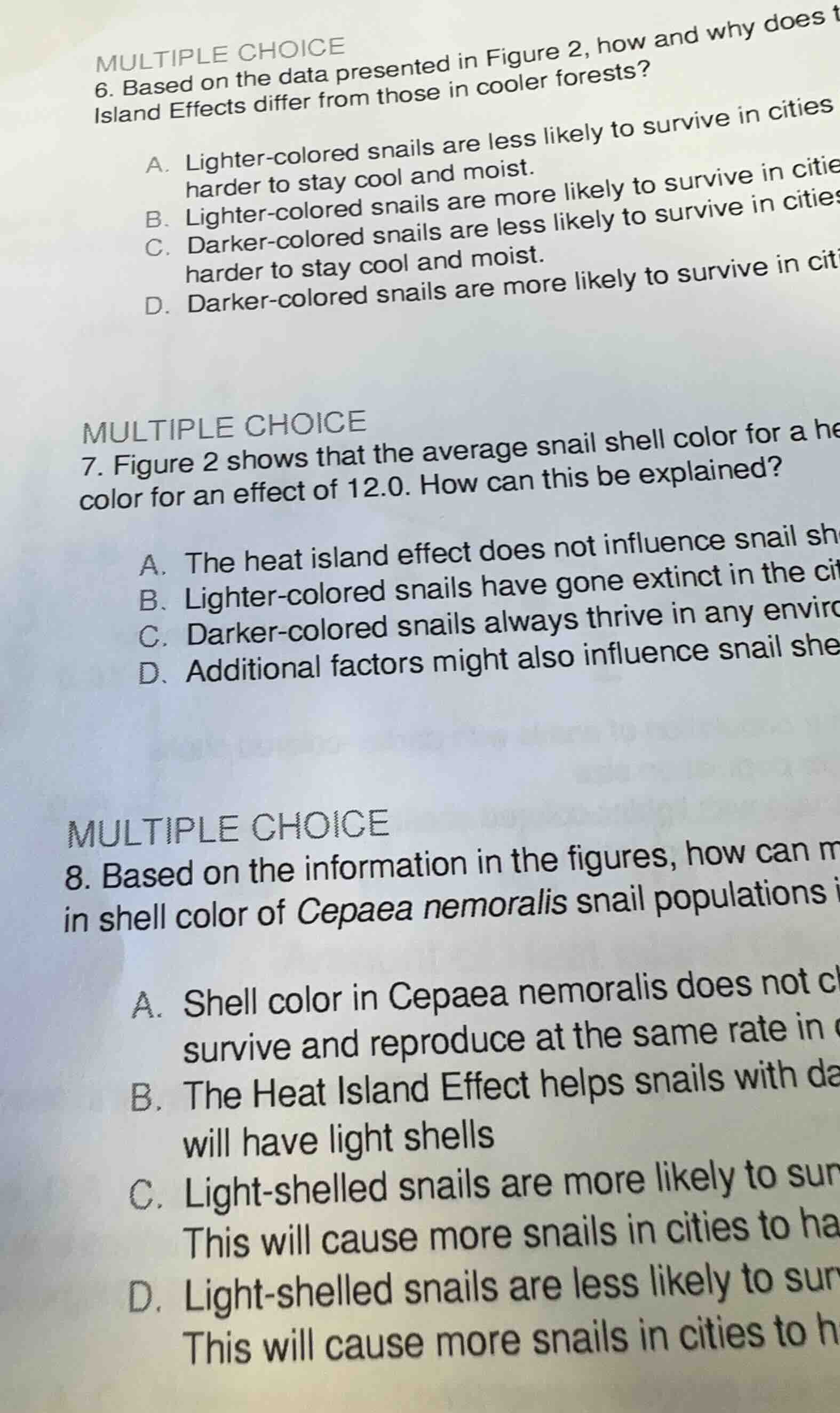
- based on the data presented in figure 2, how and why does island effects differ from those in cooler forests?
a. lighter - colored snails are less likely to survive in cities harder to stay cool and moist.
b. lighter - colored snails are more likely to survive in citie
c. darker - colored snails are less likely to survive in citie harder to stay cool and moist.
d. darker - colored snails are more likely to survive in cit
multiple choice
- figure 2 shows that the average snail shell color for a he color for an effect of 12.0. how can this be explained?
a. the heat island effect does not influence snail sh
b. lighter - colored snails have gone extinct in the ci
c. darker - colored snails always thrive in any envirc
d. additional factors might also influence snail she
multiple choice
- based on the information in the figures, how can m in shell color of cepaea nemoralis snail populations i
a. shell color in cepaea nemoralis does not cl survive and reproduce at the same rate in
b. the heat island effect helps snails with da will have light shells
c. light - shelled snails are more likely to sur this will cause more snails in cities to ha
d. light - shelled snails are less likely to sur this will cause more snails in cities to h
Question 6
To solve this, we analyze the heat island effect (cities are warmer) and snail survival. Darker colors absorb more heat, so in warmer city (heat island) environments, darker - colored snails would have a harder time staying cool and moist, making them less likely to survive. Lighter - colored snails reflect heat, so they are more likely to survive in cities. Option A says lighter - colored snails are less likely (wrong). Option B says lighter - colored snails are more likely (correct logic, but let's check others). Option C says darker - colored snails are less likely (but the reason given is wrong as darker absorbs heat, so in warmer cities, they have a harder time, but the option's reason is same as A's wrong reason? Wait, no, the key is survival. In warmer cities, darker snails have trouble staying cool/moist, so they are less likely? Wait, no, the heat island makes cities warmer. So for snails, in cooler forests, maybe darker is better, but in warmer cities, lighter is better. So lighter - colored snails are more likely to survive in cities (because they don't absorb as much heat, so stay cooler and moist). Wait, the options:
A: Lighter - colored snails less likely in cities (wrong, because lighter reflects heat, better in warm cities).
B: Lighter - colored snails more likely in cities (correct, as lighter color helps in warm city environment to stay cool and moist).
C: Darker - colored snails less likely in cities, harder to stay cool and moist (darker absorbs heat, so in warm city, they get too hot, hard to stay cool/moist, so less likely. But wait, the question is how Island Effects (city, warm) differ from cooler forests. So in cooler forests, darker might be better (absorb heat), in warm cities, lighter is better. So the correct answer should be B? Wait, maybe I misread. Wait the options:
Wait the original question: "how and why does Island Effects differ from those in cooler forests?"
Island effect (city) is warmer. So in cities (warmer), lighter - colored snails (which reflect heat) are more likely to survive (because they don't overheat), while in cooler forests, darker - colored snails (which absorb heat) might be more likely. So the difference is that in cities (island effect), lighter - colored snails are more likely to survive. So option B: "Lighter - colored snails are more likely to survive in cities" (assuming the rest of the option is correct, maybe the original had a typo, but among the options, B is the correct one based on heat absorption/reflection and survival in warm environment.
The question is about why the average snail shell color for a heat island effect of 12.0 is different (the full question is a bit cut off, but the options:
A: Heat island effect does not influence snail shell color (wrong, because heat island is a factor).
B: Lighter - colored snails have gone extinct in the city (extinct is extreme, unlikely).
C: Darker - colored snails always thrive in any environment (always is wrong, no species thrives in all environments).
D: Additional factors might also influence snail shell color (correct, because in ecology, multiple factors (like predation, food availability, other environmental factors) can influence traits besides just the heat island effect).
The question is about changes in shell color of Cepaea nemoralis snail populations. Let's analyze the options:
A: Shell color does not change, all survive/reproduce same (wrong, because natural selection would act on shell color based on environment).
B: Heat Island Effect helps snails with dark... will have light shells (nonsensical, mixed message).
C: Light - shelled snails more likely to survive... cause more snails in cities to have light shells (if light - shelled snails are more likely to survive in cities (heat island, warm), then over time, the population will have more light - shelled snails. This is natural selection: favorable trait (light shell in warm city) leads to more survival and reproduction, so more light - shelled snails.
D: Light - shelled snails less likely to survive... cause more snails in cities to have... (if light - shelled are less likely, then dark - shelled would be more, so D is wrong).
So option C makes sense: Light - shelled snails are more likely to survive (in warm city environment), so over time, more snails in cities will have light shells (due to natural selection, as light - shelled snails survive and reproduce more).

Snap & solve any problem in the app
Get step-by-step solutions on Sovi AI
Photo-based solutions with guided steps
Explore more problems and detailed explanations
B. Lighter - colored snails are more likely to survive in cities