QUESTION IMAGE
Question
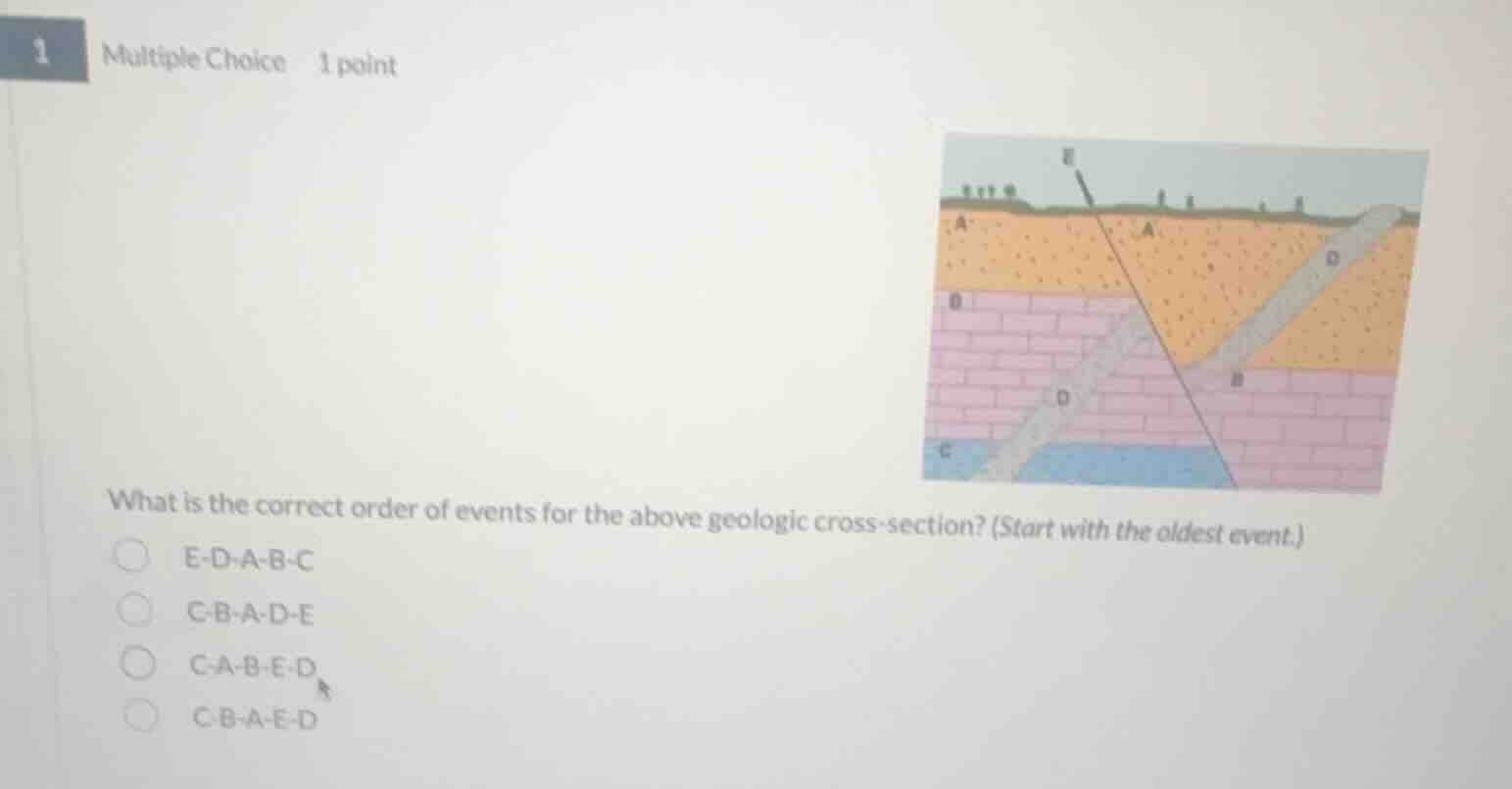
1 multiple choice 1 point what is the correct order of events for the above geologic cross - section? (start with the oldest event.) e - d - a - b - c c - b - a - d - e c - a - b - e - d c - b - a - e - d
To determine the order of geologic events, we use the principle of superposition (older layers are below younger ones) and cross - cutting relationships (a feature that cuts another is younger).
- First, identify the oldest layer. Layer C is at the bottom, so it is the oldest (deposition of C).
- Then layer B is deposited on top of C, so B is younger than C (deposition of B).
- Next, layer A is deposited on top of B, so A is younger than B (deposition of A).
- Then, the fault E cuts through A, B, and C, so E is younger than A, B, and C (formation of fault E).
- Finally, the dike D cuts through A, B, and E? No, looking at the cross - section, D cuts through A, B, and C, but after E? Wait, no. Wait, D is a dike. Wait, the correct sequence: C (oldest, deposited first), then B (deposited on C), then A (deposited on B), then E (fault cuts A, B, C), then D (dike? Wait, no, in the options, the correct sequence should be C - B - A - E - D? Wait, no, let's re - evaluate. Wait, the options: Let's check the options. The second option is C - B - A - D - E? No, the fourth option is C - B - A - E - D. Wait, the cross - cutting: E is a fault, D is a dike. A fault (E) that cuts through layers is younger than the layers it cuts. A dike (D) that cuts through the fault (E) would be younger than E. Wait, in the diagram, D cuts through E? Wait, no, looking at the diagram, D is a dike that goes through A, B, and C, and E is a fault that cuts through A, B, C, and D? Wait, no, maybe I got it wrong. Wait, the correct order using superposition and cross - cutting:
- Deposition of C (oldest, at the bottom).
- Deposition of B (on top of C).
- Deposition of A (on top of B).
- Then, fault E forms (cuts A, B, C) – so E is younger than A, B, C.
- Then, dike D forms (cuts E? No, in the diagram, D is a dike that is offset by E? Wait, no, maybe D is a dike that was intruded before E? No, the fault E cuts through D? Wait, the diagram shows E as a fault line, and D as a dike. If E cuts through D, then E is younger than D. But that contradicts. Wait, maybe the correct order is C (oldest), B (next), A (next), then D (intrusion), then E (fault). But the options don't have that. Wait, the options are:
- E - D - A - B - C (wrong, E can't be oldest)
- C - B - A - D - E (D before E? If E is a fault that cuts D, then E is younger than D, so D is older than E, so this could be wrong)
- C - A - B - E - D (wrong, A can't be before B, superposition says B is below A, so B is older than A)
- C - B - A - E - D (C (oldest), B (next), A (next), E (fault, cuts A, B, C), D (dike, cuts E? So D is younger than E). Wait, but in the diagram, D is a dike that is offset by E? No, maybe D is a dike that was intruded, then E faulted it. So the order is C (deposited), B (deposited on C), A (deposited on B), D (intruded through A, B, C), then E (faulted, cutting D, A, B, C). But that would be C - B - A - D - E, but that's the second option. Wait, I'm confused. Wait, the key is superposition (older layers below) and cross - cutting (a feature that cuts is younger). So:
- Layers: C (bottom, oldest), B (above C), A (above B). So C is older than B, older than A.
- Then, D is a dike that intrudes through A, B, C – so D is younger than A, B, C (because it cuts them).
- Then, E is a fault that cuts through A, B, C, and D – so E is younger than D (because it cuts D).
But the options don't have C - B - A - D - E as the correct? Wait, no, the second option is C - B - A - D - E, and the fourth is C - B - A - E - D. Wait, maybe I made a mistake in identifying D and E. Maybe D is a sedimentary layer?…

Snap & solve any problem in the app
Get step-by-step solutions on Sovi AI
Photo-based solutions with guided steps
Explore more problems and detailed explanations
C - B - A - E - D