QUESTION IMAGE
Question
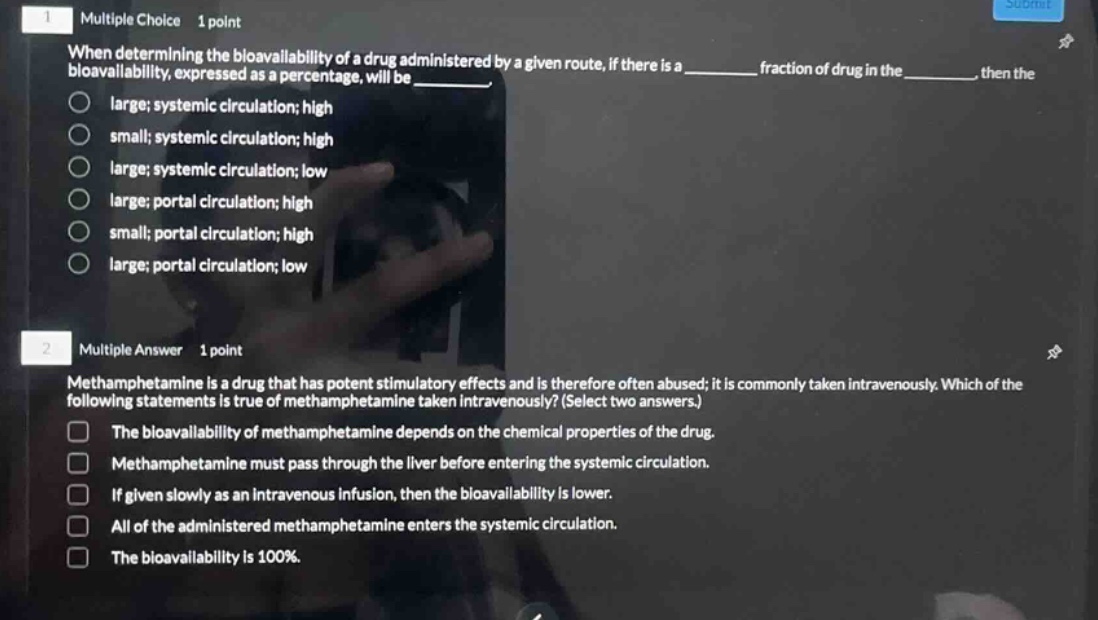
1 multiple choice 1 point when determining the bioavailability of a drug administered by a given route, if there is a ____ fraction of drug in the __ then the bioavailability, expressed as a percentage, will be ____. large; systemic circulation; high small; systemic circulation; high large; systemic circulation; low large; portal circulation; high small; portal circulation; high large; portal circulation; low 2 multiple answer 1 point methamphetamine is a drug that has potent stimulatory effects and is therefore often abused; it is commonly taken intravenously. which of the following statements is true of methamphetamine taken intravenously? (select two answers.) the bioavailability of methamphetamine depends on the chemical properties of the drug. methamphetamine must pass through the liver before entering the systemic circulation. if given slowly as an intravenous infusion, then the bioavailability is lower. all of the administered methamphetamine enters the systemic circulation. the bioavailability is 100%.
Question 1 (Multiple Choice)
Bioavailability is the fraction of drug reaching systemic circulation. A large fraction in portal circulation (e.g., oral route with first - pass metabolism) means less reaches systemic, so bioavailability is low. But for routes where less drug is in portal (or more in systemic), bioavailability is high. Wait, correction: When a drug is administered, if a large fraction is in portal circulation (subject to first - pass metabolism), the amount reaching systemic is less, so bioavailability (which is based on systemic) is low. But the correct logic: If there is a small fraction of drug in portal circulation (so more bypasses portal, like IV or other routes with less first - pass), then more is in systemic, so bioavailability is high? Wait no, let's re - think. Bioavailability (F) is the fraction of drug reaching systemic circulation. If a drug is administered, and there's a large fraction in portal circulation (e.g., oral, where drug goes to portal first), then due to first - pass metabolism in liver, the fraction reaching systemic (systemic circulation) is small, so F is low. But the options: Let's analyze each option.
Option 1: large; systemic circulation; high. If large fraction in systemic, bioavailability (which is about systemic) would be high. But the first blank is "fraction of drug in the...". Wait, the sentence structure: "if there is a __ fraction of drug in the then the bioavailability... will be __".
Bioavailability is the amount reaching systemic. So if a large fraction is in systemic circulation, then bioavailability (which is based on systemic) is high. But that seems circular. Wait, no. Let's think about routes. For example, IV administration: drug goes directly to systemic, so fraction in portal is small, fraction in systemic is large, bioavailability is 100% (high). For oral: drug goes to portal first, so fraction in portal is large, fraction in systemic is small (due to first - pass), so bioavailability is low.
So the correct logic: If there is a small fraction of drug in portal circulation (meaning more drug bypasses portal, like IV), then the fraction in systemic is large, so bioavailability is high. Wait, the options:
Looking at the options:
Option "small; portal circulation; high": If the fraction of drug in portal circulation is small (so more drug is not in portal, i.e., more in systemic), then bioavailability (which is about systemic) is high. Yes, that makes sense. Wait, but let's check the options again.
Wait the options are:
- large; systemic circulation; high
- small; systemic circulation; high
- large; systemic circulation; low
- large; portal circulation; high
- small; portal circulation; high
- large; portal circulation; low
Ah! Let's re - express. The first blank: fraction of drug in the (portal or systemic) circulation. The second blank: the circulation (portal or systemic). The third blank: bioavailability.
Bioavailability is the amount reaching systemic. So if a large fraction is in portal circulation (e.g., oral route, drug absorbed into portal), then due to first - pass metabolism in liver (which is part of portal circulation processing), the fraction reaching systemic is small, so bioavailability is low. So "large; portal circulation; low" is correct? Wait no, the option is "large; portal circulation; low". Let's check:
If there is a large fraction of drug in portal circulation (so most of the absorbed drug is in portal), then after first - pass metabolism, the fraction reaching systemic is small, so bioavailability (which is the fraction reaching systemic) is low. Y…
- "The bioavailability of methamphetamine depends on the chemical properties of the drug." → False. For IV administration, bioavailability is 100% (if no issues), and it doesn't depend on chemical properties in the same way as other routes (since it's directly in systemic). Wait, no. Wait, bioavailability for IV is 100% because it bypasses absorption barriers. But the statement: "The bioavailability of methamphetamine depends on the chemical properties of the drug." → For IV, bioavailability is 100% regardless of chemical properties (as long as it's properly administered). So this statement is false.
- "Methamphetamine must pass through the liver before entering the systemic circulation." → False. IV administration: drug goes directly into systemic circulation, bypassing liver (portal circulation and liver first - pass).
- "If given slowly as an intravenous infusion, then the bioavailability is lower." → False. IV bioavailability is always 100% (assuming complete administration), regardless of infusion rate, because it's directly in systemic.
- "All of the administered methamphetamine enters the systemic circulation." → True. IV administration: drug is injected directly into a vein, so it goes straight to systemic circulation, so all administered drug (assuming no loss during injection) enters systemic.
- "The bioavailability is 100%." → True. For IV administration, bioavailability is 100% because the drug bypasses the absorption phase and first - pass metabolism, so the fraction of drug reaching systemic circulation is 100% of the administered dose (assuming no errors in administration).
So the correct answers are "All of the administered methamphetamine enters the systemic circulation." and "The bioavailability is 100%."

Snap & solve any problem in the app
Get step-by-step solutions on Sovi AI
Photo-based solutions with guided steps
Explore more problems and detailed explanations
- large; portal circulation; low