QUESTION IMAGE
Question
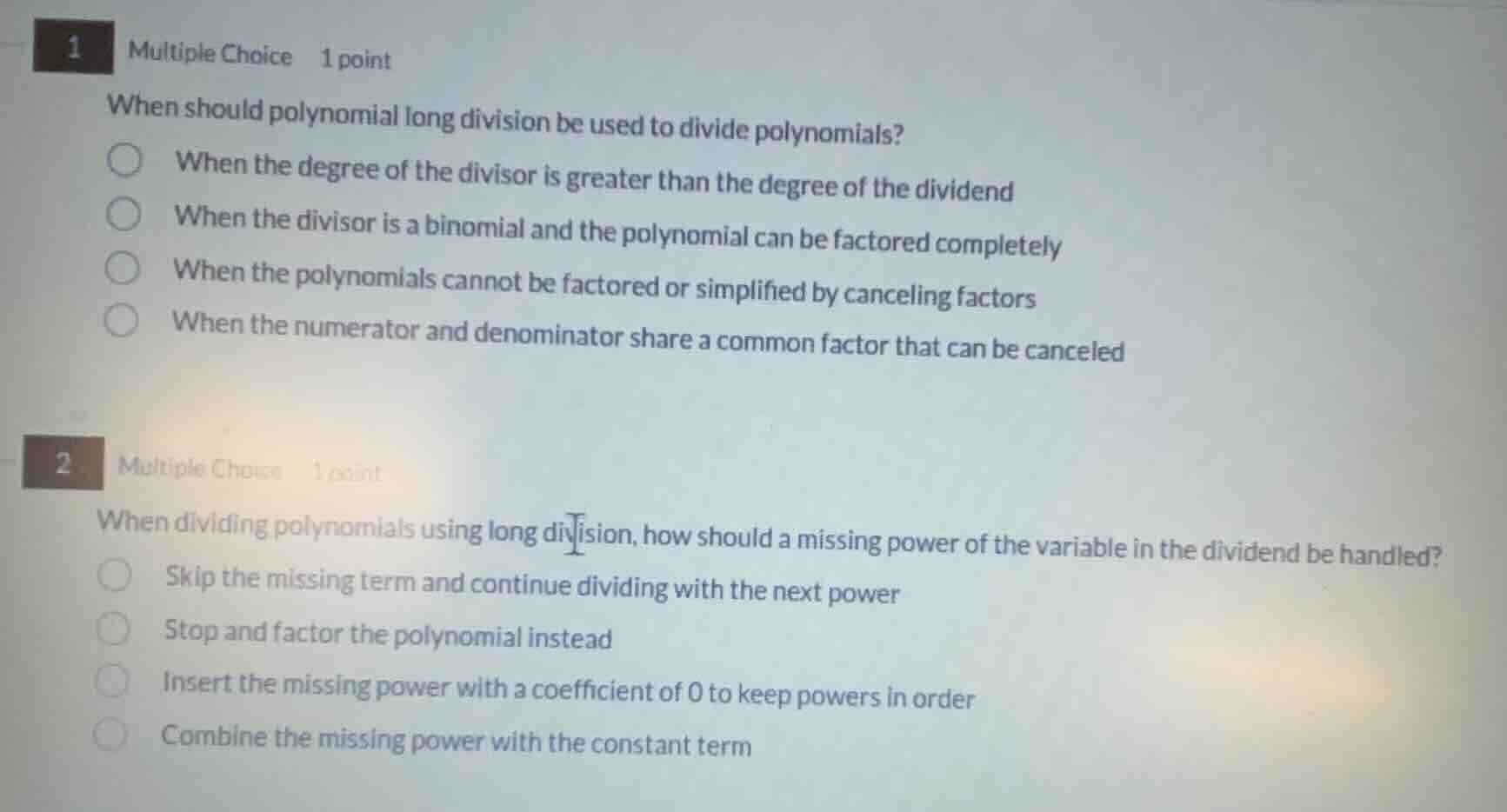
1 multiple choice 1 point
when should polynomial long division be used to divide polynomials?
when the degree of the divisor is greater than the degree of the dividend
when the divisor is a binomial and the polynomial can be factored completely
when the polynomials cannot be factored or simplified by canceling factors
when the numerator and denominator share a common factor that can be canceled
2 multiple choice 1 point
when dividing polynomials using long division, how should a missing power of the variable in the dividend be handled?
skip the missing term and continue dividing with the next power
stop and factor the polynomial instead
insert the missing power with a coefficient of 0 to keep powers in order
combine the missing power with the constant term
- For the first question: Polynomial long division is a fallback method when simpler techniques like factoring and canceling common factors don't work. If the divisor has a higher degree than the dividend, the result is just the fraction itself. Factoring or canceling factors means we don't need long division.
- For the second question: When doing polynomial long division, we need to maintain the order of variable powers. A missing power is represented by a term with a coefficient of 0 to keep the structure correct for the division steps.

Snap & solve any problem in the app
Get step-by-step solutions on Sovi AI
Photo-based solutions with guided steps
Explore more problems and detailed explanations
- When the polynomials cannot be factored or simplified by canceling factors
- Insert the missing power with a coefficient of 0 to keep powers in order