QUESTION IMAGE
Question
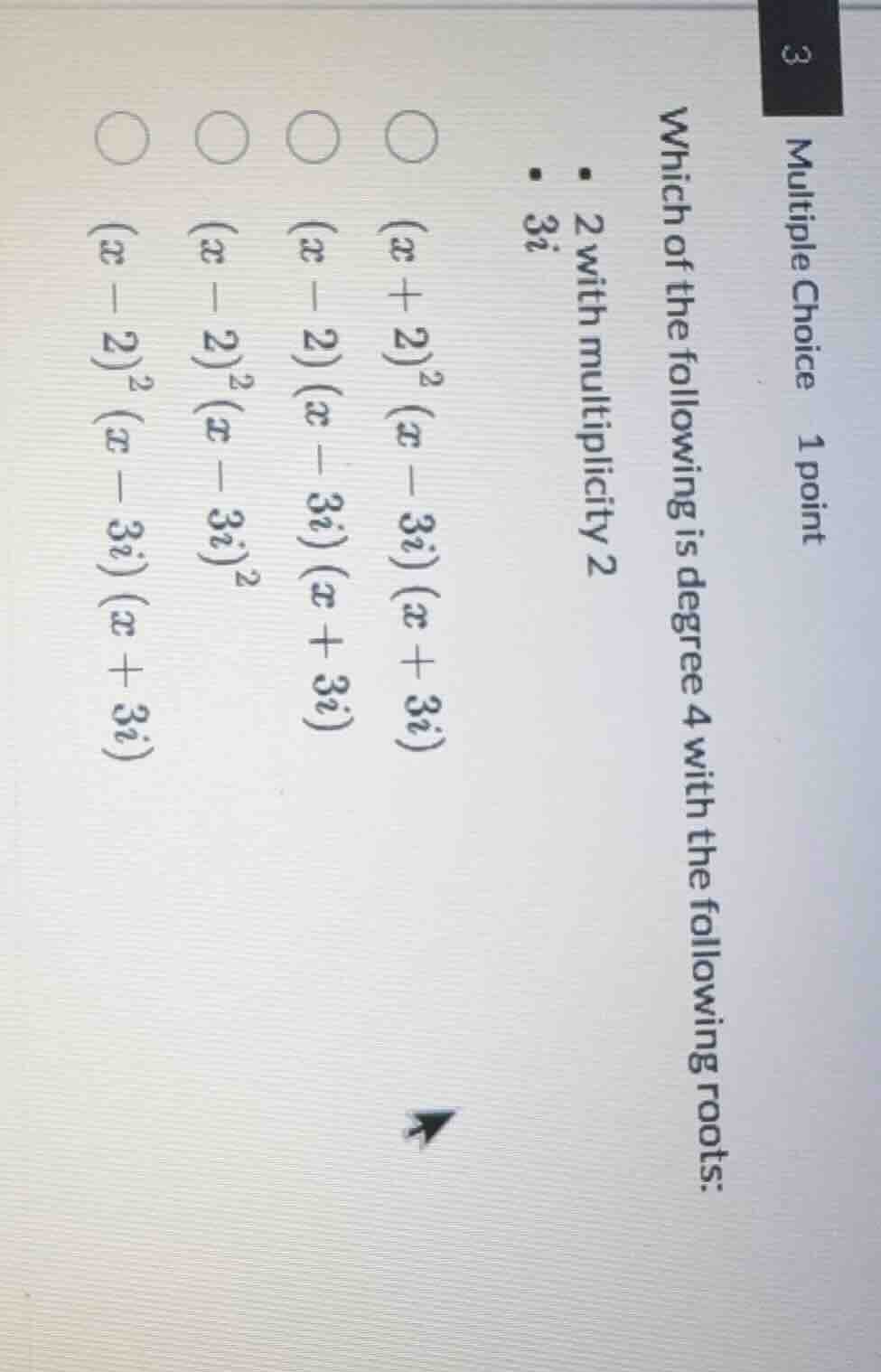
multiple choice 1 point which of the following is degree 4 with the following roots: 2 with multiplicity 2 3i which of the following is degree 4 with the following roots: 2 with multiplicity 2 3i (x + 2)^2 (x - 3i) (x + 3i) (x - 2) (x - 3i) (x + 3i) (x - 2)^2 (x - 3i)^2 (x - 2)^2 (x - 3i) (x + 3i)
Step1: Recall the Factor Theorem
If \( r \) is a root of a polynomial, then \( (x - r) \) is a factor. If a root has multiplicity \( m \), then \( (x - r)^m \) is a factor. Also, complex roots come in conjugate pairs. So if \( 3i \) is a root, then \( -3i \) is also a root.
The root \( 2 \) has multiplicity \( 2 \), so the factor corresponding to \( 2 \) is \( (x - 2)^2 \) (since for a root \( r \) with multiplicity \( m \), the factor is \( (x - r)^m \); here \( r = 2 \), \( m = 2 \)).
The root \( 3i \) implies the factor \( (x - 3i) \), and its conjugate \( -3i \) implies the factor \( (x + 3i) \). Since there's no mention of multiplicity for \( 3i \) and \( -3i \) other than being roots, but we need the polynomial to be degree \( 4 \). Wait, no, let's check the options. Wait, the root \( 2 \) has multiplicity \( 2 \), so \( (x - 2)^2 \), and roots \( 3i \) and \( -3i \). Wait, but let's check the degree. Let's expand each option's factors:
Option 1: \( (x + 2)^2(x - 3i)(x + 3i) \). The root here would be \( -2 \) with multiplicity \( 2 \), but we need root \( 2 \) with multiplicity \( 2 \), so eliminate this.
Option 2: \( (x - 2)(x - 3i)(x + 3i) \). The degree here is \( 1 + 1 + 1=3 \)? Wait, no, \( (x - 2) \) is degree 1, \( (x - 3i) \) degree 1, \( (x + 3i) \) degree 1, total degree 3. But we need degree 4. Wait, no, maybe I miscalculated. Wait, \( (x - 2) \) is degree 1, \( (x - 3i) \) degree 1, \( (x + 3i) \) degree 1, so total degree 3. Not 4. Eliminate.
Option 3: \( (x - 2)^2(x - 3i)^2 \). But complex roots should come in conjugate pairs, so if \( 3i \) is a root with multiplicity 2, then \( -3i \) should also be a root with multiplicity 2? Wait, no, the problem says roots are \( 2 \) (multiplicity 2) and \( 3i \). Wait, maybe the problem has a typo, but according to the factor theorem, complex roots are conjugates. Wait, the correct factors should be \( (x - 2)^2 \) (for root 2, multiplicity 2) and \( (x - 3i)(x + 3i) \) (for roots \( 3i \) and \( -3i \)). Let's check the degrees: \( (x - 2)^2 \) is degree 2, \( (x - 3i)(x + 3i)=x^2 + 9 \) (since \( (a - b)(a + b)=a^2 - b^2 \), here \( a = x \), \( b = 3i \), so \( x^2 - (3i)^2 = x^2 - (-9)=x^2 + 9 \)), which is degree 2. So total degree \( 2 + 2 = 4 \). Now let's check the options. Option 4: \( (x - 2)^2(x - 3i)(x + 3i) \). Wait, the options:
Wait, the fourth option (the last one) is \( (x - 2)^2(x - 3i)(x + 3i) \). Let's check the roots: root \( 2 \) with multiplicity 2, roots \( 3i \) and \( -3i \). The degree is \( 2 + 1 + 1 = 4 \), which matches. Wait, but let's check the options again. Wait, the options are:
- \( (x + 2)^2(x - 3i)(x + 3i) \)
- \( (x - 2)(x - 3i)(x + 3i) \)
- \( (x - 2)^2(x - 3i)^2 \)
- \( (x - 2)^2(x - 3i)(x + 3i) \)
So the correct one should have \( (x - 2)^2 \) (for root 2, multiplicity 2) and \( (x - 3i)(x + 3i) \) (for complex roots \( 3i \) and \( -3i \)), which is the fourth option.
Step2: Verify Each Option
- Option 1: Roots are \( -2 \) (multiplicity 2), \( 3i \), \( -3i \). Incorrect root (needs \( 2 \), not \( -2 \)).
- Option 2: Degree is \( 1 + 1 + 1 = 3 \), but we need degree 4. Incorrect.
- Option 3: Roots are \( 2 \) (multiplicity 2), \( 3i \) (multiplicity 2). But complex roots should have their conjugates, so \( -3i \) should also be a root, but this option has only \( 3i \) with multiplicity 2, so the polynomial would have \( (x - 3i)^2 \), but then \( -3i \) is not a root here? Wait, no, \( (x - 3i)^2 = x^2 - 6ix - 9 \), which doesn't have \( -3i \) as a root. So this is incorrect because complex roots must come in…

Snap & solve any problem in the app
Get step-by-step solutions on Sovi AI
Photo-based solutions with guided steps
Explore more problems and detailed explanations
\( \boldsymbol{(x - 2)^2(x - 3i)(x + 3i)} \) (the fourth option, assuming the options are labeled as 1 to 4 with the fourth being \( (x - 2)^2(x - 3i)(x + 3i) \))