QUESTION IMAGE
Question
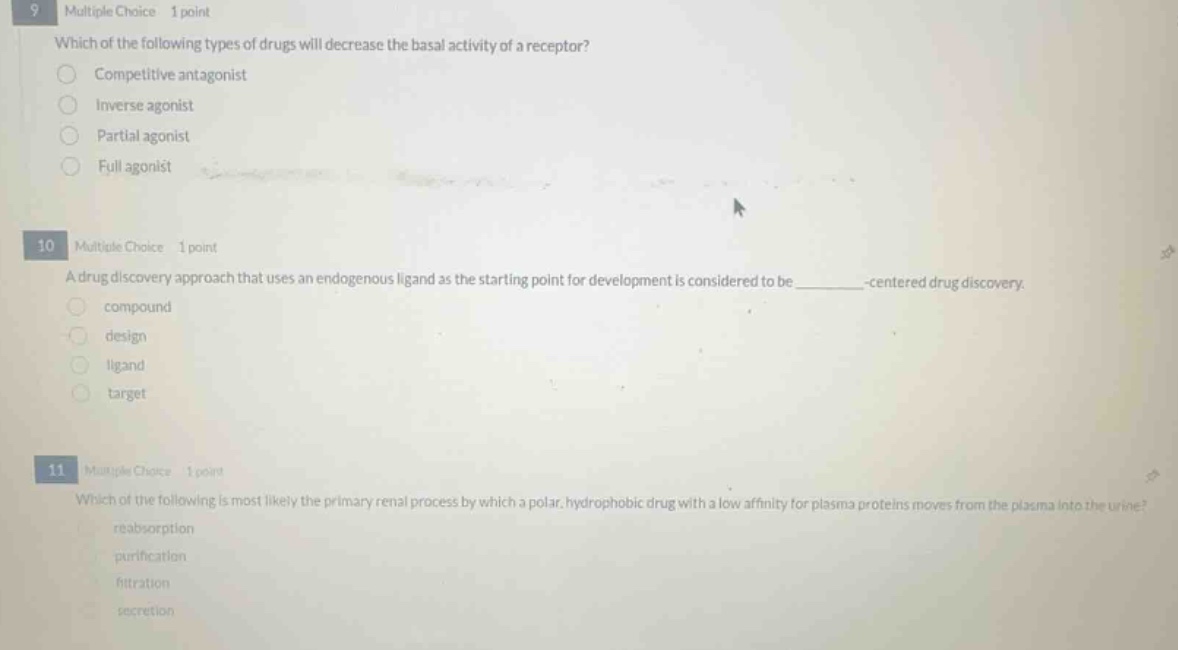
9 multiple choice 1 point
which of the following types of drugs will decrease the basal activity of a receptor?
- competitive antagonist
- inverse agonist
- partial agonist
- full agonist
10 multiple choice 1 point
a drug discovery approach that uses an endogenous ligand as the starting point for development is considered to be ______-centered drug discovery.
- compound
- design
- ligand
- target
11 multiple choice 1 point
which of the following is most likely the primary renal process by which a polar, hydrophobic drug with a low affinity for plasma proteins moves from the plasma into the urine?
- reabsorption
- purification
- filtration
- secretion
Response
Question 9
Brief Explanations
- Competitive antagonists block agonists but don't decrease basal activity (they just prevent agonist - induced activation, basal activity remains as is).
- Inverse agonists bind to receptors and reduce their basal (constitutive) activity, as they stabilize the inactive form of the receptor.
- Partial agonists have intrinsic activity but usually increase activity from basal (but less than full agonists) or can act as antagonists in the presence of full agonists, but they don't decrease basal activity.
- Full agonists increase receptor activity above basal levels.
Brief Explanations
- Compound - centered drug discovery starts with a small molecule (compound) rather than an endogenous ligand.
- Design - centered is not a standard term for this type of drug discovery approach.
- Ligand - centered drug discovery uses an endogenous ligand (a natural ligand for a receptor or enzyme) as the starting point for developing new drugs, modifying the ligand to improve its properties.
- Target - centered drug discovery focuses on the biological target (like a receptor or enzyme) and finding molecules that interact with it, not starting from an endogenous ligand.
Brief Explanations
- Reabsorption is the process of moving substances from the filtrate back into the blood, so it's not moving the drug from plasma to urine.
- Purification is not a renal process for drug excretion.
- Filtration in the kidneys (glomerular filtration) allows small, polar, and non - protein - bound substances to move from the plasma (in the glomerular capillaries) into the Bowman's capsule (filtrate) which then becomes urine. A polar, hydrophobic drug with low affinity for plasma proteins can pass through the glomerular filter (since it's not bound to proteins and is small enough) via filtration.
- Secretion is the active transport of substances from the blood (peritubular capillaries) into the renal tubule, but for a polar, hydrophobic drug with low protein binding, filtration is the primary process for getting from plasma to urine.

Snap & solve any problem in the app
Get step-by-step solutions on Sovi AI
Photo-based solutions with guided steps
Explore more problems and detailed explanations
B. Inverse agonist