QUESTION IMAGE
Question
multiple-choice question
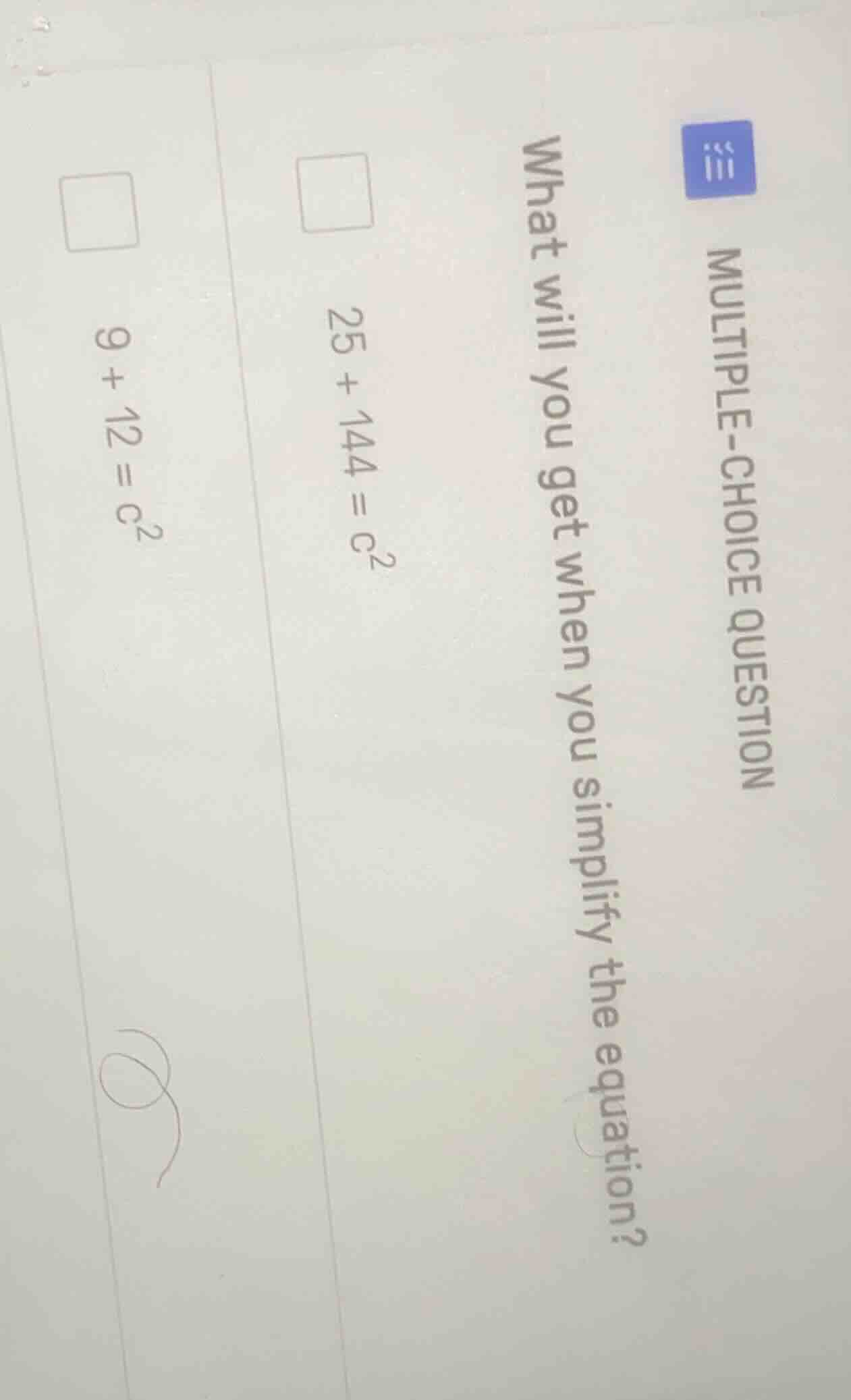
what will you get when you simplify the equation?
25 + 144 = c²
9 + 12 = c²
To solve for \( c \) in each equation, we follow these steps:
For the first equation \( 25 + 144 = c^2 \):
Step 1: Add the numbers on the left side
\( 25 + 144 = 169 \), so the equation becomes \( c^2 = 169 \).
Step 2: Take the square root of both sides
\( c=\pm\sqrt{169}=\pm 13 \) (since \( 13\times13 = 169 \) and \( (- 13)\times(-13)=169 \)).
For the second equation \( 9 + 12 = c^2 \):
Step 1: Add the numbers on the left side
\( 9+12 = 21 \), so the equation becomes \( c^2=21 \).
Step 2: Take the square root of both sides
\( c = \pm\sqrt{21}\approx\pm 4.583 \) (since \( \sqrt{21} \) is an irrational number and we can give its approximate decimal value).
If we assume we are looking for positive solutions (common in geometric contexts like the Pythagorean theorem where \( c \) represents a length), then for \( 25 + 144=c^2 \), \( c = 13 \); for \( 9+12=c^2 \), \( c=\sqrt{21}\approx4.58 \).
If we consider the options (even though the full multiple - choice context with options is not completely clear from the image, but based on the equations):
For \( 25 + 144=c^2 \), \( c^2=169 \), \( c = 13 \) (if we take positive root).
For \( 9 + 12=c^2 \), \( c^2 = 21 \), \( c=\sqrt{21}\approx4.58 \)
If we are to choose the correct equation simplification:
For \( 25+144 = c^2 \), simplifying the left - hand side gives \( c^2=169 \), and \( c = 13 \) (for positive \( c \)).
For \( 9 + 12=c^2 \), \( c^2=21 \), \( c=\sqrt{21}\)
If we assume the question is about which equation is set up correctly (maybe in a Pythagorean theorem context, where \( a^2 + b^2=c^2 \)):
If we have a right - triangle with legs \( 5 \) and \( 12 \) (since \( 5^2=25 \) and \( 12^2 = 144 \)), then \( 25+144=c^2 \) is a correct Pythagorean theorem setup (as \( 5 - 12-13 \) is a Pythagorean triple). The equation \( 9 + 12=c^2 \) would correspond to legs \( 3 \) (since \( 3^2 = 9 \)) and \( \sqrt{12}\) (which is not an integer), so it is not a standard Pythagorean triple setup.
So, if we are to find which equation simplifies to a perfect square for \( c \) (when \( c \) is an integer), the equation \( 25 + 144=c^2 \) simplifies to \( c^2 = 169 \), and \( c = 13 \).

Snap & solve any problem in the app
Get step-by-step solutions on Sovi AI
Photo-based solutions with guided steps
Explore more problems and detailed explanations
To solve for \( c \) in each equation, we follow these steps:
For the first equation \( 25 + 144 = c^2 \):
Step 1: Add the numbers on the left side
\( 25 + 144 = 169 \), so the equation becomes \( c^2 = 169 \).
Step 2: Take the square root of both sides
\( c=\pm\sqrt{169}=\pm 13 \) (since \( 13\times13 = 169 \) and \( (- 13)\times(-13)=169 \)).
For the second equation \( 9 + 12 = c^2 \):
Step 1: Add the numbers on the left side
\( 9+12 = 21 \), so the equation becomes \( c^2=21 \).
Step 2: Take the square root of both sides
\( c = \pm\sqrt{21}\approx\pm 4.583 \) (since \( \sqrt{21} \) is an irrational number and we can give its approximate decimal value).
If we assume we are looking for positive solutions (common in geometric contexts like the Pythagorean theorem where \( c \) represents a length), then for \( 25 + 144=c^2 \), \( c = 13 \); for \( 9+12=c^2 \), \( c=\sqrt{21}\approx4.58 \).
If we consider the options (even though the full multiple - choice context with options is not completely clear from the image, but based on the equations):
For \( 25 + 144=c^2 \), \( c^2=169 \), \( c = 13 \) (if we take positive root).
For \( 9 + 12=c^2 \), \( c^2 = 21 \), \( c=\sqrt{21}\approx4.58 \)
If we are to choose the correct equation simplification:
For \( 25+144 = c^2 \), simplifying the left - hand side gives \( c^2=169 \), and \( c = 13 \) (for positive \( c \)).
For \( 9 + 12=c^2 \), \( c^2=21 \), \( c=\sqrt{21}\)
If we assume the question is about which equation is set up correctly (maybe in a Pythagorean theorem context, where \( a^2 + b^2=c^2 \)):
If we have a right - triangle with legs \( 5 \) and \( 12 \) (since \( 5^2=25 \) and \( 12^2 = 144 \)), then \( 25+144=c^2 \) is a correct Pythagorean theorem setup (as \( 5 - 12-13 \) is a Pythagorean triple). The equation \( 9 + 12=c^2 \) would correspond to legs \( 3 \) (since \( 3^2 = 9 \)) and \( \sqrt{12}\) (which is not an integer), so it is not a standard Pythagorean triple setup.
So, if we are to find which equation simplifies to a perfect square for \( c \) (when \( c \) is an integer), the equation \( 25 + 144=c^2 \) simplifies to \( c^2 = 169 \), and \( c = 13 \).