QUESTION IMAGE
Question
multiple - choice questions
questions (1 - 5): for each statement or question, choose the number of the word or expression that, of those given, best completes the statement or answers the question.
base your answer to questions 1 and 2 on the passage below and your knowledge of social studies.
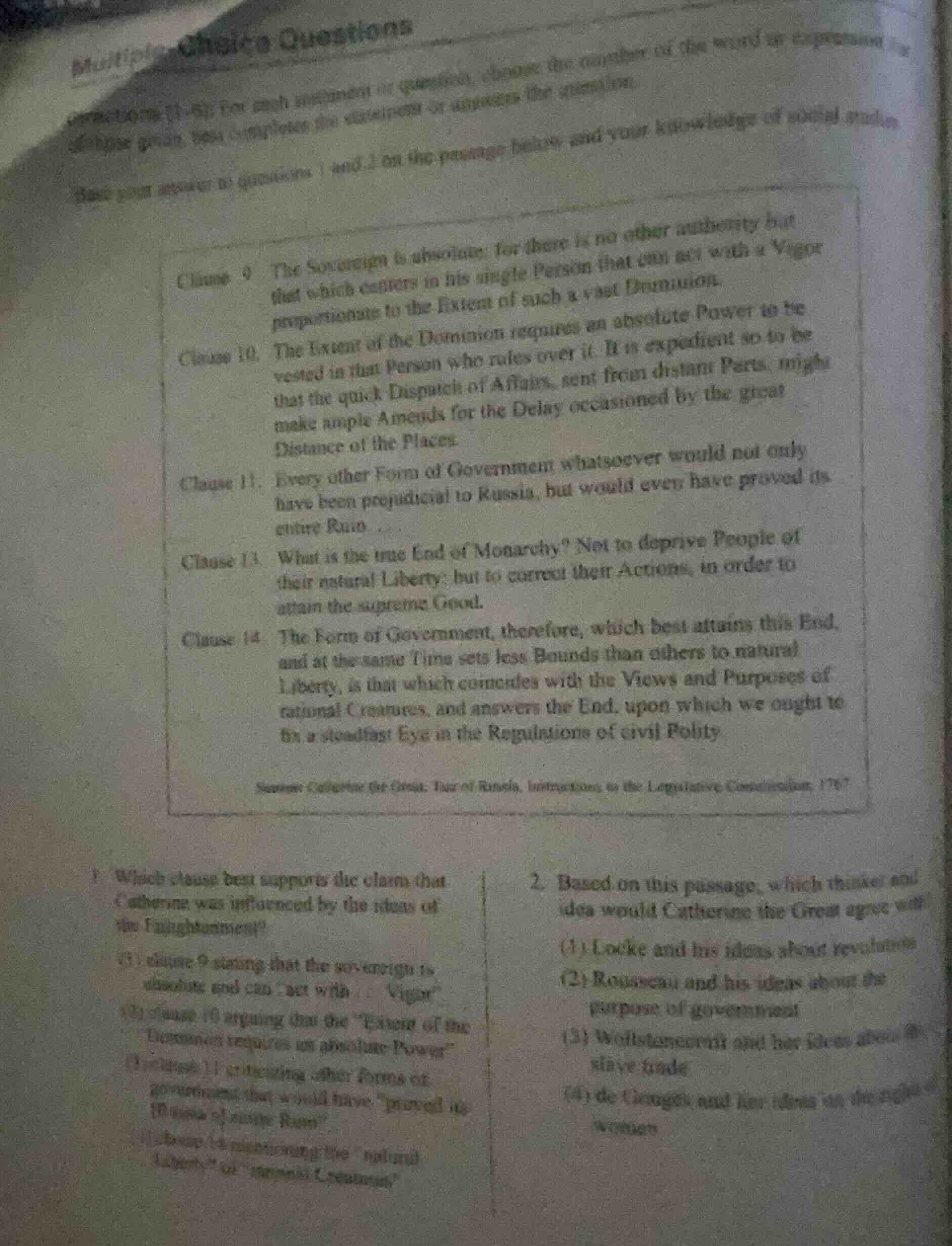
clause 9 the sovereign is absolute; for there is no other authority but that which centers in his single person that can act with a vigor proportionate to the extent of such a vast dominion.
clause 10. the extent of the dominion requires an absolute power to be vested in that person who rules over it. it is expedient so to be that the quick dispatch of affairs, sent from distant parts, might make ample amends for the delay occasioned by the great distance of the places.
clause 11. every other form of government whatsoever would not only have been prejudicial to russia, but would even have proved its entire ruin...
clause 13. what is the true end of monarchy? not to deprive people of their natural liberty; but to correct their actions, in order to attain the supreme good.
clause 14. the form of government, therefore, which best attains this end, and at the same time sets less bounds than others to natural liberty, is that which coincides with the views and purposes of rational creatures, and answers the end, upon which we ought to fix a steadfast eye in the regulations of civil polity
source: catherine the great, tsar of russia, instructions to the legislative commission, 1767
- which clause best supports the claim that catherine was influenced by the ideas of the enlightenment?
(1) clause 9 stating that the sovereign is absolute and can “act with... vigor”
(2) clause 10 arguing that the “extent of the dominion requires an absolute power”
(3) clause 11 criticizing other forms of government that would have “proved its russia’s ruin”
(4) clause 14 mentioning the “natural liberty” of “rational creatures”
- based on this passage, which thinker and idea would catherine the great agree with?
(1) locke and his ideas about revolution
(2) rousseau and his ideas about the purpose of government
(3) wollstonecraft and her ideas about the slave trade
(4) de gouges and her ideas on the rights of women
Question 1
To determine which clause shows Enlightenment influence, we analyze each option:
- Option 1 (Clause 9): States the sovereign is absolute, which is more absolutist, not Enlightenment (Enlightenment emphasized individual rights, limited govt, etc.).
- Option 2 (Clause 10): Argues for absolute power due to dominion size, also absolutist, not Enlightenment.
- Option 3 (Clause 11): Criticizes other govt forms but focuses on Russia's ruin, not Enlightenment ideas.
- Option 4 (Clause 14): Mentions "natural Liberty" and "rational Creatures", aligning with Enlightenment focus on natural rights and rationality.
We analyze each thinker:
- Option 1 (Locke): Locke's ideas on revolution (right to overthrow tyrannical govt) don't align with Catherine's absolute rule.
- Option 2 (Rousseau): Rousseau's social contract and purpose of govt (general will, common good) matches Clause 14's focus on "supreme Good" and "rational Creatures" for civil polity.
- Option 3 (Wollstonecraft): Her ideas on slave trade are unrelated to Catherine's govt philosophy here.
- Option 4 (de Gouges): Her ideas on women's rights are not relevant to this passage's govt focus.

Snap & solve any problem in the app
Get step-by-step solutions on Sovi AI
Photo-based solutions with guided steps
Explore more problems and detailed explanations
(4) clause 14 mentioning the "natural Liberty" of "rational Creatures"