QUESTION IMAGE
Question
multiple-choice questions
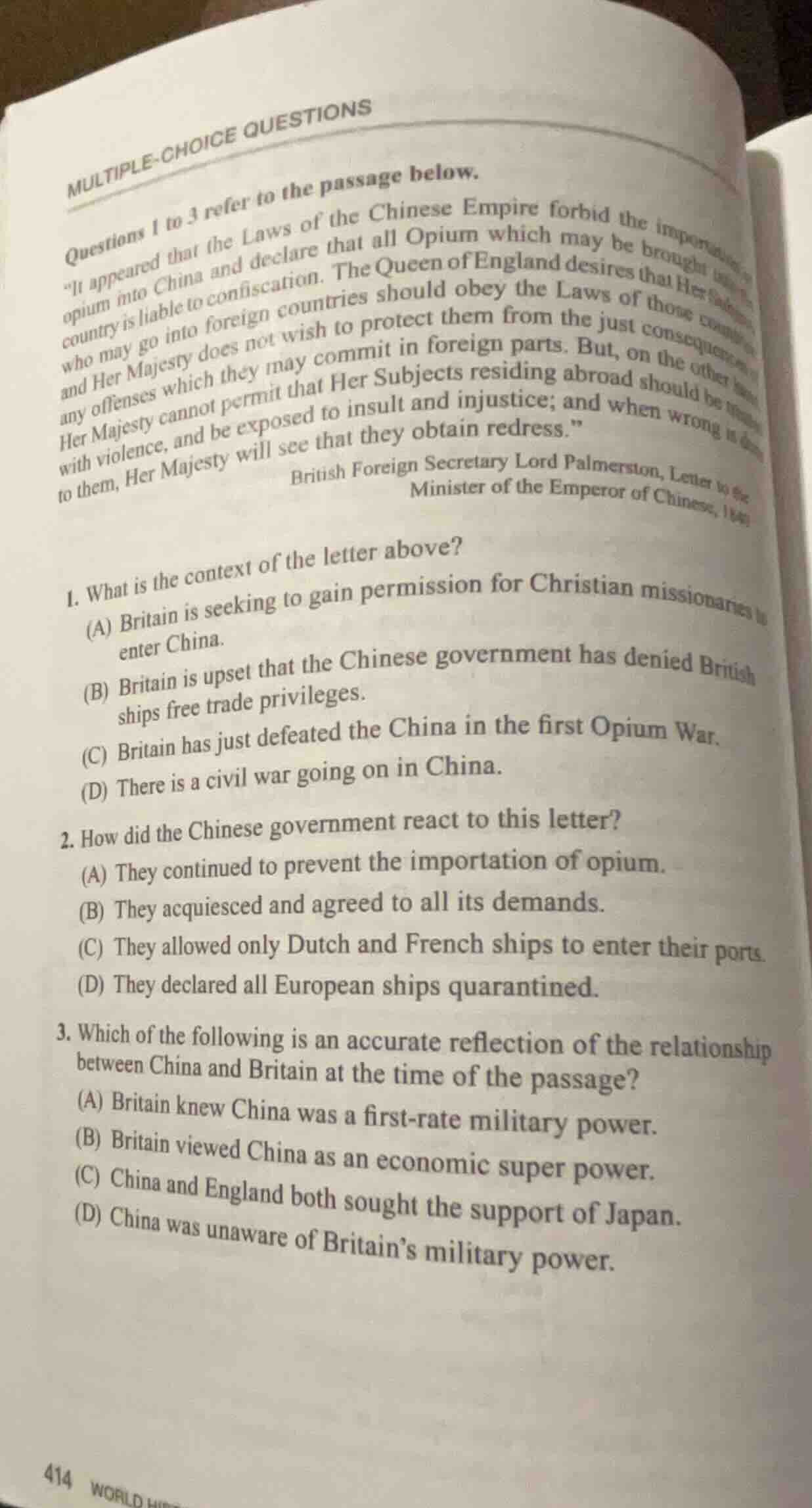
questions 1 to 3 refer to the passage below.
\it appeared that the laws of the chinese empire forbid the importation of opium into china and declare that all opium which may be brought into the country is liable to confiscation. the queen of england desires that her subjects who may go into foreign countries should obey the laws of those countries, and her majesty does not wish to protect them from the just consequences of any offenses which they may commit in foreign parts. but, on the other hand, her majesty cannot permit that her subjects residing abroad should be treated with violence, and be exposed to insult and injustice; and when wrong is done to them, her majesty will see that they obtain redress.\
british foreign secretary lord palmerston, letter to the minister of the emperor of chinese, 1840
- what is the context of the letter above?
(a) britain is seeking to gain permission for christian missionaries to enter china.
(b) britain is upset that the chinese government has denied british ships free trade privileges.
(c) britain has just defeated the china in the first opium war.
(d) there is a civil war going on in china.
- how did the chinese government react to this letter?
(a) they continued to prevent the importation of opium.
(b) they acquiesced and agreed to all its demands.
(c) they allowed only dutch and french ships to enter their ports.
(d) they declared all european ships quarantined.
- which of the following is an accurate reflection of the relationship between china and britain at the time of the passage?
(a) britain knew china was a first - rate military power.
(b) britain viewed china as an economic super power.
(c) china and england both sought the support of japan.
(d) china was unaware of britains military power.
- For question 1: The letter references Chinese laws banning opium import, and Lord Palmerston's 1840 letter ties to tensions before the First Opium War, where Britain pushed against opium bans after trade restrictions. Option B aligns with Britain's anger over denied trade access for opium.
- For question 2: The Qing government maintained its opium ban policy in response to British demands to reverse the restriction, refusing to yield on the core issue of opium importation.
- For question 3: At the time of the letter (1840), the Qing dynasty underestimated Britain's military capabilities, leading to its entry into the First Opium War without full awareness of British military strength.

Snap & solve any problem in the app
Get step-by-step solutions on Sovi AI
Photo-based solutions with guided steps
Explore more problems and detailed explanations
- (B) Britain is upset that the Chinese government has denied British ships free trade privileges.
- (A) They continued to prevent the importation of opium.
- (D) China was unaware of Britain's military power.