QUESTION IMAGE
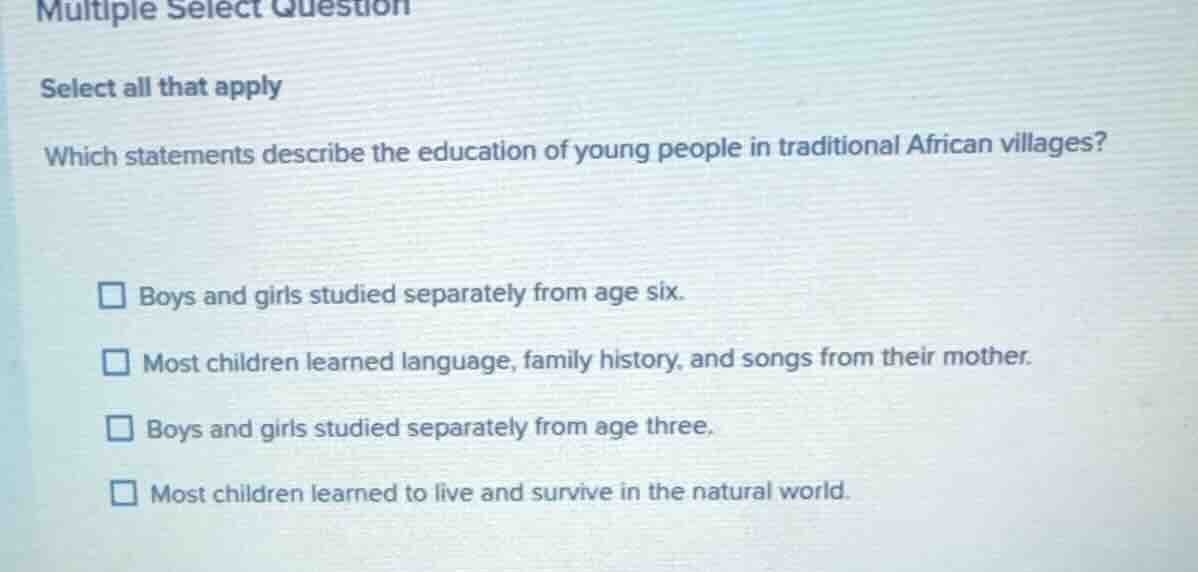
Question
multiple select question
select all that apply
which statements describe the education of young people in traditional african villages?
boys and girls studied separately from age six.
most children learned language, family history, and songs from their mother.
boys and girls studied separately from age three.
most children learned to live and survive in the natural world.
Brief Explanations
- In traditional African village education, gender-segregated learning typically began around age six, as children started to take on gender-specific roles and skills.
- Mothers were primary educators for young children, teaching them language, family history, and cultural songs as part of early enculturation.
- Survival skills related to the natural world (such as farming, foraging, and understanding local ecosystems) were core to traditional education for all children, essential for community life.
- Separating children at age three is not accurate, as early childhood education in these settings was often communal or family-focused without strict gender segregation at that young age.

Snap & solve any problem in the app
Get step-by-step solutions on Sovi AI
Photo-based solutions with guided steps
Explore more problems and detailed explanations
A. Boys and girls studied separately from age six.
B. Most children learned language, family history, and songs from their mother.
D. Most children learned to live and survive in the natural world.