QUESTION IMAGE
Question
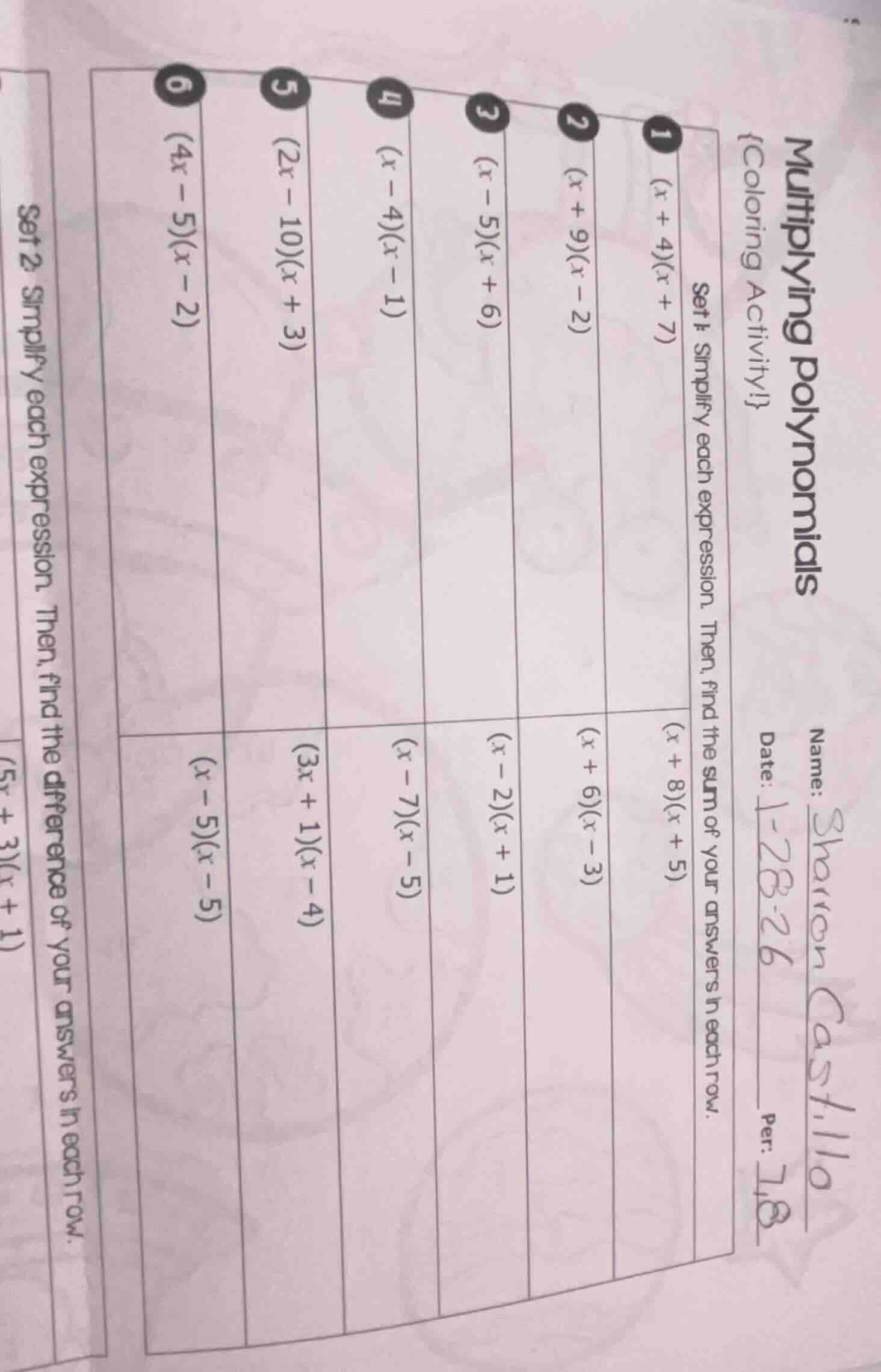
multiplying polynomials {coloring activity} set 1: simplify each expression. then, find the sum of your answers in each row. 1 ((x + 4)(x + 7)) ((x + 8)(x + 5)) 2 ((x + 9)(x - 2)) ((x + 6)(x - 3)) 3 ((x - 5)(x + 6)) ((x - 2)(x + 1)) 4 ((x - 4)(x - 1)) ((x - 7)(x - 5)) 5 ((2x - 10)(x + 3)) ((3x + 1)(x - 4)) 6 ((4x - 5)(x - 2)) ((x - 5)(x - 5)) set 2: simplify each expression. then, find the difference of your answers in each row. name: sharon castillo date: 1 - 28 - 26 per: 7,8
Let's solve each multiplication problem in Set 1 and then find the sum of each row. We'll use the distributive property (FOIL method) for binomial multiplication.
Row 1 (First Column Top and Bottom)
- Top: \((x + 4)(x + 7)\)
Step1: Apply FOIL (First, Outer, Inner, Last)
\(x \cdot x + x \cdot 7 + 4 \cdot x + 4 \cdot 7\)
Step2: Simplify each term
\(x^2 + 7x + 4x + 28\)
Step3: Combine like terms
\(x^2 + 11x + 28\)
- Bottom: \((x + 8)(x + 5)\)
Step1: Apply FOIL
\(x \cdot x + x \cdot 5 + 8 \cdot x + 8 \cdot 5\)
Step2: Simplify each term
\(x^2 + 5x + 8x + 40\)
Step3: Combine like terms
\(x^2 + 13x + 40\)
- Sum of Row 1: \((x^2 + 11x + 28) + (x^2 + 13x + 40)\)
Step1: Combine like terms for \(x^2\), \(x\), and constants
\(2x^2 + 24x + 68\)
Row 2 (Second Column Top and Bottom)
- Top: \((x + 9)(x - 2)\)
Step1: Apply FOIL
\(x \cdot x + x \cdot (-2) + 9 \cdot x + 9 \cdot (-2)\)
Step2: Simplify each term
\(x^2 - 2x + 9x - 18\)
Step3: Combine like terms
\(x^2 + 7x - 18\)
- Bottom: \((x + 6)(x - 3)\)
Step1: Apply FOIL
\(x \cdot x + x \cdot (-3) + 6 \cdot x + 6 \cdot (-3)\)
Step2: Simplify each term
\(x^2 - 3x + 6x - 18\)
Step3: Combine like terms
\(x^2 + 3x - 18\)
- Sum of Row 2: \((x^2 + 7x - 18) + (x^2 + 3x - 18)\)
Step1: Combine like terms
\(2x^2 + 10x - 36\)
Row 3 (Third Column Top and Bottom)
- Top: \((x - 5)(x + 6)\)
Step1: Apply FOIL
\(x \cdot x + x \cdot 6 + (-5) \cdot x + (-5) \cdot 6\)
Step2: Simplify each term
\(x^2 + 6x - 5x - 30\)
Step3: Combine like terms
\(x^2 + x - 30\)
- Bottom: \((x - 2)(x + 1)\)
Step1: Apply FOIL
\(x \cdot x + x \cdot 1 + (-2) \cdot x + (-2) \cdot 1\)
Step2: Simplify each term
\(x^2 + x - 2x - 2\)
Step3: Combine like terms
\(x^2 - x - 2\)
- Sum of Row 3: \((x^2 + x - 30) + (x^2 - x - 2)\)
Step1: Combine like terms
\(2x^2 - 32\)
Row 4 (Fourth Column Top and Bottom)
- Top: \((x - 4)(x - 1)\)
Step1: Apply FOIL
\(x \cdot x + x \cdot (-1) + (-4) \cdot x + (-4) \cdot (-1)\)
Step2: Simplify each term
\(x^2 - x - 4x + 4\)
Step3: Combine like terms
\(x^2 - 5x + 4\)
- Bottom: \((x - 7)(x - 5)\)
Step1: Apply FOIL
\(x \cdot x + x \cdot (-5) + (-7) \cdot x + (-7) \cdot (-5)\)
Step2: Simplify each term
\(x^2 - 5x - 7x + 35\)
Step3: Combine like terms
\(x^2 - 12x + 35\)
- Sum of Row 4: \((x^2 - 5x + 4) + (x^2 - 12x + 35)\)
Step1: Combine like terms
\(2x^2 - 17x + 39\)
Row 5 (Fifth Column Top and Bottom)
- Top: \((2x - 10)(x + 3)\)
Step1: Apply FOIL
\(2x \cdot x + 2x \cdot 3 + (-10) \cdot x + (-10) \cdot 3\)
Step2: Simplify each term
\(2x^2 + 6x - 10x - 30\)
Step3: Combine like terms
\(2x^2 - 4x - 30\)
- Bottom: \((3x + 1)(x - 4)\)
Step1: Apply FOIL
\(3x \cdot x + 3x \cdot (-4) + 1 \cdot x + 1 \cdot (-4)\)
Step2: Simplify each term
\(3x^2 - 12x + x - 4\)
Step3: Combine like terms
\(3x^2 - 11x - 4\)
- Sum of Row 5: \((2x^2 - 4x - 30) + (3x^2 - 11x - 4)\)
Step1: Combine like terms
\(5x^2 - 15x - 34\)
Row 6 (Sixth Column Top and Bottom)
- Top: \((4x - 5)(x - 2)\)
Step1: Apply FOIL
\(4x \cdot x + 4x \cdot (-2) + (-5) \cdot x + (-5) \cdot (-2)\)
Step2: Simplify each term
\(4x^2 - 8x - 5x + 10\)
Step3: Combine like terms
\(4x^2 - 13x + 10\)
- Bottom: \((x - 5)(x - 5)\)
Step1: Apply FOIL (or recognize as \((x - 5)^2\))
\(x \cdot x + x \cdot (-5) + (-5) \cdot x + (-5) \cdot (-5)\)
Step2: Simplify each term
\(x^2 - 5x - 5x + 25\)
Step3: Combine like terms
\(x^2 - 10x + 25\)
- Sum of Row 6: \((4x^2 - 13x +…

Snap & solve any problem in the app
Get step-by-step solutions on Sovi AI
Photo-based solutions with guided steps
Explore more problems and detailed explanations
Let's solve each multiplication problem in Set 1 and then find the sum of each row. We'll use the distributive property (FOIL method) for binomial multiplication.
Row 1 (First Column Top and Bottom)
- Top: \((x + 4)(x + 7)\)
Step1: Apply FOIL (First, Outer, Inner, Last)
\(x \cdot x + x \cdot 7 + 4 \cdot x + 4 \cdot 7\)
Step2: Simplify each term
\(x^2 + 7x + 4x + 28\)
Step3: Combine like terms
\(x^2 + 11x + 28\)
- Bottom: \((x + 8)(x + 5)\)
Step1: Apply FOIL
\(x \cdot x + x \cdot 5 + 8 \cdot x + 8 \cdot 5\)
Step2: Simplify each term
\(x^2 + 5x + 8x + 40\)
Step3: Combine like terms
\(x^2 + 13x + 40\)
- Sum of Row 1: \((x^2 + 11x + 28) + (x^2 + 13x + 40)\)
Step1: Combine like terms for \(x^2\), \(x\), and constants
\(2x^2 + 24x + 68\)
Row 2 (Second Column Top and Bottom)
- Top: \((x + 9)(x - 2)\)
Step1: Apply FOIL
\(x \cdot x + x \cdot (-2) + 9 \cdot x + 9 \cdot (-2)\)
Step2: Simplify each term
\(x^2 - 2x + 9x - 18\)
Step3: Combine like terms
\(x^2 + 7x - 18\)
- Bottom: \((x + 6)(x - 3)\)
Step1: Apply FOIL
\(x \cdot x + x \cdot (-3) + 6 \cdot x + 6 \cdot (-3)\)
Step2: Simplify each term
\(x^2 - 3x + 6x - 18\)
Step3: Combine like terms
\(x^2 + 3x - 18\)
- Sum of Row 2: \((x^2 + 7x - 18) + (x^2 + 3x - 18)\)
Step1: Combine like terms
\(2x^2 + 10x - 36\)
Row 3 (Third Column Top and Bottom)
- Top: \((x - 5)(x + 6)\)
Step1: Apply FOIL
\(x \cdot x + x \cdot 6 + (-5) \cdot x + (-5) \cdot 6\)
Step2: Simplify each term
\(x^2 + 6x - 5x - 30\)
Step3: Combine like terms
\(x^2 + x - 30\)
- Bottom: \((x - 2)(x + 1)\)
Step1: Apply FOIL
\(x \cdot x + x \cdot 1 + (-2) \cdot x + (-2) \cdot 1\)
Step2: Simplify each term
\(x^2 + x - 2x - 2\)
Step3: Combine like terms
\(x^2 - x - 2\)
- Sum of Row 3: \((x^2 + x - 30) + (x^2 - x - 2)\)
Step1: Combine like terms
\(2x^2 - 32\)
Row 4 (Fourth Column Top and Bottom)
- Top: \((x - 4)(x - 1)\)
Step1: Apply FOIL
\(x \cdot x + x \cdot (-1) + (-4) \cdot x + (-4) \cdot (-1)\)
Step2: Simplify each term
\(x^2 - x - 4x + 4\)
Step3: Combine like terms
\(x^2 - 5x + 4\)
- Bottom: \((x - 7)(x - 5)\)
Step1: Apply FOIL
\(x \cdot x + x \cdot (-5) + (-7) \cdot x + (-7) \cdot (-5)\)
Step2: Simplify each term
\(x^2 - 5x - 7x + 35\)
Step3: Combine like terms
\(x^2 - 12x + 35\)
- Sum of Row 4: \((x^2 - 5x + 4) + (x^2 - 12x + 35)\)
Step1: Combine like terms
\(2x^2 - 17x + 39\)
Row 5 (Fifth Column Top and Bottom)
- Top: \((2x - 10)(x + 3)\)
Step1: Apply FOIL
\(2x \cdot x + 2x \cdot 3 + (-10) \cdot x + (-10) \cdot 3\)
Step2: Simplify each term
\(2x^2 + 6x - 10x - 30\)
Step3: Combine like terms
\(2x^2 - 4x - 30\)
- Bottom: \((3x + 1)(x - 4)\)
Step1: Apply FOIL
\(3x \cdot x + 3x \cdot (-4) + 1 \cdot x + 1 \cdot (-4)\)
Step2: Simplify each term
\(3x^2 - 12x + x - 4\)
Step3: Combine like terms
\(3x^2 - 11x - 4\)
- Sum of Row 5: \((2x^2 - 4x - 30) + (3x^2 - 11x - 4)\)
Step1: Combine like terms
\(5x^2 - 15x - 34\)
Row 6 (Sixth Column Top and Bottom)
- Top: \((4x - 5)(x - 2)\)
Step1: Apply FOIL
\(4x \cdot x + 4x \cdot (-2) + (-5) \cdot x + (-5) \cdot (-2)\)
Step2: Simplify each term
\(4x^2 - 8x - 5x + 10\)
Step3: Combine like terms
\(4x^2 - 13x + 10\)
- Bottom: \((x - 5)(x - 5)\)
Step1: Apply FOIL (or recognize as \((x - 5)^2\))
\(x \cdot x + x \cdot (-5) + (-5) \cdot x + (-5) \cdot (-5)\)
Step2: Simplify each term
\(x^2 - 5x - 5x + 25\)
Step3: Combine like terms
\(x^2 - 10x + 25\)
- Sum of Row 6: \((4x^2 - 13x + 10) + (x^2 - 10x + 25)\)
Step1: Combine like terms
\(5x^2 - 23x + 35\)
Final Answers (Sums of Each Row)
- Row 1: \(\boldsymbol{2x^2 + 24x + 68}\)
- Row 2: \(\boldsymbol{2x^2 + 10x - 36}\)
- Row 3: \(\boldsymbol{2x^2 - 32}\)
- Row 4: \(\boldsymbol{2x^2 - 17x + 39}\)
- Row 5: \(\boldsymbol{5x^2 - 15x - 34}\)
- Row 6: \(\boldsymbol{5x^2 - 23x + 35}\)